


The short answer
St John’s wort is one of the few herbal supplements with genuine antidepressant evidence behind it, and that is exactly what makes it dangerous in combination. The constituent most linked to its mood-lifting effect, hyperforin, also reprograms the liver enzymes and transporters that clear a long list of common drugs.[1]
That reprogramming has documented consequences. With SSRIs such as sertraline or paroxetine, case reports describe serotonin syndrome when the two are combined.[8] With birth control pills, a controlled trial in women on a low-dose oral contraceptive found a 13 to 15 percent drop in hormone exposure, more breakthrough bleeding, and follicle growth with probable ovulation when St John’s wort was added.[6] With warfarin, systematic reviews record falling INR values, which means less protection against stroke and clots.[3]
So the short answer is unusually short for us. If you take any antidepressant, an oral contraceptive, warfarin, or a transplanted organ’s worth of immunosuppressants, St John’s wort belongs in a conversation with your prescriber, not in your shopping cart. Our physician-reviewed interaction base grades the antidepressant and warfarin pairings as major concerns and the oral contraceptive pairing as a moderate concern: SSRIs + St John’s wort, oral contraceptives + St John’s wort, and warfarin + St John’s wort.
What St John’s wort is, and why that matters here
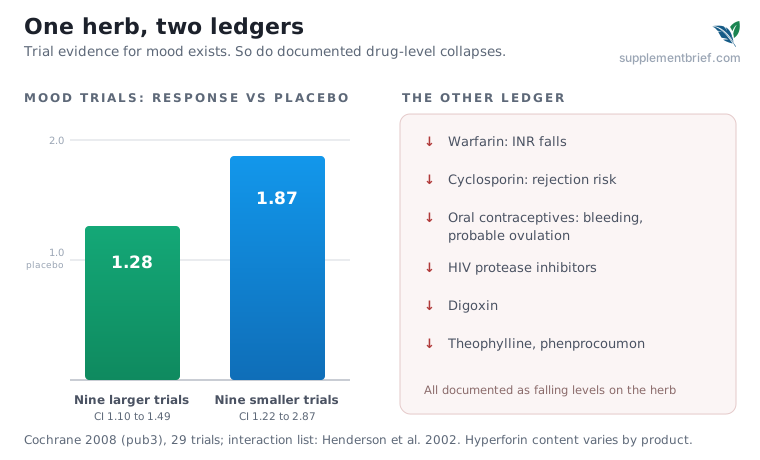
St John’s wort (Hypericum perforatum) is a flowering plant whose extracts have been tested for depression more rigorously than most supplements ever get tested for anything. The current Cochrane review pooled 29 trials with 5,489 patients comparing hypericum extracts with placebo and with standard antidepressants. In the nine larger placebo-controlled trials, the response rate ratio versus placebo was 1.28 (95% CI 1.10 to 1.49); in nine smaller trials it reached 1.87 (95% CI 1.22 to 2.87). Against SSRIs specifically, the pooled response ratio was 1.00 (95% CI 0.90 to 1.11), which showed no detectable difference in response rates, with fewer side effects than the drugs in the same trials.[4] A later network meta-analysis of 66 primary-care studies with 15,161 patients found hypericum significantly superior to placebo, in the same band as several prescription classes.[5] The Cochrane authors still urge caution: results vary with trial size and country of origin, and preparations vary considerably in pharmaceutical quality.
We open with this on purpose. The usual supplement-safety story is “the herb does nothing, so it can’t hurt anything.” St John’s wort breaks that story: it is pharmacologically active enough to help mood in trials and active enough to interfere with other medicines in clinics. In 2000, two heart-transplant patients in Switzerland acutely rejected their new organs after self-medicating with St John’s wort, because the herb accelerated the breakdown of their anti-rejection drug cyclosporin until its blood levels collapsed.[2] That report in The Lancet is why transplant centers now ask about it by name.
The herb deserves respect on both sides of that ledger. This article covers the combination side.
The mechanism: an herb that reprograms liver enzymes
Most interactions people worry about are competitive: two substances fighting over the same enzyme, and the effect fades within hours of one of them leaving. St John’s wort works differently, and the difference explains everything else in this article.
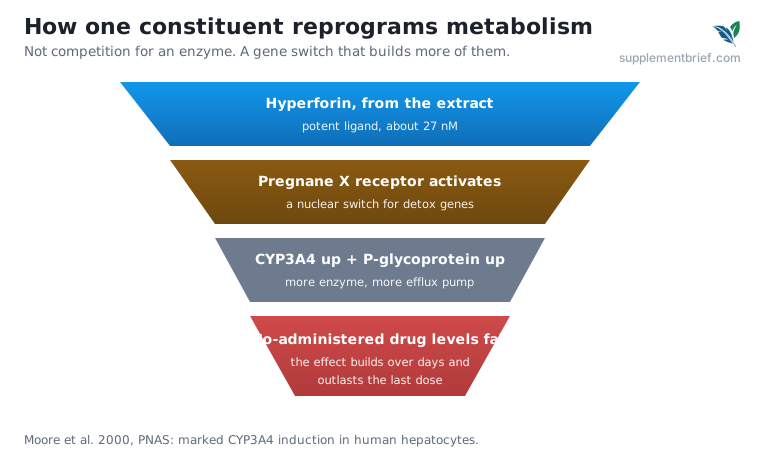
The active player is hyperforin, one of the two constituents the industry talks about. In a landmark pharmacology study, hyperforin proved to be a potent ligand for the pregnane X receptor, with a binding affinity around 27 nanomoles, and treating human liver cells with hypericum extracts produced marked induction of CYP3A4, one of the key enzymes in the metabolism of a large number of medicines.[1] Activation of that receptor also turns up P-glycoprotein, a transporter that can limit the absorption of some drugs in the intestine and promote their elimination.
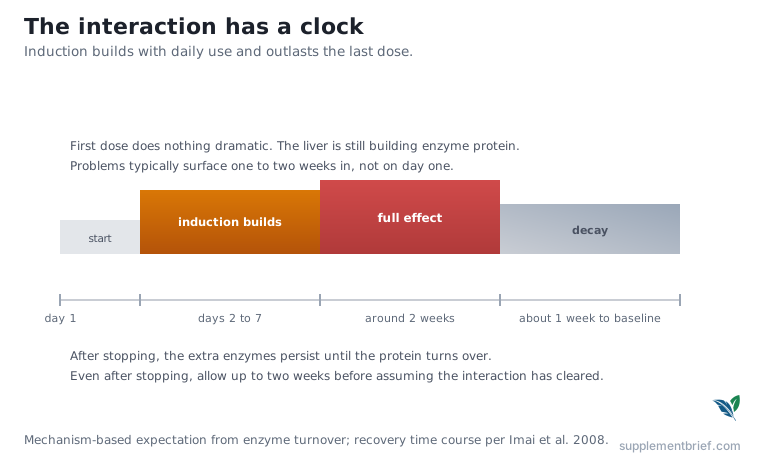
Two consequences follow. First, the scale: CYP3A4, its sibling enzymes CYP2C9 and CYP1A2, and P-glycoprotein together govern a long list of medications, and a systematic review of interactions documented falling drug levels with warfarin, cyclosporin, HIV protease inhibitors, theophylline, digoxin, and oral contraceptives.[3] Second, the timing: induction means your liver builds extra enzyme protein, so the effect builds over days of continuous use and does not switch off the day you stop. The extra enzymes decay with normal protein turnover; in a controlled probe study, CYP3A activity was back at baseline about one week after the last dose, and planning conservatively, allow up to two weeks.[11]
The label on the bottle does not rescue you here. Commercial extracts are typically standardized to hypericin, the constituent associated with mood effects, while hyperforin content varies widely between products and batches.[3] Two bottles with identical hypericin labels can carry very different hyperforin loads, so switching brands can change the size of the interaction without any warning on the label.
With antidepressants: the serotonin syndrome question
St John’s wort itself is thought to act partly through serotonin, and SSRIs raise serotonin signaling directly. Stacking two serotonergic substances is the classic setup for serotonin syndrome: agitation, tremor, sweating, racing heart, fever, and in severe cases a medical emergency.
This is documented. A literature review of herb-drug interactions records serotonin syndrome when St John’s wort was combined with SSRIs, naming sertraline and paroxetine among the reported cases.[8] Case reports are the natural currency of rare adverse events, and nobody has run, or should run, a trial that deliberately stacks the two for effect.
The prescription angle matters as much as the chemistry. If you take an antidepressant and are tempted by St John’s wort, the tempting part is usually “something more natural,” and the honest response is that the question is real but belongs to the prescriber: adjusting an antidepressant regimen, adding anything serotonergic, or switching to hypericum are all treatment decisions. What you can do without anyone’s permission is disclose. Every interaction in this article is invisible to a prescriber who does not know the herb is in the picture.
Readers taking antidepressants for sexual side effects have a separate, safer lane: our supplements for SSRI-induced ED guide covers what has actual trial support, including saffron and citrulline, with no serotonin overlap.
With birth control: two trials, one lesson
The interaction between St John’s wort and oral contraceptives is unusually well studied for a supplement question, and the two best trials triangulate something important.
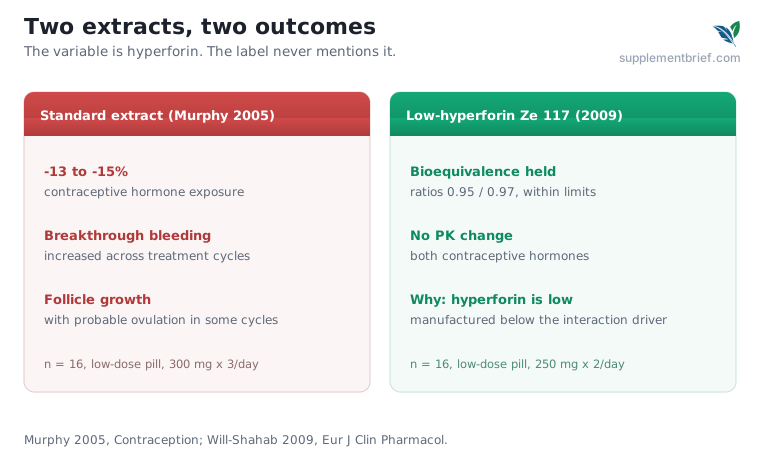
The first trial: sixteen healthy women on a low-dose combined pill (norethindrone plus ethinyl estradiol) took St John’s wort 300 mg three times daily across two full cycles. Contraceptive hormone exposure fell by 13 to 15 percent, breakthrough bleeding increased, and ultrasound showed follicle growth with probable ovulation in some cycles. The authors’ own conclusion was that the herb may interfere with contraceptive effectiveness.[6] Independent reviews connect the same mechanism to real-world outcomes: breakthrough bleeding and unplanned pregnancies in women combining the pill with the herb.[8]
The second trial: sixteen women on a different low-dose pill took a specific German extract called Ze 117, 250 mg twice daily for two weeks, and the pharmacokinetics of both hormones held within bioequivalence limits.[7] Ze 117 is manufactured to be low in hyperforin, which is exactly why it behaved differently.
Together the trials carry one lesson. The interaction is real and dose-of-hyperforin dependent, and the average buyer cannot tell which kind of extract is in the bottle, because labels standardize to hypericin. A product that was fine last month may have been replaced by a hyperforin-heavy batch this month. For anyone relying on the pill for contraception, the practical reading is that because St John’s wort can reduce the effectiveness of hormonal contraceptives, combining the two should include a conversation with a doctor about whether an additional method of contraception is needed. Readers balancing the pill with an incretin injection have a parallel question; our semaglutide and birth control guide covers the dedicated evidence.
With warfarin: the INR problem
Warfarin works inside a narrow window. Too much anticoagulation and you bleed; too little and the clots it was prescribed to prevent come back. Enzyme induction pushes toward the second failure: systematic reviews list warfarin among the drugs whose concentrations or effects fall in the presence of St John’s wort, driven by the same CYP induction.[3]
For a patient, the numbers that matter arrive as an INR reading that drifts down for no obvious dietary reason. Our warfarin interaction hub already tracks several supplements that push INR in either direction, and St John’s wort is one of the clearest cases: the interaction is mechanism-based, the monitoring already exists in the form of INR checks, and the fix belongs to the anticoagulation clinic. Combining the two without telling anyone is how a preventable stroke becomes a statistic.
The wider list: where else this shows up
The three combinations above get their own sections because they match what our readers ask. The fuller list from the interaction literature is longer, and it shares one mechanism.[3][8][10]
- Immunosuppressants. Cyclosporin levels collapse under induction — this is the documented route of the reported transplant rejections; tacrolimus levels also fall, with the interaction documented pharmacokinetically.[2]
- HIV protease inhibitors such as indinavir, where subtherapeutic levels breed resistance.[1]
- Digoxin, whose absorption depends on the P-glycoprotein transporter that hyperforin turns up.[3]
- Theophylline, used in respiratory disease, and phenprocoumon, warfarin’s cousin.[3]
- Statins and some blood pressure medications that ride the same enzyme pathway, where reviews note reduced drug levels.[8]
The pattern to internalize: drugs that are substrates of CYP3A4 or P-glycoprotein can potentially interact with this herb, and the clinical significance depends on the specific medication. A safety report published in The Lancet alongside the rejection reports concluded that the herb interacts with a wide range of medicines and that the solution is disclosure, and nothing about the subsequent literature has softened that conclusion.[9]
Who must talk to a prescriber, and what to do instead
Ask first, without exception, if any of these describe you:
- You take any antidepressant: an SSRI, an SNRI, or tricyclic. The concern with SSRIs is serotonin syndrome; with any of them, stacking two antidepressant substances is a treatment decision.[8]
- You rely on an oral contraceptive and cannot accept an unplanned pregnancy. Treat breakthrough bleeding on the combination as a same-week conversation and use backup contraception in the meantime.[6]
- You take warfarin or another anticoagulant, and your INR is monitored.[3]
- You are a transplant recipient or take any immunosuppressant. This is the category with the worst documented outcomes.[2]
- You take antiretroviral therapy, digoxin, theophylline, or several prescriptions at once.
- You are pregnant, breastfeeding, or under 18.
The symptoms worth memorizing if you already combine the herb with an antidepressant: agitation, tremor, sweating, diarrhea, racing heart, fever, muscle twitching. That cluster is a same-day medical conversation, not a supplement-tolerance question.
And the constructive version of all of this: if low mood is the problem, that conversation belongs with your prescriber. The trial evidence for hypericum on its own exists; whether the herb fits a particular regimen is a prescriber judgement.[4] Our winter blues guide covers the non-prescription side of mood support that does not interact with anything, and our mirtazapine weight gain guide is the template for what careful supplement questions on psychiatric medication look like.
FAQ
Can I take St John's wort with sertraline (Zoloft)?
No, not without your prescriber's explicit sign-off. Sertraline is one of the SSRIs named in published case reports of serotonin syndrome when combined with St John's wort.[8] Both substances push serotonin signaling, and the combination is exactly the setup that case describes. Our [SSRI + St John's wort interaction page](/interactions/ssris/st-johns-wort/) carries the full grading.
Does St John's wort stop birth control from working?
It can weaken it. In a controlled trial, a standard extract cut hormone exposure by 13 to 15 percent and produced breakthrough bleeding and probable ovulation in some cycles.[6] Reviews also link the combination to unplanned pregnancies.[8] If you are on both, use backup contraception and talk to your prescriber or pharmacist this week, especially if you notice spotting.
How long does the interaction last after I stop taking it?
Up to two weeks. The herb raises the amount of drug-metabolizing enzyme your liver produces, and that extra enzyme persists until the protein turns over; a controlled study measured CYP3A activity back at baseline seven days after the last dose, so the conservative planning number is up to two weeks.[11] The interaction also takes days to build, which is why problems sometimes appear a week or two after someone starts the herb, not on day one.
Is a low-hyperforin St John's wort product safe with my medication?
Low-hyperforin extracts exist and behaved differently in the one well-controlled contraceptive study.[7] The catch is that retail labels standardize to hypericin, so you cannot verify the hyperforin content of what you bought. Until labeling changes, any hypericum product is a question for your pharmacist, bottle in hand.
Can I take St John's wort with 5-HTP instead of my SSRI?
That swaps one serotonergic stack for another. 5-HTP supplies the precursor to serotonin, St John's wort adds serotonergic activity of its own, and the combination has the same theoretical profile that makes the SSRI combination a documented concern. Neither belongs in a self-managed stack on top of anything serotonergic.
Why don't you list a trial dose for St John's wort?
Because the trials that established its effects used prescription-grade extracts with declared hyperforin content, and the retail shelf sells products standardized to a different constituent.[3] A dose page built on trials of standardized extracts would mislead about bottles that share the name but not the chemistry. When labeling catches up to hyperforin disclosure, we will revisit it.
Free weekly brief
Want the supplement evidence brief once a week?
Get one hype-free email on evidence changes, safety notes, and interaction-base updates before you buy. No daily sequences, no paid rankings.
Get the free checklistFree. One email a week. Unsubscribe anytime.
How this article was researched
Evidence scan: PubMed, September 2026, with search terms including “St John’s wort drug interactions”, “hypericum oral contraceptive”, “St John’s wort warfarin”, and “hyperforin pregnane X receptor”. Priority went to the landmark mechanism study, the Cochrane review and its primary-care successor, two head-to-head contraceptive pharmacokinetic trials, and systematic interaction reviews. Every PMID was verified against live PubMed records on the research day.
Two claims commonly found in coverage of this herb did not survive verification and were left out rather than softened. Framing follows our editorial boundary: this article explains what a supplement does to medication levels, and every decision about changing either side of that combination belongs to a prescriber.
Interaction severity language matches our physician-reviewed interaction base, and the three new pair pages linked above carry the full mechanism, evidence tier, and reviewer sign-off.
Research date: September 10, 2026. Updates planned when hyperforin labeling standards change, or when new combination trials register.
Sources
-
Moore LB, Goodwin B, Jones SA, et al. St. John's wort induces hepatic drug metabolism through activation of the pregnane X receptor. Proceedings of the National Academy of Sciences. 2000;97(13):7500-7502. doi:10.1073/pnas.130155097. PMID 10852961.
-
Ruschitzka F, Meier PJ, Turina M, et al. Acute heart transplant rejection due to Saint John's wort. The Lancet. 2000;355(9203):548-549. doi:10.1016/S0140-6736(99)05467-7. PMID 10683008.
-
Henderson L, Yue QY, Bergquist C, et al. St John's wort (Hypericum perforatum): drug interactions and clinical outcomes. British Journal of Clinical Pharmacology. 2002;54(4):349-356. doi:10.1046/j.1365-2125.2002.01683.x. PMID 12392581.
-
Linde K, Berner MM, Kriston L. St John's wort for major depression. Cochrane Database of Systematic Reviews. 2008;(4):CD000448.pub3. doi:10.1002/14651858.CD000448.pub3. PMID 18843608.
-
Linde K, Kriston L, Rücker G, et al. Efficacy and acceptability of pharmacological treatments for depressive disorders in primary care: systematic review and network meta-analysis. Annals of Family Medicine. 2015;13(1):69-79. doi:10.1370/afm.1687. PMID 25583895.
-
Murphy PA, Kern SE, Stanczyk FZ, Westhoff CL. Interaction of St. John's Wort with oral contraceptives: effects on the pharmacokinetics of norethindrone and ethinyl estradiol, ovarian activity and breakthrough bleeding. Contraception. 2005;71(6):402-408. doi:10.1016/j.contraception.2004.11.004. PMID 15914127.
-
Will-Shahab L, Bauer S, Kunter U, et al. St John's wort extract (Ze 117) does not alter the pharmacokinetics of a low-dose oral contraceptive. European Journal of Clinical Pharmacology. 2009;65(3):287-294. doi:10.1007/s00228-008-0587-2. PMID 19015839.
-
Hu Z, Yang X, Ho PC, et al. Herb-drug interactions: a literature review. Drugs. 2005;65(9):1239-1282. doi:10.2165/00003495-200565090-00005. PMID 15916450.
-
Yue QY, Bergquist C, Gerdén B. Safety of St John's wort (Hypericum perforatum). The Lancet. 2000;355(9203):576-577. doi:10.1016/S0140-6736(05)73227-X. PMID 10683030.
-
National Center for Complementary and Integrative Health. St. John's Wort: Usefulness and Safety. nccih.nih.gov. Accessed September 10, 2026.
-
Imai H, Kotegawa T, Tsutsumi K, et al. The recovery time-course of CYP3A after induction by St John's wort administration. British Journal of Clinical Pharmacology. 2008;65(5):701-707. doi:10.1111/j.1365-2125.2008.03120.x. PMID 18294328.