


The short answer
Retatrutide is the first weight-loss drug that makes a bariatric surgery question out of a weekly injection. Lilly’s Phase 3 TRIUMPH-1 trial reported average weight loss of 28.3 percent at 80 weeks on the highest dose, with an extension cohort reaching 30.3 percent at 104 weeks.[1] By percentage, that is sleeve gastrectomy territory, and the percentage is where the equivalence ends: surgery and a weekly injection differ in timeline, starting population, operative risk, and the long-term effects bariatric procedures carry. Lilly plans to file with the FDA in Q1 2027.[2]
Read this first
Retatrutide is not approved anywhere. It is investigational, and nothing here should be read as guidance for obtaining or using it. What this article does is ask a question that matters before approval arrives: what does 30 percent weight loss demand nutritionally, and what does the existing evidence say about the supplement conversation that will follow?
The nutritional question is where retatrutide parts ways with everything before it. Semaglutide produces about 15 percent weight loss; tirzepatide about 20. Retatrutide at 28 to 30 percent enters the zone where bariatric surgery programs mandate lifelong micronutrient monitoring, structured protein targets, and muscle-preservation protocols. The incretin field has not yet built that infrastructure, and a 2025 review in Nutrients put the gap in one line: after bariatric surgery, structured nutritional frameworks exist, but for GLP-1 receptor agonist therapy, no equivalent frameworks do.[3]
A joint advisory from four major US nutrition and obesity societies published in May 2025 set the first clinical consensus for GLP-1 companion nutrition, with eight priorities including baseline nutritional assessment, micronutrient monitoring, and muscle and bone preservation.[4] Retatrutide is coming into a field that has just started writing the rules for its predecessors.
We have filed a public prediction on the lean-mass question: TRIUMPH-1 will confirm a 25 percent lean share of total weight lost, matching tirzepatide, with no lean-sparing advantage from retatrutide’s glucagon receptor. This article lays out what we know, what we do not, and what to discuss with a clinician when the drug arrives.
The verdict
- Best evidence-backed preparation: what the 2025 joint consensus recommends for GLP-1 nutrition applies here, amplified by the larger weight-loss magnitude. Protein at 80 to 120 g per day, resistance training, and micronutrient baseline labs carry the strongest grounding.[4] Our GLP-1 companion guide covers the details.
- Most overrated in advance: the assumption that retatrutide’s glucagon-receptor mechanism will spare muscle through thermogenesis. No published human energy-expenditure data for retatrutide exists. The only body-composition data (Phase 2, DXA, n=103) says the lean-mass proportion is similar to other treatments.[5]
- Honest gap we cannot fill: no retatrutide trial has measured micronutrient status, gallstone rates, or body composition in the Phase 3 population. Every number in this article about those questions comes from comparator drugs or bariatric surgery.
- Skip without a clinician: any compounded or research-grade retatrutide. The FDA has issued repeated warnings about this channel for the entire incretin class.[6]
What TRIUMPH-1 actually showed (and did not)
The headline numbers began as press-release grade. Lilly reported TRIUMPH-1 in a May 2026 investor announcement and presented full data at the American Diabetes Association in June 2026.[1] The peer-reviewed paper arrived on September 29, 2026, in the New England Journal of Medicine, and it is now the anchor for everything below.[22]
The journal numbers are lower than the June headlines, and the reason is the estimand. In the primary analysis, which handles treatment discontinuation with a treatment-regimen strategy, mean body weight fell 17.6 percent on 4 mg, 23.7 percent on 9 mg, and 25.0 percent on 12 mg, versus 3.9 percent on placebo over 80 weeks (both dose comparisons P<0.001).[22] The 28.3 percent figure from the ADA presentation reflects the stricter adherence-based view of the same data. Both are real; the journal-primary one is the number a reader should carry, and roughly 21 percentage points of it is separated from placebo.
The journal paper also carries two co-primary outcomes that matter for who this drug is for. In the 574 participants with knee osteoarthritis, pain scores fell 3.5 to 3.6 points on retatrutide versus 1.9 on placebo. In the 243 participants with obstructive sleep apnea, apnea-hypopnea events fell by 34.3 per hour on the middle dose versus 9.6 on placebo. The most common adverse events were gastrointestinal, consistent with the topline.[22]
What is reported: 2,339 adults with obesity (without diabetes) were randomized to retatrutide 4, 9, or 12 mg weekly versus placebo for 80 weeks. The highest dose produced an average 28.3 percent body-weight reduction, the middle dose 25.9 percent, the lowest 19.0 percent, versus 2.2 percent on placebo. Waist fell up to 24.1 cm, triglycerides up to 41 percent, systolic blood pressure up to 12.3 mmHg. Nearly half of the highest-dose group (45.3 percent) achieved 30 percent or greater weight loss, and 65.3 percent dropped below BMI 30.[1]
What is not reported: body composition by DXA, micronutrient status, gallstone or biliary event rates, and the lean-mass share of total weight lost. These absences were standard for a topline release, and the journal paper does not fill them either: its primary report carries no DXA body-composition outcomes, so the lean-mass share still waits for a substudy.
The extension cohort tells its own story. Only participants with baseline BMI of 35 or higher who completed the main 80-week study and tolerated their dose entered the extension (n=532), receiving 24 additional weeks with dose escalation. The highest-dose group went from 28.3 percent at week 80 to 30.3 percent at week 104, gaining only 2 percentage points in six months, roughly a quarter of the main study’s pace.[1] The drug decelerates. That plateau is where nutrition starts to matter most, because the body has already shed what it was going to shed easily, and what remains is the tissue you need to protect.
Adverse events were dose-ordered and consistent with the incretin class: nausea 28.6 to 42.4 percent (versus 14.8 on placebo), vomiting 10.6 to 25.3 percent, diarrhea up to 32 percent. Discontinuation for adverse events reached 11.3 percent on the highest dose. Two signals appeared that deserve watching: dysesthesia (altered skin sensation, up to 12.5 percent versus 0.9 on placebo) and a dose-dependent heart-rate increase.[1]
The lean-mass question, traced to its primary source
At 30 percent weight loss, the fraction coming from muscle versus fat stops being academic. The incretin class has a lean-mass record, and it deserves a clear accounting.
The best DXA data comes from tirzepatide. In the SURMOUNT-1 body-composition substudy (n=160 with paired scans at 72 weeks), weight fell 21.3 percent, fat mass 33.9 percent, and lean mass 10.9 percent. The authors’ verbatim conclusion: approximately 75 percent of body weight lost was fat mass and 25 percent was lean mass, for both tirzepatide and placebo, consistent across most subgroup analyses.[7]
For semaglutide, the number everyone quotes requires a source trail. The STEP-1 DXA substudy was presented at the Endocrine Society meeting in 2021 (n=140, 68 weeks) but never published as a full journal paper.[8] It reported relative changes: weight down 15 percent, fat mass down 19.3 percent, lean mass down 9.7 percent. From those percentages, later reviews calculated that roughly 39 percent of the tissue lost was lean. The 2025 joint advisory cites 5.3 kg lean out of 13.6 kg total.[4] A 2026 systematic review of 35 studies found the median muscle-based share of weight loss across incretin trials was 28.3 percent, with a very wide interquartile range of 16 to 40 percent.[9]
Retatrutide’s only human body-composition data comes from a Phase 2 DXA substudy in 103 adults with type 2 diabetes (42 US centers, 36 weeks, dulaglutide as active comparator). Fat mass results were strong: the 8 mg pooled arm lost 26.1 percent of total fat mass versus 4.5 percent on placebo and 2.6 percent on dulaglutide. But for lean mass, the paper states only that the proportion of lean-mass loss to weight loss was similar to other obesity treatments, without publishing the number.[5] All seven authors are Eli Lilly employees.
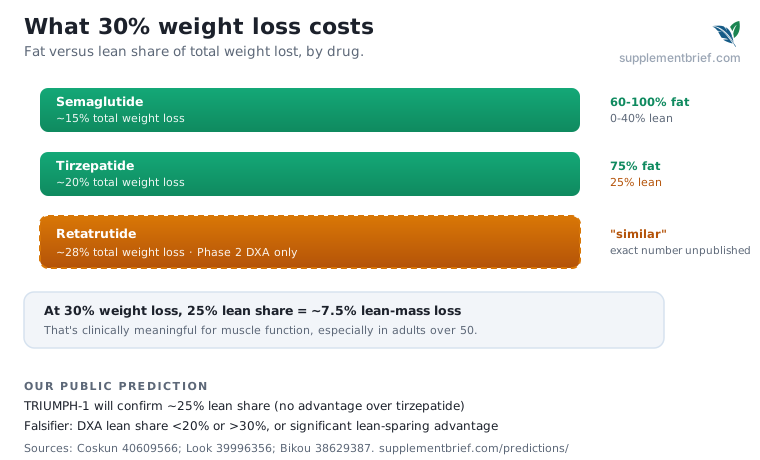
Our prediction, filed publicly at our predictions ledger: when TRIUMPH-1 publishes in a journal, the DXA-measured lean share will be approximately 25 percent, matching tirzepatide. The glucagon receptor’s theoretical lean-sparing advantage has not been demonstrated in any published human incretin trial, and the retatrutide-specific trial that would answer it (NCT06313528, n=85, energy expenditure versus placebo, completed August 2025) has not posted results.[10]
A 2025 network meta-analysis of 22 RCTs (2,258 participants) found lean mass at approximately 25 percent of total weight loss across the GLP-1 class, with tirzepatide 15 mg and semaglutide 2.4 mg among the least effective for lean preservation despite being the most effective for weight and fat loss.[11] At 30 percent total weight loss, a 25 percent lean share means losing roughly 7.5 percent of starting lean mass. For someone weighing 120 kg with about 54 kg lean, that is around 4 kg of muscle, bone, and water. A Diabetes Care review put the incretin-class lean loss in perspective: about 10 percent of lean mass or roughly 6 kg, comparable to a decade or more of aging.[12]
The glucagon question: what the third receptor might do
Retatrutide’s distinguishing feature is the glucagon receptor. GLP-1 and GIP agonists suppress appetite; glucagon receptor activation is supposed to add energy expenditure, lipolysis, and hepatic fat oxidation, a mechanism documented convincingly in animal models. Retatrutide normalized body weight even in mice lacking GLP-1 receptors, proving the other two receptors carry real weight-loss load.[13]
The thermogenesis part matters for the nutrition story because it is the theoretical basis for lean sparing: if the drug burns fat through thermogenesis rather than creating a pure caloric deficit that strips muscle, the lean-mass share should come in lower than 25 percent. A 2025 review of glucagon signalling in humans put the caveat in its own words: the pathways modulated by chronic pharmacological activation of the glucagon receptor in humans remain to be delineated, and the energy-expenditure increase is documented at least in animal models.[14]
The trial designed to answer this in humans exists: NCT06313528, a Lilly-sponsored Phase 1 study of retatrutide versus placebo on calorie intake and energy expenditure in 85 participants with obesity under calorie restriction, with 24-hour energy expenditure and sleep metabolic rate as secondary endpoints. It completed on August 26, 2025, and no results have been posted as of September 2026, thirteen months later.[10]
Heart rate deserves a mention because the glucagon receptor carries a known signal. A 2026 network meta-analysis found retatrutide raised pulse by an average of 3.5 beats per minute, reaching 5.5 bpm at the highest dose, more than tirzepatide or semaglutide, though less than orforglipron.[15] Dose-ordered, consistent with the mechanism, and worth knowing about but not a safety alarm in the trial context. For a person without cardiovascular disease, an increase of this size is not considered a problem; the group where it actually matters is people who start with tachycardia, atrial fibrillation or another arrhythmia, heart failure, or medications that affect heart rate.
The 2025 consensus that started writing the rules
In May 2025, four organizations published a joint clinical advisory in four journals simultaneously: the American College of Lifestyle Medicine, the American Society for Nutrition, the Obesity Medicine Association, and The Obesity Society. First author Dariush Mozaffarian of Tufts University, 18 authors total.[4]
The eight nutritional priorities define what the field now considers standard of care for GLP-1 companion nutrition:
- Patient-centered initiation of GLP-1 therapy
- Baseline nutritional assessment and screening
- Management of gastrointestinal side effects
- Navigation of dietary preferences and intakes
- Prevention and mitigation of nutrient deficiencies
- Preservation of muscle and bone mass
- Maximization of weight reduction through diet quality
- Other supportive lifestyle interventions
On protein, the consensus is precise. Higher targets of 1.2 to 1.6 g per kg per day have been proposed during active weight reduction, but the authors flag a practical problem: for patients with obesity, using actual body weight can significantly overestimate protein requirements. A calculation based on lean body mass is more accurate but requires body composition data most clinics do not have. The consensus offers a simpler alternative: set an absolute protein target of 80 to 120 g per day, or 16 to 24 percent of energy on a 2000 kcal diet, which may enhance adherence while ensuring adequate intake.[4]
On muscle and bone, the consensus cites the STEP-1 data (8.3 kg fat, 5.3 kg lean out of 13.6 kg total), notes that muscle comprises roughly half of lean mass, and calculates that approximately 20 percent of total weight reduction is muscle loss. For bone: weight reduction that is substantial (14 percent or more) and rapid (over 3 to 4 months) is associated with significant bone loss.[4] Retatrutide at its highest dose exceeds both thresholds.
The consensus does not mention retatrutide by name; it was written before TRIUMPH-1 read out. But every one of its eight priorities applies with greater force at 28 percent weight loss than at 15.
The micronutrient gap, measured and unmeasured
The best available number for how many GLP-1 users develop nutritional deficiencies comes from a retrospective claims analysis of 461,382 adults newly prescribed GLP-1 receptor agonists (July 2017 through December 2021), published in June 2025. Within 12 months, 22.4 percent had a diagnosed nutritional deficiency, with vitamin D the most common at 13.6 percent incidence.[16]
For retatrutide specifically: no trial has measured iron, B12, vitamin D, or any other micronutrient marker. The gap is total. What we have is the bariatric surgery comparison, which is the right frame for the size of the loss, not an equivalence: the mechanism differs in the next paragraph, and so do timeline, population, and risk.
After gastric bypass, iron deficiency affects 30 to 60 percent of patients, B12 deficiency reaches up to 50 percent, and vitamin D deficiency hit 86.4 percent at four years in one cited cohort.[17] Retatrutide does not surgically alter absorption, so the mechanism differs: the risk is volume-driven (less food means less of everything), not malabsorption-driven. But the clinical consequence is the same pattern bariatric programs learned to catch by mandatory screening: a slowly developing deficiency that the patient does not feel until it is entrenched.
A 2025 Nutrients review made the bridge explicit: bariatric surgery guidelines mandate structured nutritional monitoring, but for GLP-1 therapy, no equivalent frameworks exist, despite GLP-1 users developing deficiencies within 12 months.[3] Retatrutide at 30 percent weight loss will be the first mass-market test of whether that gap matters clinically.
Bone: the quiet concern
Bone density is the part of the lean-mass conversation that gets the least attention and probably deserves more. A 52-week randomized secondary analysis in 195 adults found that liraglutide 3.0 mg alone reduced hip and spine bone mineral density more than exercise alone, despite similar weight loss. The combination of liraglutide plus exercise preserved BMD.[18] A critical appraisal across GLP-1 trials concluded the bone signal is mixed but broadly reassuring: fracture risk does not seem to increase.[19]
At 30 percent weight loss, the bone question scales up, especially for postmenopausal women. The consensus flags that weight loss which is substantial and rapid carries bone-loss risk, and retatrutide exceeds both thresholds.[4] Two honest qualifiers from our medical reviewer: research here is still running, so the potential risk to bone density deserves attention but is not an established adverse effect of the drug, and postmenopausal women are the group where it counts twice over.
What to prepare, practically
None of this is medical advice, and none of it should be implemented before retatrutide is approved and prescribed. But the companion-nutrition evidence from the class applies, amplified.
Protein first, and the number is simpler than the debate. The joint consensus offers both the per-kilogram formula (1.2 to 1.6 g/kg, with the caveat about actual body weight overestimating) and the flat target (80 to 120 g per day) that better serves adherence in a patient whose appetite is suppressed.[4] Our protein for GLP-1 guide covers the practical strategies and the protein trial floors page shows what the studied doses look like.
Resistance training is the non-negotiable co-intervention. The consensus recommendation is structured strength training. A Diabetes Care review proposes a specific protocol: more than 10 weeks of supervised resistance training as an adjunct to incretin therapy, based on the observation that supervised programs typically add about 3 kg of lean mass and 25 percent to strength measures.[12]
Baseline labs before starting. Iron, ferritin, B12, and vitamin D are the four micronutrient markers that both the consensus and the bariatric literature track; a sensible baseline also includes creatinine, sodium, potassium, and the liver enzymes ALT, AST, and GGT. A baseline gives you and your clinician a comparison point if symptoms emerge.
Electrolyte and hydration awareness. Larger weight loss means larger fluid shifts. Our electrolytes guide covers the fatigue-hydration axis. The washout calculator handles the practical question of which supplements to stop before blood tests.
Fiber and constipation. The class slows the gut, and higher doses mean more slowdown. Our constipation on GLP-1 guide covers psyllium, magnesium, and the limits of probiotics. The Akkermansia evidence check covers the newest GLP-1 booster claims.
FAQ
Will retatrutide make me lose muscle?
Every incretin drug causes some lean-mass loss alongside fat. Tirzepatide's DXA data showed 25 percent of weight lost was lean; semaglutide's DXA substudy suggested roughly 39 percent; the class-wide median is 28 percent with a wide range.[7][9] Retatrutide's Phase 2 body-composition data says the proportion is similar to other treatments without publishing the number.[5] Our public prediction: 25 percent when TRIUMPH-1 publishes.
When will retatrutide be approved?
What supplements should I take with retatrutide?
The same companion stack that the 2025 joint consensus recommends for GLP-1 therapy: adequate protein (80-120 g/day), resistance training, and attention to electrolytes and constipation. See our [companion guide](/glp-1-companion-supplements/). Nothing supplement-specific has been tested with retatrutide.
Does retatrutide burn fat without losing muscle?
The glucagon receptor is supposed to raise energy expenditure and spare muscle, but no published human energy-expenditure data for retatrutide exists. The trial designed to answer this (NCT06313528, n=85) completed in August 2025 with no results posted.[10] The only body-composition data says the lean proportion is similar to other treatments.[5]
Does retatrutide cause gallstones?
Rapid weight loss is an established risk factor, and 28 to 30 percent is rapid. No biliary data appeared in the TRIUMPH-1 topline. The bariatric literature documents elevated gallstone rates at this magnitude.[17]
What you should take away
What is actually known: retatrutide produced 28.3 percent weight loss at 80 weeks in Phase 3 (press-release grade), with a safety profile consistent with the class plus two new signals (dysesthesia, heart-rate increase). Filing is planned for Q1 2027. Phase 2 DXA data shows strong fat-mass reduction (up to 26.1 percent) with a lean-mass proportion described as similar to other treatments but not published as a number.[5]
What is still unknown: the exact lean-mass share (our prediction: 25 percent), human thermogenesis data, micronutrient effects, gallstone rates, body composition in the Phase 3 population, and bone-density outcomes. TRIUMPH-1 has now published in a peer-reviewed journal and does not answer them: the primary paper reports no DXA body composition, so the lean-mass share waits for a substudy, and the energy-expenditure trial has not posted.
Where the evidence ends: at the drug comparison. The incretin class has years of post-marketing data. Retatrutide has press releases and one published Lancet trial in type 2 diabetes.[20] Companion nutrition decisions today are extrapolated from the class, not from the drug.
When preparation is reasonable: now, using the class-wide companion evidence and the 2025 joint consensus. Protein, training, hydration, and baseline labs are not wasted effort regardless of which drug you take.
When it is the wrong choice: purchasing unregulated retatrutide, or treating any supplement stack as a substitute for medical supervision of a 30 percent weight-loss intervention.
Questions worth bringing to your clinician: whether your baseline labs are current before starting any incretin; what your protein and training plan looks like; whether your history suggests higher gallstone, sarcopenia, or bone-density risk; and whether bone-density screening is warranted at your age and weight-loss target.
How this article was researched: PubMed and ClinicalTrials.gov searches in September 2026; all PMIDs verified against live records with author rosters checked; TRIUMPH-1 numbers were press-release grade when drafted (cross-checked against at least three independent outlets) and were reconciled against the peer-reviewed New England Journal of Medicine publication on October 2, 2026, including the estimand difference behind the two sets of weight-loss figures; the STEP-1 lean-mass figure is traced to its actual primary source (ENDO 2021 conference abstract, n=140, never published as a journal paper); the lean-mass prediction is filed publicly at our predictions ledger and remains open, because the primary publication carries no body-composition outcomes.
Sources
-
Lilly Research Laboratories. TRIUMPH-1 topline results (press release, May 2026; full data at ADA, June 2026). NCT05929066. ClinicalTrials.gov.
-
CNBC (Berger E). Eli Lilly will file for approval of retatrutide obesity drug in 2027. July 23, 2026. cnbc.com.
-
Sibal R, et al. Can we learn from metabolic and bariatric surgery? Nutritional considerations for GLP-1 receptor agonist therapy. Nutrients. 2025;17(23):3659. PMID 41373949.
-
Mozaffarian D, Agarwal M, Aggarwal M, et al. Nutritional priorities to support GLP-1 therapy for obesity: a joint Advisory from ACLM, ASN, OMA, and TOS. American Journal of Clinical Nutrition. 2025;122(1):344-367. PMID 40450457.
-
Coskun T, Wu Q, Schloot NC, et al. Retatrutide and body composition by DXA in adults with type 2 diabetes: phase 2 substudy. Lancet Diabetes and Endocrinology. 2025;13(8):674-684. PMID 40609566.
-
US FDA. Warnings on compounded and counterfeit GLP-1 products. fda.gov.
-
Look M, Dunn JP, Kushner RF, et al. Tirzepatide body composition in SURMOUNT-1: DXA substudy. Diabetes, Obesity and Metabolism. 2025;27(5):2720-2729. PMID 39996356.
-
Wilding JPH, et al. Impact of semaglutide on body composition: exploratory analysis of the STEP 1 study. ENDO 2021 meeting abstract. Journal of the Endocrine Society. 2021;5(Suppl 1):A16-A17. PMC8089287.
-
Batsis JA, et al. Lean mass share of weight loss with incretin therapies: a systematic review. Annals of Internal Medicine. 2026;179(7):996-1013. PMID 41996180.
-
ClinicalTrials.gov. NCT06313528: retatrutide versus placebo on calorie intake and energy expenditure. Completed August 2025; no results posted. ClinicalTrials.gov.
-
Karakasis P, Patoulias D, Fragakis N, Mantzoros CS. Lean mass loss with GLP-1 receptor agonists: a systematic review and network meta-analysis. Metabolism. 2025;164:156113. PMID 39719170.
-
Locatelli JC, et al. Incretin-based therapies and muscle mass: the case for resistance exercise. Diabetes Care. 2024;47(10):1718-1730. PMID 38687506.
-
Perez-Tilve D, et al. GIPR:GCGR co-agonism restores normal weight in obese rodents. Molecular Metabolism. 2026. PMID 41997446.
-
Neff GW, et al. Shared mechanistic pathways of glucagon signalling. Diabetes, Obesity and Metabolism. 2025;27(12):6869-6883. PMID 41025406.
-
Zhang Y, et al. Effect of GLP-1 receptor agonists on heart rate in non-diabetic individuals with overweight or obesity: a systematic review and meta-analysis. European Journal of Medical Research. 2026;31(1):318. PMID 41582189.
-
Scott Butsch W, Sulo S, Chang AT, et al. Nutritional deficiencies and muscle loss in adults with type 2 diabetes using GLP-1 receptor agonists: a retrospective observational study. Obesity Pillars. 2025;15:100186. PMID 40584822.
-
Reytor-González C, et al. Micronutrient deficiencies after bariatric surgery. Nutrients. 2025;17(5):741. PMID 40077612.
-
Jensen SBK, et al. Liraglutide, exercise, and bone mineral density: a randomized secondary analysis. JAMA Network Open. 2024;7(6):e2416775. PMID 38916894.
-
Anastasilakis AD, et al. GLP-1 receptor agonists and bone: a critical appraisal. Diabetes, Obesity and Metabolism. 2025;27(9):4674-4688. PMID 40555693.
-
Bajaj HS, et al. Retatrutide in drug-naive type 2 diabetes (TRANSCEND-T2D-1). Lancet. 2026;407(10546):2402-2413. PMID 42250575.
-
Brown C. Retatrutide expanded access program opens in the US. BMJ. 2026;394:e100530. PMID 42567543.
-
Jastreboff AM, Kaplan LM, Davies MJ, et al. Retatrutide, a Triple Hormone Receptor Agonist, for Treatment of Obesity. New England Journal of Medicine. 2026. Online ahead of print Sep 29. doi:10.1056/NEJMoa2604169. PMID 42814954.