


The short answer
The hottest ingredient in the probiotic aisle right now is a gut bacterium with an unpronounceable name and a remarkable scientific backstory. Akkermansia muciniphila lives in the mucus layer of your intestine, eats that mucus, and spent two decades being studied by one determined Belgian research group before becoming, in June 2025, a Danone acquisition.[17] In 2026 you can buy it in products named after a blockbuster drug class: Pendulum’s GLP-1 Probiotic, Designs for Health’s Akkermansia Pro GLP-1 Probiotic, and a shelf of “natural GLP-1” listings.
Read this first
Nothing in this article replaces your GLP-1 medication, and no Akkermansia product should be bought as one. The defensible version of the evidence supports, at best, a modest effect on keeping weight off after a diet, seen in one well-run trial. The GLP-1 part of the marketing is built on mice and one exploratory lab measurement. People who are pregnant, immunocompromised, or seriously ill should treat any live bacterial product as a prescriber conversation first.
The evidence in three sentences. Akkermansia has a genuinely interesting mouse story, a small but real human record of seven randomized trials totaling roughly 590 people between 2019 and 2026, and exactly one strong result: people who took pasteurized Akkermansia after a weight-loss diet regained 1.2 kg over six months while placebo regained 3.2 kg.[1] The “boosts your GLP-1” claim that sells the bottles has a chain of evidence that runs through mice, a cell culture, and one exploratory measurement in a trial whose main endpoint failed, run by the company that sells the strain.[2] And the most replicable finding across studies is that the people most likely to respond are those who start with low Akkermansia levels, a thing almost nobody can check before buying.[3]
Our dose registry does not list Akkermansia, for the same reason it lists no probiotics: we only floor ingredients with a defensible human dose-response record, and this one has a seven-trial record where the strongest number is a two-kilogram difference from a sponsor-affiliated study.
The verdict
- Best evidence-backed use: pasteurized Akkermansia muciniphila MucT as an experiment in weight maintenance after a diet, run with a clinician’s knowledge and judged over months, not weeks. One trial, n=90, 2.0 kg less regain over 24 weeks.[1]
- Most overrated: the GLP-1 framing. No human trial has shown fasting GLP-1 elevation from an Akkermansia product, and zero registered trials combine Akkermansia with an actual GLP-1 drug.[4] None of this replaces medication therapy; the ceiling is two kilograms of regained weight, next to 10 to 20 percent from the drug class.
- Honest gap we cannot fill: whether a live Akkermansia capsule, the form several bestsellers sell, does anything at all. Evidence for the live forms is simply insufficient, and the one solid live-strain trial found no overall benefit[5]; that is an efficacy gap, not evidence that live forms are dangerous.
- Skip without a clinician in the loop: pregnancy and breastfeeding (the EU authorization excludes them explicitly), immunocompromise, and anyone treating this as an Ozempic alternative.[18]
What the shelf actually sells
Start with what a buyer meets, because the marketing is the story’s engine.
The Akkermansia Company, the Belgian spin-off founded by the two professors behind the science, sells pasteurized Akkermansia at 30 billion cells per daily tablet, around $65 a month, with language about gut barrier protection and weight maintenance.[19] Danone announced its acquisition in June 2025, which is the clearest signal yet that big food considers this a serious category.[17] Pendulum, the best-known American brand, sells live Akkermansia at 100 million active units per capsule, about $54 to $84 a month, and markets a separate multi-strain product literally named GLP-1 Probiotic, “designed to support natural GLP-1 activity.”[20] Designs for Health launched a practitioner-channel product in June 2026 that puts live Akkermansia and the claim “helps support the body’s natural GLP-1 production” on the same label.[21]
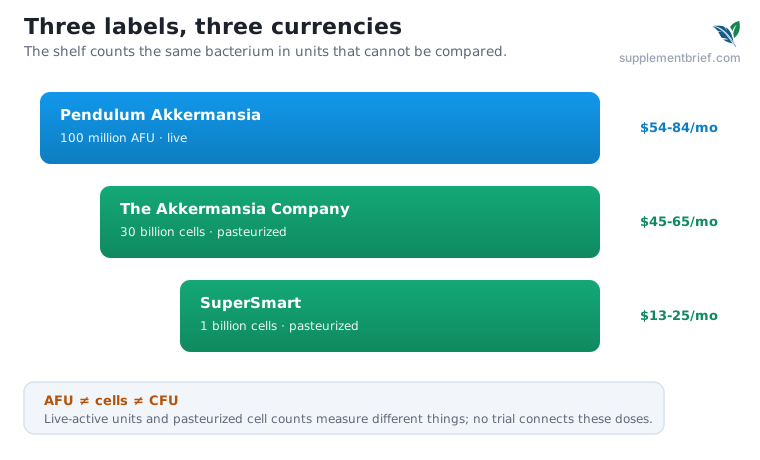
Notice the dose spread: 100 million live units, 30 billion pasteurized cells, 1 billion cells, all sold next to each other. No trial evidence connects any of those numbers to each other, and the units themselves are different currencies. When a category’s labels cannot agree on how to count the active ingredient, that is the first sign the marketing is ahead of the science.
There is also a hidden split the labels rarely announce: pasteurized versus live. The company behind most of the positive data sells dead bacteria, pasteurized, because that is the form that worked in its trials and the form Europe authorized as a novel food with a striking specification: viable cells below the limit of detection, meaning killed beyond counting.[18] Several competitors sell live bacteria on the back of that same research. Whether that transfer is valid has barely been tested.
The mouse chain that built the fame
The backstory deserves a fair telling, because unlike most probiotic marketing, this one began with genuinely good science.
In 2004, microbiologists in Wageningen cultured a new bacterium from human feces that could survive on mucus alone, and named it Akkermansia muciniphila, roughly “mucus-loving.” It lives in the gut’s protective slime layer, where it nibbles on the mucus and, in doing so, appears to provoke the gut into producing fresh layers of it: a gardener that trims the hedge so the hedge grows back thicker.[6]
The Belgian group led by Patrice Cani connected it to metabolism in a series of mouse studies that read like a detective story. First, in 2007, they showed that a high-fat diet roughly doubles to triples the bacterial toxin LPS in the blood, a state they named metabolic endotoxemia, and that injecting LPS alone reproduced weight gain and insulin resistance in mice.[7] The next year they added the permeability step: fat-rich feeding loosened the gut barrier, letting LPS through.[8] Then the 2013 finding that made the bacterium famous: in obese mice, Akkermansia levels fall, and feeding it back reversed the fat gain, the endotoxemia, and the insulin resistance.[9]
Then came the twist that made the product possible. In 2017 the same group reported that pasteurized Akkermansia outperformed the live bacterium in mice, protecting fat mass, insulin sensitivity, and lipids, and they identified a heat-stable membrane protein called Amuc_1100 that talks to the immune system through a receptor called TLR2 and partly reproduces the bacterium’s barrier effects.[10] Dead bacteria working better than live ones was heresy in probiotics, and it solved the product problem at the same time: a strict anaerobe that dies on contact with oxygen makes a terrible shelf-stable capsule, but a pasteurized one ships like a vitamin.
The GLP-1 chapter of the mouse story arrived in 2021, from a different group: Akkermansia raised GLP-1 levels in mice through a secreted protein dubbed P9, which pushed gut cells to release the hormone and turned up fat burning.[11] That is the actual scientific basis of every “GLP-1 probiotic” label on the shelf. It is a mouse protein, in a mouse study, from a field where the bacteria-to-benefit translations have a long history of not surviving the trip into humans.
One more piece of honesty about this chain: it is largely the work of one research lineage, and its two senior professors co-founded the company that sells the strain and are named inventors on the patents, disclosures they carry openly in their papers.[12] That does not make the science wrong. It makes the independent replication, when it finally arrived, worth reading closely. Keep reading.
The human trials: all seven, in plain language
Between 2019 and 2026, seven randomized trials put Akkermansia products into humans. Here is the whole record, including the parts the marketing omits.
The 2019 pilot (32 completers, overweight and insulin-resistant, three months) is the study behind most of the early hype. Pasteurized Akkermansia improved insulin sensitivity by 28.6 percent and lowered insulin and cholesterol versus placebo, with the pasteurized arm outperforming the live one, exactly as the mouse work predicted. The number the press releases skip: weight did not significantly change, and the trial was a safety pilot powered for tolerability, not for efficacy.[13]
The 2026 weight-maintenance trial is the category’s best evidence. Ninety people with overweight first lost at least 8 percent of their weight on a supervised low-energy diet, then took pasteurized Akkermansia or placebo for six months of maintenance. The Akkermansia group regained 1.2 kg, placebo regained 3.2 kg, a two-kilogram difference that was statistically solid (P=0.012), with no serious side effects.[1] Read honestly: a real effect, in the right direction, in the exact use case the products advertise. Read just as honestly: the study’s senior team includes executives and co-founders of the company that sells the strain, so this is a sponsor’s flagship, awaiting independent replication.[1]
Then the record gets rougher. A four-month trial in 142 people with metabolic syndrome, run by the same company’s scientists, found no improvement in its primary endpoint, whole-body insulin sensitivity.[2] A Chinese trial of a live strain in 58 people with type 2 diabetes and obesity found no difference between groups overall.[5] That Chinese trial matters twice: it is the best independent (non-company) test of the metabolic claim, and it was the one using a live strain, the form several bestsellers sell.
The remaining three are smaller stories: a Korean trial of a different pasteurized strain in 100 adults over 60 that improved leg strength measures, run by the strain’s owner company;[14] a heat-killed strain trial that improved respiratory symptom scores in a different population;[15] and an Iranian trial of Akkermansia-fortified yogurt that improved waist circumference and body fat versus plain yogurt, with authors employed by the dairy.[16]
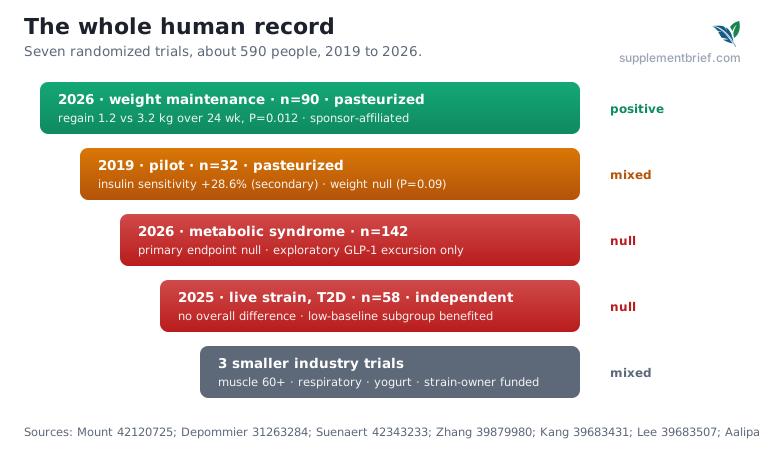
Count it up: seven trials, roughly 590 people, one strong positive in the flagship use case, two null primaries on the metabolic promise, and a heavy concentration of company authorship everywhere except the null live-strain trial.
The GLP-1 question, answered precisely
Since GLP-1 is the phrase paying for this whole shelf, here is exactly what exists, rung by rung.
Rung one: mice. Prebiotic feeding raised GLP-1 in obese mice in 2011,[22] and the 2021 P9 protein study showed Akkermansia itself driving GLP-1 release and thermogenesis in mice.[11] Rung two: cell culture. A 2025 industry-affiliated study found Akkermansia extracts prompting GLP-1 release in lab-grown gut cells, at magnitudes that tell you about the culture dish and nothing about a human taking capsules.[23] Rung three: humans, once, partially. In that four-month company trial whose primary endpoint failed, an exploratory measurement caught a larger rise in GLP-1 after a glucose drink in the Akkermansia group than placebo at the three-month mark.[2] Post-drink excursion, not fasting hormone; exploratory, not primary; sponsor-run.
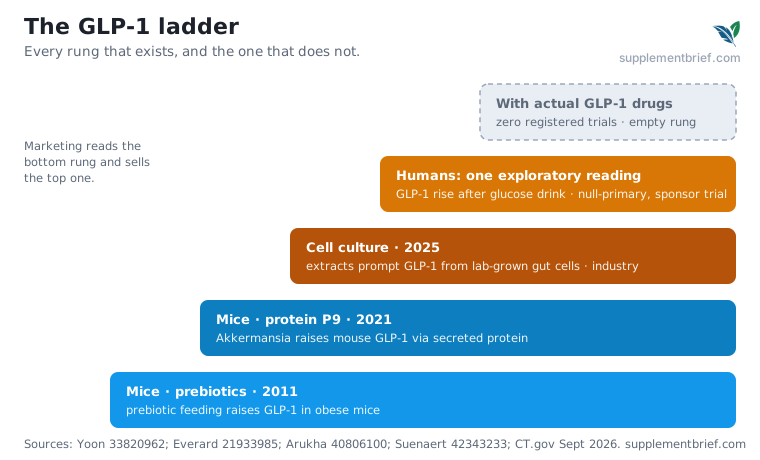
What does not exist: any human trial showing fasting GLP-1 elevation from an Akkermansia product. Any trial showing weight loss caused by GLP-1 from Akkermansia. Any registered trial pairing Akkermansia with a GLP-1 medication, which is the question every Ozempic user actually has; a search of the world’s trial registries returns none as of September 2026.[4] The one relevant glimmer is preclinical: a 2026 mouse study pairing a GLP-1 drug with Akkermansia, which is how these hypotheses look two to three years before a human trial exists.[4]
“Supports natural GLP-1 production,” the phrase on real labels, is doing legal work there. It gestures at a real mouse mechanism and one exploratory human data point while implying a drug-adjacent benefit no trial has demonstrated. A 2026 review of microbiome strategies for weight management put the whole field’s caveat in one line: microbiome changes alone do not establish clinically meaningful mechanisms, and care should remain food-first.[24]
The subgroup clue almost everyone misses
Buried in three of these trials is the most replicable finding in the entire Akkermansia literature, and it reframes who the products could plausibly help.
In the Chinese live-strain trial, participants who started with low gut Akkermansia levels lost meaningful weight, fat, and HbA1c on the supplement, while those starting high showed poor colonization and no benefit.[5] In the company’s metabolic-syndrome trial, the low-baseline subgroup was the only one with improved insulin sensitivity, better GLP-1 excursion, and less trunk fat.[2] The weight-maintenance trial reported the same direction: baseline Akkermansia abundance tracked with response.[1]
The pattern is coherent enough to be biology: if your gut already hosts plenty of Akkermansia, a capsule has little room to add anything, and colonization is poor; if your levels are low, there is a niche to fill. That is genuinely useful science hiding inside mixed results.
The commercial problem is obvious. Almost no consumer can find out their Akkermansia level. The tests that report it exist but are not standard medicine, and no brand tells you to check before buying. So the shelf sells a product whose best-documented responders are a subgroup nobody buying it can identify, at 45 to 115 dollars a month.
Safety, and who should genuinely skip this
The safety news is the one genuinely reassuring part of this story. Across all seven trials, Akkermansia products, live and pasteurized, showed a clean tolerability record in the populations studied, with no serious product-related adverse events in the flagship trial.[1] Europe authorized the pasteurized form as a novel food in 2022 after a safety review, with specifications that read like an industrial process: total cells in a defined range, viable cells below the detection limit.[18] In the United States, an FDA New Dietary Ingredient notification for a pasteurized Akkermansia strain completed in 2026, which means the agency did not object to the safety evidence submitted; it is a safety filing, with no evaluation of whether the product does anything.[25]
Boundaries that matter more than marketing: the EU authorization excludes pregnant and breastfeeding women, and trials have not studied them.[18] Live bacterial products deserve caution in immunocompromised people, a general probiotic principle that applies to the live Akkermansia brands specifically.[26] And anyone buying this to go off a GLP-1 medication, or to avoid starting one, is making a decision the evidence flatly does not support; the best Akkermansia result on Earth is two kilograms over six months, an order of magnitude below what the drugs do.[1]
Our GLP-1 companion guide ranks where probiotics sit among companion options, and our constipation guide covers what the broader probiotic evidence does and does not support: GLP-1 companion supplements, constipation on GLP-1. The parallel with berberine’s “natural Ozempic” arc is also worth a look: berberine vs Ozempic.
FAQ
Does Akkermansia boost GLP-1?
In mice, yes, through an identified bacterial protein.[11] In humans, the entire evidence is one exploratory measurement: a larger GLP-1 rise after a glucose drink in a four-month trial whose main insulin-sensitivity endpoint failed, run by the strain's seller.[2] No trial has shown fasting GLP-1 elevation or GLP-1-driven weight loss from an Akkermansia product in people.
Is Akkermansia a natural Ozempic?
No. Ozempic-class drugs produce 10 to 20 percent body-weight reductions in trials; the best Akkermansia result is 2 kg less weight regain over six months after a diet.[1] Even the comparison-friendly framing, a maintenance aid after weight loss, is a different job description than the drugs have.
Pasteurized or live Akkermansia: which form works?
The evidence sits with pasteurized. The flagship trials used pasteurized MucT, and the mouse work suggests a heat-stable protein carries the benefit.[10][13] The one solid trial of a live strain was null overall[5]: too little data to call the form ineffective, and no proof of harm either. Several popular brands sell live bacteria on the strength of pasteurized-form research, a transfer nobody has demonstrated.
Can I take Akkermansia with Ozempic or Wegovy?
No trial has tested the combination; nothing on the registries is running one as of September 2026.[4] There is no documented interaction signal either, and the reasonable stance is disclosure to your prescriber plus food-first companions, protein and fiber, which do have trial grounding: [companion guide](/glp-1-companion-supplements/).
How long before Akkermansia works?
Is Akkermansia safe?
In the studied populations, tolerability was clean across seven trials, and Europe authorized the pasteurized form after a formal safety review that excludes pregnancy and breastfeeding.[18] The US NDI notification is a safety filing, not an effectiveness endorsement.[25] Immunocompromised readers should treat live formulations as a clinician question first.
What you should take away
What is actually known: Akkermansia muciniphila is a real gut bacterium with a strong metabolic story in mice, a growing human record of seven randomized trials, one well-run positive result in weight maintenance after dieting, and a clean safety record so far in the groups studied.
What is still unknown: whether live products work at all, whether any product raises GLP-1 in fasting humans, what happens when people on GLP-1 drugs take it, whether effects survive independent replication, and who, beyond the low-baseline subgroup, should expect anything.
Where the evidence ends: at the drug comparison. Two kilograms over six months is the ceiling of what has been shown, and it was shown by the company selling it. Anyone framing Akkermansia as an alternative to GLP-1 therapy has left the evidence entirely.
When a trial is a reasonable choice: after a supervised weight-loss phase, with your clinician’s knowledge, pasteurized form, judged over six months, in someone who has struggled with regain. That describes the single positive trial’s population precisely.[1]
When it is the wrong choice: pregnancy and breastfeeding, immunocompromise with live forms, budgets that 45 to 115 dollars a month strains, and any purchase made in the belief that a probiotic can stand in for a medication.[18]
Questions worth bringing to your clinician: whether your weight-maintenance plan has room for an experiment like this at all; whether anything in your history argues against live bacterial products; and whether the money is better spent on the companions with stronger records, protein and fiber.
How this article was researched: PubMed searches in September 2026 for every randomized trial of Akkermansia muciniphila in humans (2019 through 2026), every PMID verified against live records with author rosters checked, registry searches on ClinicalTrials.gov for Akkermansia-plus-GLP-1 combinations, and live fetches of product pages, the EU novel food authorization, and the FDA NDI docket. Marketing quotes are verbatim from brand pages. Two widely repeated claims were checked and rejected: the “5.2 to 14.4 billion dollars” figure describes the entire GLP-1 companion-products market, not Akkermansia or probiotics, and Akkermansia’s own market is measured in tens to low hundreds of millions; and “Ozempic’s bacterial cousin,” which circulates in summaries, has no findable original source.
Sources
-
Mount S, Canfora EE, Jocken JWE, et al. Pasteurized Akkermansia muciniphila MucT for weight loss maintenance in people with overweight and obesity: a controlled randomized trial. Nature Medicine. 2026;32(6):2107-2116. PMID 42120725.
-
Suenaert P, Segers A, Rymenans L, et al. Effect of pasteurized Akkermansia muciniphila MucT on insulin sensitivity, body composition and GLP-1 production in subjects with metabolic syndrome. Gut Microbes. 2026;18(1):2690689. PMID 42343233.
-
Zhang Y, et al. Live Akkermansia muciniphila WST01 in overweight and obese type 2 diabetes: subgroup effects by baseline Akkermansia. Cell Metabolism. 2025;37(3):592-605. PMID 39879980.
-
ClinicalTrials.gov. Registry searches "Akkermansia GLP-1" and "Akkermansia semaglutide", September 2026: no registered trial combines an Akkermansia intervention with a GLP-1 receptor agonist. Preclinical combination: Gao et al. 2026 (GLP-1 RA + A. muciniphila Akk11 in diabetic mice). clinicaltrials.gov.
-
Zhang Y, et al. Cell Metabolism. 2025;37(3):592-605. Null overall; low-baseline subgroup benefited. PMID 39879980.
-
Derrien M, Vaughan EE, Plugge CM, de Vos WM. Akkermansia muciniphila gen. nov., sp. nov., a human intestinal mucin-degrading bacterium. International Journal of Systematic and Evolutionary Microbiology. 2004;54(Pt 5):1469-1476. PMID 15388697.
-
Cani PD, Amar J, Iglesias MA, et al. Metabolic endotoxemia initiates obesity and insulin resistance. Diabetes. 2007;56(7):1761-1772. PMID 17456850.
-
Cani PD, Bibiloni R, Knauf C, et al. Changes in gut microbiota control metabolic endotoxemia-induced inflammation in high-fat diet-induced obesity and diabetes in mice. Diabetes. 2008;57(6):1470-1481. PMID 18305141.
-
Everard A, Belzer C, Geurts L, et al. Cross-talk between Akkermansia muciniphila and intestinal epithelium controls diet-induced obesity. PNAS. 2013;110(22):9066-9071. PMID 23671105.
-
Plovier H, Everard A, Druart C, et al. A purified membrane protein from Akkermansia muciniphila or the pasteurized bacterium improves metabolism in obese and diabetic mice. Nature Medicine. 2017;23(1):107-113. PMID 27892954.
-
Yoon HS, Cho CH, Yun MS, et al. Akkermansia muciniphila secretes a glucagon-like peptide-1-inducing protein that improves metabolic homeostasis and reduces adipose inflammation. Nature Microbiology. 2021;6(5):563-573. PMID 33820962.
-
Garcia-Vello P, Tytgat HLP, et al. Structure of Akkermansia muciniphila lipooligosaccharide and its immunomodulatory role. Nature Communications. 2024;15:8411. PMID 39333588.
-
Depommier C, Everard A, Druart C, et al. Supplementation with Akkermansia muciniphila in overweight and obese human volunteers: a proof-of-concept exploratory study. Nature Medicine. 2019;25(7):1096-1103. PMID 31263284.
-
Kang CH, Jung ES, Jung SJ, et al. Pasteurized Akkermansia muciniphila HB05 improves muscle strength and function: a 12-week randomized controlled trial. Nutrients. 2024;16(23):4037. PMID 39683431.
-
Lee HW, et al. Heat-killed Akkermansia muciniphila and respiratory symptom scores: a 12-week randomized trial. Nutrients. 2024;16(23):4113. PMID 39683507.
-
Aalipanah E, et al. Akkermansia muciniphila-fortified yogurt and body composition: an 8-week randomized trial. Clinical Nutrition ESPEN. 2025;68:438-446. PMID 40451504.
-
Danone. Danone further invests in gut health and next-generation biotic research with the acquisition of The Akkermansia Company. June 2025. danone.com.
-
European Commission. Implementing Regulation (EU) 2022/168 authorising pasteurised Akkermansia muciniphila as a novel food. EUR-Lex.
-
The Akkermansia Company. Akkermansia Essential product page: dose, pricing, claims. theakkermansiacompany.com.
-
Pendulum. Pendulum Akkermansia and GLP-1 Probiotic product pages. pendulumlife.com.
-
Designs for Health. Akkermansia Pro GLP-1 Probiotic, launched June 2026. designsforhealth.com.
-
Everard A, Lazarevic V, Derrien M, et al. Responses of gut microbiota and glucose and lipid metabolism to prebiotics in genetic obese and diet-induced leptin-resistant mice. Diabetes. 2011;60(11):2775-2786. PMID 21933985.
-
Arukha AP, et al. Akkermansia extracts and GLP-1 secretion in NCI-H716 cells. Nutrients. 2025;17(15):2516. PMID 40806100.
-
Lim ECN, Cheng NCL, Lim CED. Gut microbiome-focused dietary interventions in weight management: causal evidence, precision nutrition and emerging gut-targeted therapies. Nutrition and Food Science. 2026. doi 10.1108/NFS-05-2026-0239.
-
US FDA. New Dietary Ingredient notification #1468, pasteurized Akkermansia muciniphila (AKK Probio), July 2026; NDI #1326 (ADM-Deerland), August 2024. regulations.gov.
-
Didari T, Solki S, Mozaffari S, et al. A systematic review of the safety of probiotics. Expert Opinion on Drug Safety. 2014;13(2):227-239. PMID 24405164.