


The short answer
Three supplements get stacked with finasteride, and the evidence gives each of them a different verdict. Creatine is the easiest call in our entire hair file: a 2025 randomized trial measured hair follicles directly on creatine and found nothing, on any metric, in either direction.[1] The DHT panic that follows creatine around comes from one 2009 study that never measured a single hair.[2]
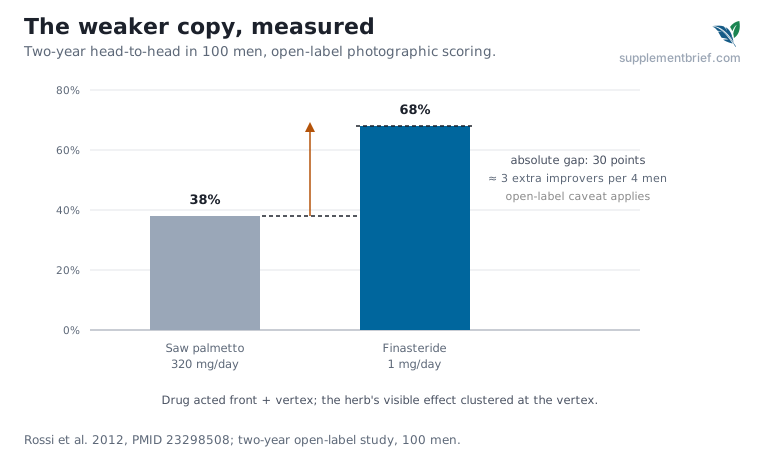
Ashwagandha and saw palmetto answer to a different kind of question. Ashwagandha measurably raises testosterone in some trials, and testosterone is the raw material finasteride’s target enzyme converts into DHT, so the stack has a plausible direction and zero direct data.[3][4] Saw palmetto blocks the same enzyme finasteride blocks, just far more weakly, and head-to-head trials show the gap: over two years, 38 percent of men on saw palmetto improved versus 68 percent on finasteride.[5] Stacking a weak blocker onto a strong one is a question for the prescriber who writes the prescription, and we grade all three pairings accordingly in our interaction base: finasteride and creatine, finasteride and ashwagandha, and finasteride and saw palmetto.
One warning belongs in the first hundred words. In May 2025 the European regulator confirmed suicidal ideation as a side effect of finasteride tablets and put a patient card into the 1 mg packaging: mood changes mean stop and call the prescriber.[6] And the drug lowers the PSA reading that prostate-cancer screening relies on, so any doctor checking your PSA needs to know you take it.[7]
Reader checkpoint
Do not start, stop, or stack anything around finasteride on your own.
Every ruling in this article routes through the prescriber who knows your dose, your PSA history, and your mood baseline. If your mood has changed since starting the drug, that is a same-week call under the 2025 European safety guidance, whichever supplement question brought you here.
What finasteride actually does
Finasteride blocks the type II isoform of 5-alpha reductase, the enzyme that converts testosterone into dihydrotestosterone (DHT). DHT is the hormone that miniaturizes scalp follicles in male-pattern hair loss, and the drug lowers the supply at the source: per the FDA label, a 1 mg tablet suppresses serum DHT by 65 percent within 24 hours.[7] Type I 5-alpha reductase keeps running untouched, which matters below.
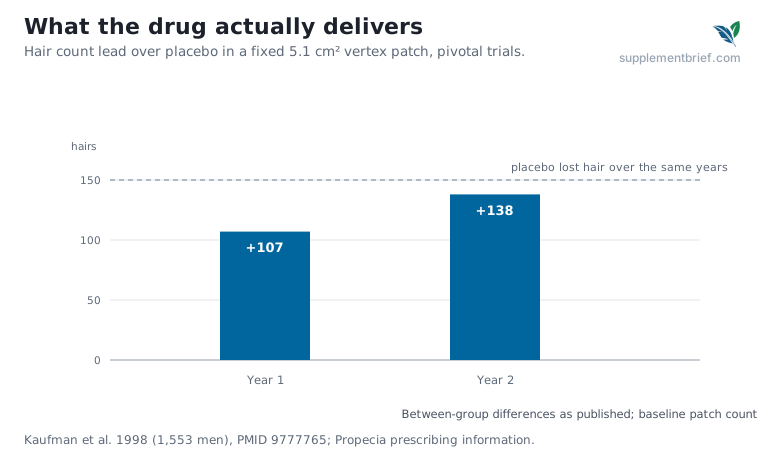
The efficacy is not in dispute. In the pivotal trials, 1,553 men took finasteride 1 mg or placebo for a year, and about half continued into a second year: hair counts in a fixed balding vertex patch ran 107 hairs ahead of placebo at year one and 138 ahead at year two, while the placebo group kept losing hair.[8] That is what a real pharmacological intervention looks like, and it is the yardstick every supplement in this article has to be measured against.
Two pieces of regulatory context frame everything else. First, the mental-health file: in May 2025, the EMA completed an EU-wide review and confirmed suicidal ideation as a side effect of finasteride, with most reports involving the 1 mg alopecia dose: 313 cases across an estimated 270 million patient-years of exposure, a frequency the agency says it cannot precisely estimate. The 1 mg packaging now carries a patient card instructing users to stop and seek advice for mood changes.[6]
Second, the PSA file. Finasteride lowered mean PSA from 0.7 to 0.5 ng/mL over a year in the drug’s own trials, and the label instructs that any confirmed PSA rise while on the drug be evaluated even if still in the normal range.[7] A supplement article cannot overstate this: the drug chemically edits your screening bloodwork, and the doctor reading it needs to know.
One more regulatory note for completeness: in April 2025 the FDA alerted clinicians and consumers about compounded topical finasteride sold through online platforms, after 32 reports of side effects between 2019 and 2024; topical finasteride has never been FDA-approved, and pharmacokinetic work shows it is absorbed systemically.[9!] The easy assumption that topical means local does not survive the data.
Creatine: a myth with one source
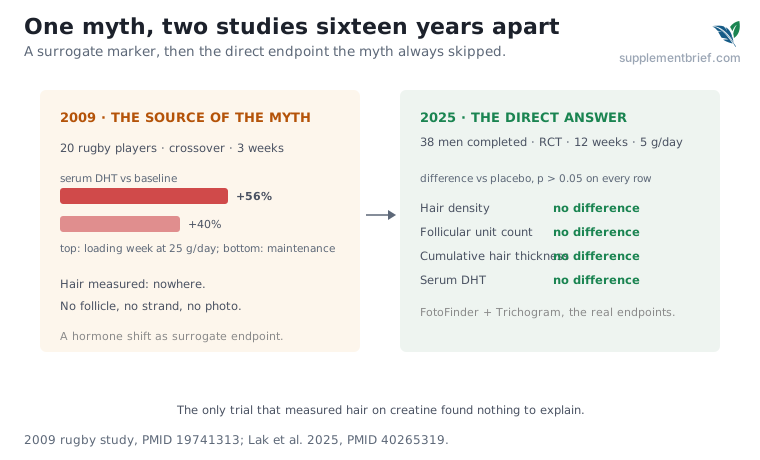
The belief that creatine causes hair loss traces to a single 2009 study: 20 college rugby players, a crossover design, three weeks of supplementation. The loading week used 25 g per day (five times the maintenance dose) and serum DHT rose 56 percent, then settled to 40 percent above baseline on the maintenance dose. Testosterone did not move.[2]
That study measured androgens. It did not measure hair: not a strand, not a follicle, not a photograph. A hormone shift in 20 athletes over three weeks is a surrogate endpoint, and surrogate endpoints have a long history of promising things direct endpoints later decline to confirm. For sixteen years, every “creatine causes balding” claim in every forum thread has rested on those 20 rugby players and their blood draws.
In 2025 the direct endpoint finally arrived. A randomized trial put 45 resistance-trained men on 5 g per day of creatine monohydrate or placebo for 12 weeks, and 38 completed it. The outcome measures were the real thing: Trichogram testing and FotoFinder imaging (hair density, follicular unit count, cumulative hair thickness) plus serum DHT, DHT-to-testosterone ratio, and total and free testosterone. Every comparison came back null, with no group-by-time interaction on any hormone and no difference on any hair parameter, all p > 0.05.[1] The trial’s own conclusion calls it the first study to directly assess hair follicle health after creatine, and strong evidence against the hair-loss claim.
Two footnotes worth attaching to that trial. It was 12 weeks in 38 men, so slow-moving effects in a small sample would be missed; the authors say as much. And three of its authors, including the senior author, hold industry relationships with creatine brands and the ISSN society, disclosed in the paper.[1] We note it because we note funding everywhere, and because the trial’s null result is the opposite of what an industry-sponsored trial is usually engineered to produce. Nulls are not where supplement money goes.
The finasteride-specific question closes even faster. On finasteride, the type II enzyme that converts testosterone to DHT is already blocked; creatine’s mythical DHT-raising effect would have to run through the same blocked pipeline. The 2025 trial found no DHT rise to route anywhere. Our interaction base grades the pair as a caution with the myth explicitly documented: no measured hormonal effect, no hair effect, no clinical interaction on record.[1]
Ashwagandha: the substrate question
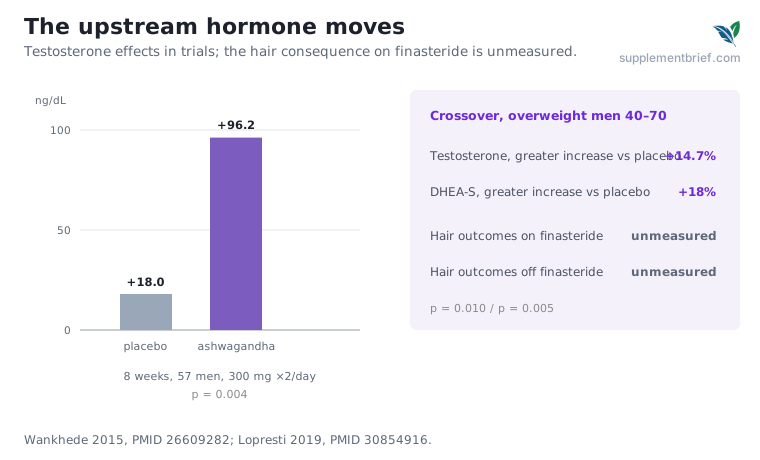
Ashwagandha is the supplement finasteride users ask about for the opposite reason: it may raise the hormone upstream. In an 8-week trial in 57 men, 300 mg of a standardized root extract twice daily lifted testosterone by 96.2 ng/dL versus 18.0 ng/dL on placebo (p = 0.004).[3] A separate crossover trial in overweight men aged 40-70 found a 14.7 percent greater testosterone increase versus placebo alongside an 18 percent rise in DHEA-S.[4] A 2021 systematic review of herbs and testosterone in men ranks ashwagandha among the few with consistent trial support.[9]
Whether that matters for hair on finasteride is untested, and we will say so plainly. The mechanistic logic cuts both ways. More testosterone does not necessarily translate into more DHT while finasteride is suppressing the conversion: the type II enzyme is inhibited, type I keeps running, and the net effect on scalp hormone exposure is untested. Against that, a roughly 15 percent testosterone bump in men whose levels start in the normal range is a modest perturbation, and no trial has measured hair outcomes in finasteride users taking ashwagandha. The defensible summary: a plausible direction, a small magnitude, and a complete absence of outcome data.[9]
Our interaction base grades the pair as a caution on that basis. The practical question for the prescriber is whether any added androgen pressure belongs in your plan at all when the medication’s entire job is removing androgen pressure from the follicle, and that framing is a two-minute conversation, not a research program.
Saw palmetto: the weaker copy
Saw palmetto (Serenoa repens) occupies a special niche in this conversation because it attempts the same job as the drug. Its liposterolic extract inhibits 5-alpha reductase in laboratory and animal models, far more weakly than finasteride, and it is the one botanical with head-to-head human data in hair loss.
The head-to-head is unflattering. In a two-year open-label study, 100 men with mild to moderate male-pattern loss took either saw palmetto 320 mg daily or finasteride 1 mg daily. Photographic scoring found improvement in 38 percent of the saw palmetto group versus 68 percent of the finasteride group. That is an absolute difference of 30 percentage points, meaning roughly three additional men improved per every four treated with the drug rather than the herb, with the caveat that open-label scoring is softer than blinded endpoint committees.[5] The drug also worked across frontal and vertex regions; the herb’s visible effect clustered at the vertex.
The only other controlled hair data for saw palmetto is a small pilot from 2002, and its fine print matters: the tested capsule combined the extract with beta-sitosterol, the active arm counted ten men, and six of them were rated improved.[10] A 60 percent response rate in six men from a combination product is a hypothesis, not a number you can plan around.
On safety, saw palmetto’s record is genuinely mild: a systematic review of adverse events found mostly abdominal pain, diarrhea, nausea and headache, judged generally well tolerated, with no drug interactions documented in the available data.[11] That safety profile is exactly why the stacking question tempts people. The counterargument is arithmetic: if 320 mg of the herb cannot match one-tenth of finasteride’s DHT suppression, adding it to the drug buys little blockade and muddies attribution: if mood or sexual side effects appear, you and your prescriber will want a clean single-variable picture. Reviews also flag a theoretical bleeding-risk interaction with anticoagulants, relevant to a minority of readers.[11]
What nobody has tested
The pattern across all three stacks is the same one that runs through this entire field: combinations are where the claims live and where the data does not. No randomized trial has put creatine, ashwagandha, or saw palmetto on top of finasteride and measured hair, hormones, or side effects. Everything anyone tells you about these stacks, including clinic pages with tidy combination protocols, is extrapolation from single-agent studies.[12]
The extrapolation has a seductive logic worth naming: finasteride blocks DHT, so more blockade should mean more hair. The trade the logic skips is that finasteride’s side-effect file (sexual function, and the 2025-confirmed mood signal) scales with the same androgen-system manipulation that more blockade implies.[6] Doubling the mechanism means doubling the variables without doubling the evidence. If a stack is worth trying, it is worth trying with the prescriber who can tell which component did what.
The same discipline applies to the drug’s own label. Finasteride does not meaningfully interact with the cytochrome P450 system in labeled testing, which is why the interaction questions here are pharmacodynamic (duplicate mechanisms, substrate pressure) rather than metabolic.[7]
Who needs the prescriber conversation
Bring the question to your prescriber before the first capsule, without exception, if any of these describe you:
- You want to add saw palmetto to finasteride. Two blockers of the same enzyme in one regimen is a prescriber decision, and the two-year head-to-head suggests the herb adds little the drug does not already do.[5]
- You want to add ashwagandha while on the drug. The testosterone bump is real in trials, its hair consequence on finasteride is unmeasured, and any added androgen pressure belongs in the plan, not on top of it.[3]
- You are considering saw palmetto instead of finasteride, without a prescription. The honest framing: 38 percent improvement over two years versus 68 percent for the drug, in the one head-to-head that exists.[5]
- You have any PSA screening in your future. Finasteride lowers PSA by design; your screening needs interpretation by someone who knows you are on it.[7]
- Your mood has shifted since starting finasteride: low mood, anxiety, any thought you would classify as dark. The 2025 European guidance is stop and contact a clinician, promptly, and that pathway outranks every supplement question in this article.[6]
- You buy finasteride or a finasteride-containing formula online without a prescription, including compounded topical products. The FDA’s April 2025 alert exists specifically because of that channel.[9!]
What you should take away
- What is actually known: creatine has a dedicated 12-week randomized trial with direct hair measurements and no effect on hair or DHT; ashwagandha raises testosterone around 15 percent in trials; saw palmetto is a weak 5-alpha reductase inhibitor that improved hair in 38 percent of men over two years versus 68 percent on finasteride.
- What is still unknown: whether any of the three changes hair outcomes for someone already on finasteride. No combination trial exists for any of them.
- Where the evidence ends: all stacking advice beyond the single-agent data is extrapolation.
- When action on your own is reasonable: none of these stacks require starting before a prescriber conversation; creatine for training on finasteride is the closest to a free pass, and even that we grade as caution with the record documented.
- When this is definitely a prescriber matter: adding any DHT-directed botanical to the drug, substituting saw palmetto for a prescribed drug, any PSA testing, and any mood change on finasteride.
- Questions for your clinician: does added androgen pressure from ashwagandha matter for my regimen; is there any reason to add saw palmetto on top of finasteride; and how should my PSA screening be interpreted while I am on the drug?
FAQ
Can I take creatine while on finasteride?
Nothing in the evidence flags it. The one trial that measured hair follicles directly on creatine found no effect on hair metrics or on DHT over 12 weeks in 38 men,[1] and finasteride's blocked conversion pathway leaves the mythical mechanism nowhere to run. Our interaction base grades the pair as a caution with the myth documented rather than as a warning with a mechanism.
Does creatine cause hair loss at all?
The claim comes from one 2009 study in 20 rugby players that measured a DHT rise during a 25 g loading week and never measured hair.[2] The 2025 randomized trial measured hair directly (density, follicular units, thickness) and found no difference from placebo at the normal 5 g dose.[1] Surrogate markers lost this round cleanly.
Does ashwagandha interfere with finasteride?
No direct data exist. Ashwagandha raises testosterone modestly in trials, by 96.2 versus 18.0 ng/dL against placebo in one and about 15 percent in another[3][4], and testosterone is the substrate finasteride's enzyme converts to DHT. That makes the stack a reasonable prescriber conversation with no measured hair outcome either way. We grade it as a caution, not a warning.
Can saw palmetto replace finasteride?
The two-year head-to-head is the honest reference point: improvement in 38 percent of men on saw palmetto 320 mg versus 68 percent on finasteride 1 mg, with the drug acting across more scalp regions.[5] The herb is real but weaker, and swapping a prescription for it is a treatment decision that belongs with a prescriber, not a supplement page.
Should I double up on DHT blockers for better results?
No trial has tested any dual-blockade stack against finasteride alone. The logic of more blockade ignores that the drug's side-effect file scales with the same system being further manipulated,[6] and side-effect attribution gets harder with every added variable. If a stack is worth trying, it is worth trying with the prescriber who can tell which component did what.
Why does my doctor need to know about finasteride before a PSA test?
Finasteride lowers PSA by design: mean values fell from 0.7 to 0.5 ng/mL in the drug's trials, and the label instructs that any confirmed rise while on the drug be evaluated even within the normal range.[7] A screening value read without that context can mislead in either direction.
How this article was researched
Evidence scan: PubMed, September 2026, with search terms including “finasteride supplements”, “creatine hair loss randomized”, “Serenoa repens androgenetic alopecia”, and “ashwagandha testosterone trial”. Drug claims were verified against the current FDA prescribing information for Propecia through DailyMed, and regulatory claims against the EMA’s May 2025 review announcement and the FDA’s April 2025 compounding alert. Every PMID was checked against live PubMed records on the research day, and every author roster was verified against the live record.
One coverage pattern was corrected against primary sources rather than repeated. Clinic and forum sources routinely state that finasteride suppresses serum DHT “by about 70 percent”; the FDA label’s number is 65 percent within 24 hours of a 1 mg tablet, and we use the label figure.[7] The same sources cite the pivotal finasteride trial to a PubMed identifier that belongs to a different paper; the correct record is the 1998 trial in 1,553 men.[8] Claims that could not be anchored to a verifiable primary source were left out.
Research date: September 13, 2026. Updates planned when combination trials register, when the EMA patient-card program publishes follow-up data, or when new saw palmetto or ashwagandha hair-outcome trials appear.
Related reading: the three graded pairs live in the finasteride interaction hub; the hair-cluster evidence side is covered in Nutrafol vs minoxidil and hair loss after weight loss.
Sources
-
Lak M, Forbes SC, Ashtary-Larky D, et al. Does creatine cause hair loss? A 12-week randomized controlled trial. Journal of the International Society of Sports Nutrition. 2025;22(sup1):2495229. doi:10.1080/15502783.2025.2495229. PMID 40265319.
-
van der Merwe J, Brooks NE, Myburgh KH. Three weeks of creatine monohydrate supplementation affects dihydrotestosterone to testosterone ratio in college-aged rugby players. Clinical Journal of Sport Medicine. 2009;19(5):399-404. doi:10.1097/JSM.0b013e3181b8b52f. PMID 19741313.
-
Wankhede S, Langade D, Joshi K, Sinha SR, Bhattacharyya S. Examining the effect of Withania somnifera supplementation on muscle strength and recovery: a randomized controlled trial. Journal of the International Society of Sports Nutrition. 2015;12:43. doi:10.1186/s12970-015-0104-9. PMID 26609282.
-
Lopresti AL, Drummond PD, Smith SJ. A randomized, double-blind, placebo-controlled, crossover study examining the hormonal and vitality effects of ashwagandha (Withania somnifera) in aging, overweight males. American Journal of Men's Health. 2019;13(2):1557988319835985. doi:10.1177/1557988319835985. PMID 30854916.
-
Rossi A, Mari E, Scarno M, et al. Comparitive effectiveness of finasteride vs Serenoa repens in male androgenetic alopecia: a two-year study. International Journal of Immunopathology and Pharmacology. 2012;25(4):1167-73. doi:10.1177/039463201202500435. PMID 23298508.
-
European Medicines Agency. Measures to minimise risk of suicidal thoughts with finasteride and dutasteride medicines. ema.europa.eu. Published May 8, 2025. Accessed September 13, 2026.
-
Organon LLC. PROPECIA (finasteride) tablets, 1 mg: prescribing information. US Food and Drug Administration. dailymed.nlm.nih.gov. Accessed September 13, 2026.
-
Kaufman KD, Olsen EA, Whiting D, et al. Finasteride in the treatment of men with androgenetic alopecia. Finasteride Male Pattern Hair Loss Study Group. Journal of the American Academy of Dermatology. 1998;39(4 Pt 1):578-589. doi:10.1016/s0190-9622(98)70007-6. PMID 9777765.
-
US Food and Drug Administration. FDA alerts health care providers, compounders and consumers about potential risks associated with compounded topical finasteride products. fda.gov. Published April 25, 2025. Accessed September 13, 2026.
-
Smith SJ, Lopresti AL, Teo SYM, Fairchild TJ. Examining the Effects of Herbs on Testosterone Concentrations in Men: A Systematic Review. Advances in Nutrition. 2021;12(3):744-765. doi:10.1093/advances/nmaa134. PMID 33150931.
-
Prager N, Bickett K, French N, Marcovici G. A randomized, double-blind, placebo-controlled trial to determine the effectiveness of botanically derived inhibitors of 5-alpha-reductase in the treatment of androgenetic alopecia. Journal of Alternative and Complementary Medicine. 2002;8(2):143-152. doi:10.1089/acm.2002.8.143. PMID 12006122.
-
Agbabiaka TB, Pittler MH, Wider B, Ernst E. Serenoa repens (saw palmetto): a systematic review of adverse events. Drug Safety. 2009;32(8):637-47. doi:10.2165/00002018-200932080-00003. PMID 19591529.
-
Hair GP Clinic. Can you safely use saw palmetto with finasteride? hairgp.co.uk. Accessed September 13, 2026. Commercial clinic page; cited only as an example of uncited stacking claims corrected against primary sources in this article.