


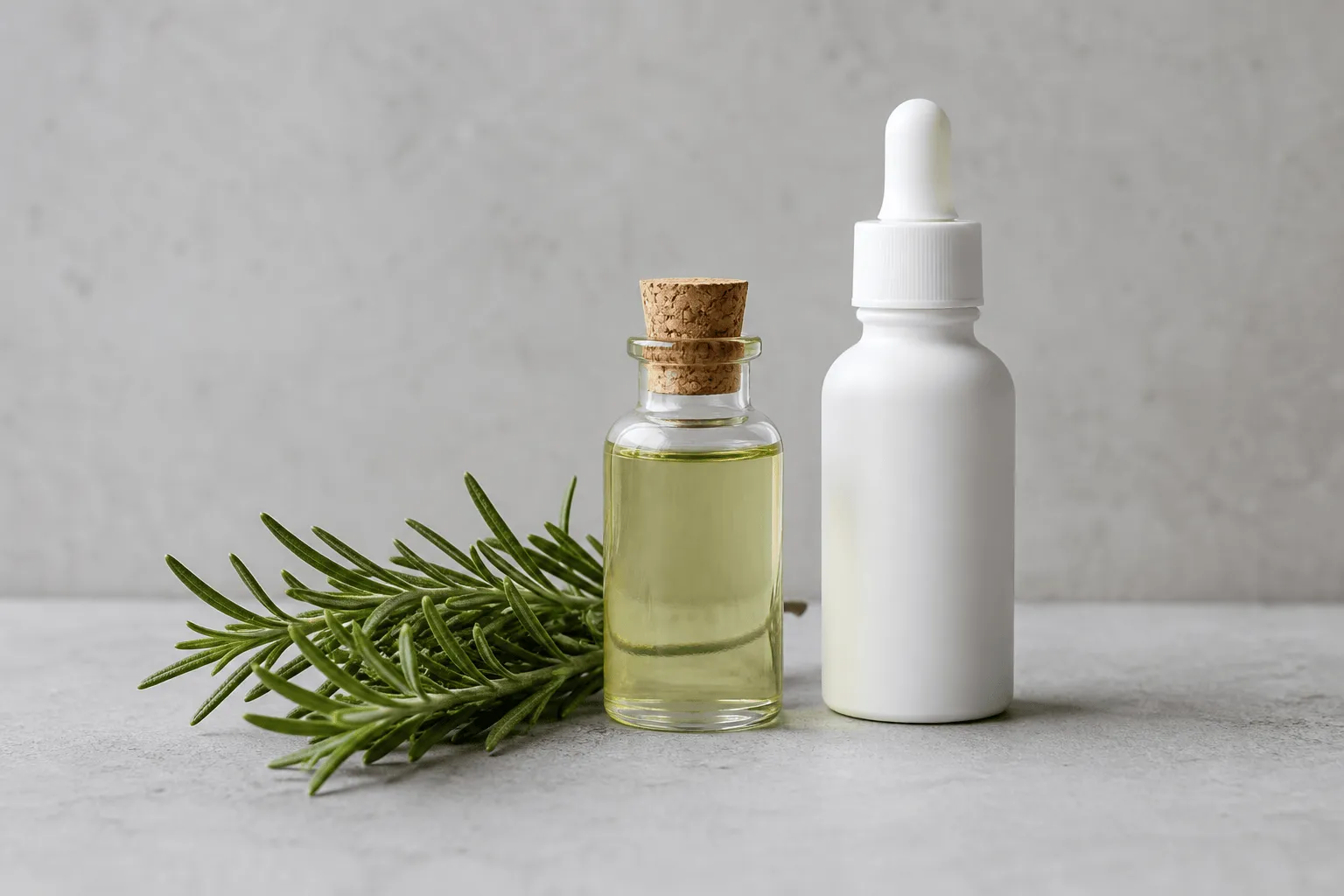
Rosemary oil is not “natural minoxidil.”
That does not make it useless. It makes one limited study carry a much stronger claim than the evidence supports.
The viral claim traces back to a 2015 randomized comparative trial by Panahi and colleagues[1]. 100 men with androgenetic alopecia used either rosemary oil or 2% minoxidil for 6 months. Both groups improved by month six. The study did not find a statistically significant difference between them.
Sounds impressive — until you notice what the study did not test. It did not compare rosemary oil with 5% minoxidil, the more relevant strength for many men with pattern hair loss. It did not include a placebo or vehicle-only group. And it does not grant rosemary oil the same evidence status as an FDA-approved medication with decades of clinical use.
The real comparison is rosemary oil’s thin evidence base versus minoxidil’s broader record. In the Olsen 2002[2] trial of 5% versus 2% minoxidil, 5% minoxidil was clearly superior to both 2% minoxidil and placebo — 45% more hair regrowth than 2% minoxidil by target-area hair counts at week 48.
Short version: minoxidil is still the better-supported regrowth treatment for androgenetic alopecia. Rosemary oil can work as a scalp-care adjunct or a lower-intensity option for someone who understands the trade-off. It is not an equal replacement.
The verdict
Minoxidil wins if the goal is measurable hair regrowth. FDA-approved topical formulations. Multiple randomized trials. Stronger evidence in androgenetic alopecia.
Rosemary oil has a narrower case. One frequently cited human trial against 2% minoxidil. Plausible mechanisms. A better “natural scalp oil” story than most essential oils. Right framing: “possible scalp adjunct,” not “natural replacement.”
Choose minoxidil first if:
- You have diagnosed or likely androgenetic alopecia.
- Thinning is gradual, patterned, family-history driven.
- You want the best-supported over-the-counter regrowth treatment.
- You can tolerate consistent topical use.
Consider rosemary oil if:
- You want a scalp-care adjunct and accept lower confidence.
- Minoxidil irritates your scalp and you are discussing alternatives with a clinician.
- Your main issue is scalp comfort, not maximum regrowth.
- You will dilute properly and stop if irritation appears.
Do not use rosemary oil if:
- You are trying to replace a proven treatment without understanding the evidence gap.
- You plan to apply undiluted essential oil directly to the scalp.
- You have active dermatitis, broken skin, burning, or allergic reactions.
- Hair loss is patchy, scarring, painful, or rapidly worsening.
Rosemary oil is not a scam. It is also not minoxidil. Use minoxidil when the goal is proven regrowth. Consider rosemary oil when the goal is lower-intensity scalp support and you accept weaker evidence. If you are losing hair quickly, painfully, in patches, or after a major trigger, do not let a viral oil study decide the diagnosis.
Evidence: rosemary oil vs minoxidil
Study Snapshot: Panahi et al. 2015
The single randomized trial behind most “rosemary oil works like minoxidil” claims. Here is what was actually tested, in whom, and what was found.
| Parameter | Detail |
|---|---|
| Study | Panahi HSA, et al.[1] Rosemary oil vs minoxidil 2% for the treatment of androgenetic alopecia: a randomized comparative trial |
| Year | 2015 |
| Design | Randomized, comparative, single-center, open-label |
| Participants | 100 men with androgenetic alopecia (androgenetic alopecia diagnosis confirmed) |
| Arms | Topical rosemary oil (formulation applied twice daily) vs 2% topical minoxidil solution (twice daily) |
| Duration | 6 months |
| Primary outcome | Hair count at baseline vs months 3 and 6, measured by standardized microphotographic assessment |
| Result at month 3 | Neither group showed a significant hair-count change |
| Result at month 6 | Both groups improved versus baseline; no statistically significant difference between rosemary oil and 2% minoxidil |
| Side effects | Scalp itching more frequent with minoxidil; rosemary oil better tolerated |
| Funding | Not clearly disclosed in the published abstract |
| Comparator strength | 2% minoxidil, not the 5% strength most commonly used for male pattern hair loss |
| Placebo group | No placebo or vehicle-only group |
| Follow-up beyond 6 months | None reported |
| Independent replication | No published randomized trial has replicated this finding |
What this study shows
- Rosemary oil produced a measurable increase in hair count at 6 months in men with androgenetic alopecia.
- The increase was statistically comparable to 2% minoxidil in this single trial.
- Rosemary oil was better tolerated than minoxidil, with less scalp itching.
What this study does not show
- It does not show that rosemary oil equals 5% minoxidil, the strength with stronger evidence in male pattern hair loss.
- It does not include a placebo group, so it cannot separate rosemary oil’s effect from massage, carrier oil, or measurement variation.
- It does not provide long-term data beyond 6 months.
- It has not been independently replicated.
Hair count change from baseline
Mean increase in hair count per cm² in androgenetic alopecia patients (Panahi et al., 2015[1]):
| Treatment | 3 months | 6 months |
|---|---|---|
| Rosemary oil | +3 | +29 |
| 2% Minoxidil | +4 | +31 |
At 3 months, neither group beat baseline by a statistically significant margin. At 6 months, both did. The gap between groups was not statistically significant at either time point. Source: Panahi et al., SKINmed, 2015[1].
Practical takeaway
Before choosing rosemary oil, ask what you are trying to treat.
- Pattern hair loss (androgenetic): minoxidil has stronger evidence. Rosemary oil is a scalp adjunct, not a replacement.
- Scalp irritation / dandruff: rosemary oil may help, but dilute properly and patch-test first.
- Postpartum shedding: usually resolves on its own in 6-12 months. Oil won't hurt, but don't credit it for regrowth that would happen anyway.
- Hair loss after rapid weight loss: check ferritin, protein intake, and weight stabilization first — scalp oil is not the main fix.
Rosemary oil vs minoxidil comparison table
| Question | Minoxidil | Rosemary oil |
|---|---|---|
| Category | FDA-approved topical hair-loss medication | Essential oil / botanical scalp product |
| Best evidence fit | Androgenetic alopecia / pattern hair loss | Scalp-care adjunct; limited androgenetic alopecia evidence |
| Human trial base | Multiple randomized trials and reviews | One main 2015 comparative trial against 2% minoxidil |
| Stronger dose evidence | 5% minoxidil was clearly superior to 2% minoxidil and placebo in Olsen 2002[2] | No comparable high-quality dose-response trial |
| Mechanism | Supports follicle growth phase; follicle-directed effect | Plausible anti-inflammatory, perfusion, and antiandrogenic mechanisms, but less proven clinically |
| Main caution | Irritation, shedding phase, unwanted facial hair, ongoing use | Irritation, allergic contact dermatitis, dilution errors |
| Best reader takeaway | The stronger regrowth treatment | A possible adjunct, not an equal substitute |
Why the 2015 rosemary oil study went viral
The Panahi 2015[1] trial is the reason rosemary oil became a TikTok hair-loss staple.
100 male patients with androgenetic alopecia, randomized into two groups. One used rosemary oil. The other used 2% minoxidil. Both treatments applied for 6 months. Researchers tracked hair count with standardized microphotographic assessment.
At 3 months, neither group had a significant hair-count change. At 6 months, both groups improved versus baseline. The study found no significant difference between rosemary oil and 2% minoxidil at the measured endpoints. Scalp itching was more frequent in the minoxidil group.
Real result. Interesting. Not nothing. Not enough to make rosemary oil a minoxidil replacement.
The problem is translation. “No significant difference versus 2% minoxidil in one 6-month trial” becomes “rosemary oil is as good as minoxidil.” Those are not the same sentence.
The limitations nobody puts in the TikTok caption
The Panahi trial[1] deserves to be read. It also deserves to be kept in proportion.
The comparator was 2% minoxidil. Many male pattern hair-loss discussions center on 5% topical minoxidil, not 2%. A botanical oil approaching 2% minoxidil in one trial does not prove equivalence to the broader minoxidil category.
The study had 100 participants total. Useful, but not large enough to overrule decades of minoxidil research.
There was no placebo or vehicle-only group. Without that, separating the effect of rosemary oil from massage, carrier effects, natural variation, adherence, or measurement noise gets harder.
Follow-up was 6 months. Pattern hair loss is chronic. The practical question is not only “did hair count change by month six?” It is “what happens at one year, two years, and after stopping?”
The evidence translation
The 2015 study makes rosemary oil interesting. It does not make it equal to minoxidil.
If a brand uses that study to imply drug-level regrowth, the marketing has gone further than the data.
The real minoxidil comparison
Look at what minoxidil does when it is tested properly.
The Olsen 2002[2] trial enrolled 393 men with androgenetic alopecia. 5% topical minoxidil, 2% topical minoxidil, or placebo, for 48 weeks. Randomized. Double-blind. Placebo-controlled. Multicenter. A much stronger design than a small head-to-head without a placebo arm.
Result was straightforward: 5% minoxidil was clearly superior to 2% minoxidil and placebo. The authors reported 5% minoxidil produced 45% more hair regrowth than 2% minoxidil by target-area hair counts at week 48, and it worked earlier.
That is the missing context. Panahi 2015[1] compared rosemary oil with 2% minoxidil. It did not compare rosemary oil with 5% minoxidil. It did not show rosemary oil belongs in the same evidence category as minoxidil.
This does not prove rosemary oil has no effect. It proves the popular shortcut — “rosemary matched minoxidil” — skips over the stronger minoxidil data.
Why minoxidil remains the growth driver
Minoxidil is boring in the best way. Studied for decades. Widely used. Randomized trial support in androgenetic alopecia.
Topical minoxidil does not fix every kind of hair loss — not low ferritin, not telogen shedding after rapid weight loss, not stress-driven shedding. For pattern hair loss, it is a follicle-directed tool with far more clinical weight behind it than rosemary oil.
That matters because androgenetic alopecia is progressive. Waiting six or twelve months on a weaker intervention can cost time, especially if thinning is already visible at the crown, temples, or part line.
The trade-off is commitment. Minoxidil works only while you use it. It can irritate the scalp. Some users see early shedding. Some dislike the residue, foam, or twice-daily routine. The product is not glamorous. It is just better supported.
Choosing minoxidil
Start with format, tolerance, consistency. Foam is often easier for people who react to solution formulas — partly because some solutions contain propylene glycol. The Olsen 2007[3] multicenter RCT found 5% minoxidil foam beat placebo on hair count and investigator assessment in men with androgenetic alopecia. Solution can be cheaper and easier to place precisely on certain scalp areas.
For men, 5% topical minoxidil is usually the more relevant comparison than 2%. For women, dosing and formulation should be individualized — irritation, unwanted facial hair, pregnancy plans, and clinician guidance all matter.
Useful criteria: concentration, foam vs solution, irritation risk, application schedule, price per month, and whether the product fits the actual diagnosis.
Where rosemary oil may still fit
For the full label-reading framework, see our 90-second supplement label checklist.
Rosemary oil’s best role is not “replacement treatment.” It is scalp-care adjunct.
That may sound less exciting. It is a more honest place for it. Some people want a botanical option because minoxidil irritates them. Some prefer a natural scalp routine. Some are not yet ready for a medication. Others use rosemary oil around a broader hair plan, as long as it does not delay diagnosis or proven treatment.
The mechanism is plausible enough to discuss. Rosemary contains compounds studied for anti-inflammatory and antioxidant effects. Some preclinical work suggests possible effects on 5-alpha-reductase pathways or scalp microcirculation. Plausible biology is not the same as strong clinical proof.
If you use rosemary oil, the standard should be realistic: scalp comfort, possible modest support, careful irritation monitoring. Not dramatic regrowth. Not “minoxidil without the downsides.” Not a cure.
Choosing a rosemary scalp oil
Rule one: dilution. Rosemary essential oil should not be applied undiluted to the scalp. A common leave-on range is around 1–2% in a carrier oil. Sensitive scalps should start lower or avoid it entirely.
Standard dilution: 2–3 drops of rosemary essential oil per teaspoon (5 mL) of carrier oil. Jojoba is a good first pick — its molecular structure sits close to natural sebum. Sweet almond and grapeseed also work. Coconut oil is heavier and doesn’t suit every scalp.
Application protocol:
- Mix 2–3 drops rosemary essential oil into 1 teaspoon of carrier oil.
- Part hair in sections, focusing on thinning areas.
- Apply with fingertips directly to the scalp — not the hair shaft.
- Massage in small circular motions for 3–4 minutes.
- Leave on for at least 30 minutes, or overnight with a satin cap.
- Shampoo out if you prefer, or leave in if the formula is lightweight enough.
The Panahi trial used twice-daily application. Once daily is more realistic for most people and likely adequate. The massage itself may earn part of the credit — a 2016 pilot study (Koyama et al.[4]) found 4 minutes of daily standardized scalp massage over 24 weeks increased hair thickness in healthy men, with no oil at all.
Consistency beats frequency. The trial ran 180 days. Don’t judge results before 90, and expect the clearest signal near six months.
Simplicity matters too. A rosemary oil product does not need a dozen stimulating oils, menthol, fragrance, and a long “growth complex” attached. More actives can mean more irritation, not more hair.
Patch test before committing. Try a small amount of the diluted product on the inner arm or behind the ear. Wait 24–48 hours. Burning, swelling, persistent redness, or itching is not “activation.” It is a reason to stop.
Cost-per-response calculator
Locked trial figures and retail tiers → dollars per additional responder or outcome unit.
Cost per hairs/cm²
$7.42
Cost per outcome unit
Formula
$/unit ≈ (monthly $ × months) ÷ effect
Locked presets
$15/mo × 6 mo ÷ 12.13 terminal hairs/cm² ≈ $7.42 per terminal hairs/cm² over the course. Feldman NMA terminal-hair estimate for generic 2% topical minoxidil — not the Panahi 2015 hair-count endpoint. Cost tier locked as low generic context.
Example: Minoxidil 2% → $7.42 / terminal hairs/cm²
Educational only — not medical or financial advice. Disclaimer.
Can you use rosemary oil and minoxidil together?
Sometimes. This is where people make their scalp angry.
The issue is not that rosemary oil and minoxidil are incompatible. The issue is irritation, timing, and not knowing which product is causing what. If someone starts minoxidil, rosemary oil, dermarolling, caffeine serum, ketoconazole shampoo, and scalp massage in the same week, they have not built a protocol. They have built a rash investigation.
If you are using minoxidil and want to add rosemary oil, keep the plan conservative:
- Stabilize minoxidil first.
- Do not apply rosemary oil to irritated skin.
- Use a properly diluted product.
- Separate application times if needed.
- Stop the oil if burning, itching, redness, or shedding worsens.
For many people, the better combination is not minoxidil plus rosemary. It is minoxidil plus diagnosis, patience, and a routine you can actually maintain.
Using rosemary oil safely
What rosemary oil cannot fix
Rosemary oil does not fix iron deficiency, low protein intake, postpartum shedding, medication-triggered telogen effluvium, or patchy/scarring/painful hair loss that needs medical evaluation.
“Natural” can become a way to avoid the more uncomfortable question: why is the hair changing?
Ask yourself: is this slow, patterned thinning, or sudden shedding after a trigger? Did the part gradually widen over years, or did the ponytail shrink after illness, childbirth, rapid weight loss, or a GLP-1 medication? Different stories.
If the story sounds like shedding after weight loss, start with the hair loss after weight loss guide. If the story sounds like pattern hair loss, rosemary oil should not be the only thing on the table.
Safety: rosemary oil is natural, not automatically gentle
Essential oils are concentrated chemical mixtures. Not a moral judgment — just chemistry.
Undiluted rosemary oil can irritate the scalp or trigger allergic contact dermatitis. Irritated skin can itch, burn, flake, and shed more. This is how a “natural hair growth” experiment becomes a new scalp problem.
Use extra caution if you have eczema, psoriasis, seborrheic dermatitis, sensitive skin, pregnancy, breastfeeding, seizure history, medication complexity, or a scalp that already reacts easily. If the scalp is broken, inflamed, or painful, do not experiment with essential oils.
Minoxidil has its own cautions: irritation, unwanted facial hair, early shedding, residue, and the need for ongoing use. Oral minoxidil is a separate prescription conversation, and so is finasteride; our finasteride guide covers the prescription pill and the supplements people stack with it.
Bottom line
Rosemary oil is worth trying as scalp support. It is not a minoxidil replacement.
- If you have androgenetic alopecia: start with 5% minoxidil. Add rosemary oil only if you want a botanical adjunct or can't tolerate minoxidil.
- If you try rosemary oil: dilute 2-3 drops per teaspoon of carrier, apply once daily, massage 3-4 minutes. Give it 4-6 months before judging.
- If you see no change at 6 months: stop and see a dermatologist. Some causes (scarring alopecia, iron deficiency, thyroid) won't respond to any topical.
- If you are pregnant: avoid rosemary essential oil (camphor content). Ask your OB before use.
FAQ
Is rosemary oil as effective as minoxidil?
No, not as a broad claim. One 2015 trial found rosemary oil comparable to 2% minoxidil over 6 months. That does not make it equivalent to 5% minoxidil or to the larger minoxidil evidence base.
What did the 2015 rosemary oil study actually show?
100 men with androgenetic alopecia, randomized to rosemary oil or 2% minoxidil for 6 months. Both groups improved by month six. No significant difference in hair count between them. Minoxidil caused more scalp itching.
Why is the rosemary oil study criticized?
Main issues: size, comparator, design. 50 people per group. Rosemary compared only with 2% minoxidil. No placebo or vehicle-only group. Interesting but not definitive.
Can rosemary oil regrow hair?
It may have a modest effect in some people. The evidence is limited. More reasonable to think of rosemary oil as scalp support than as a proven regrowth treatment for progressive pattern hair loss.
Is rosemary oil safer than minoxidil?
Not automatically. Rosemary oil can cause irritation or allergic contact dermatitis, especially undiluted. Minoxidil also can irritate, but it has a much stronger clinical evidence base for androgenetic alopecia.
Can I mix rosemary oil with minoxidil?
Do not mix them directly unless a clinician tells you to. If you use both, keep the routine simple, avoid irritated skin, use proper dilution, and stop the oil if your scalp reacts.
Should I use rosemary oil for hair loss after weight loss?
Usually not as the main answer. Hair loss after rapid weight loss is often telogen effluvium — protein intake, iron/ferritin status, weight stabilization, and time matter more than scalp oils.
How long does rosemary oil take to work?
Four to six months before you get a reliable read. In the Panahi 2015[1] trial, neither group beat baseline by a statistically significant margin at 3 months. At 6 months, both did. Hair cycles are slow — don't judge results before 90 days. Take baseline photos in consistent lighting and compare at 90 and 180 days rather than trusting visual memory.
Is rosemary oil safe during pregnancy?
Caution is warranted. Rosemary essential oil contains camphor, which NIH toxicology databases flag for reproductive toxicity concerns at high exposures. Topical absorption at cosmetic doses is low, but the conservative position is to avoid rosemary essential oil during pregnancy and ask your OB. Rosemary infused in a carrier oil at low concentrations is generally lower risk, but check with your doctor first.
Can I use rosemary oil directly on my scalp without diluting it?
No. Rosemary essential oil is a concentrated active that can cause contact dermatitis or chemical irritation at full strength. Always dilute to 2–3% in a carrier oil: 2–3 drops per teaspoon (5 mL). Jojoba and sweet almond oil are good carriers for scalp use. Undiluted application can ironically cause more scalp inflammation than you started with.
Does rosemary oil shampoo work for hair loss?
Probably not on its own. A shampoo sits on your scalp for 60–90 seconds before rinsing — too short a contact time for meaningful follicle stimulation. Rosemary shampoos can support scalp health and aren't harmful, but they shouldn't replace a dedicated leave-on scalp oil. Use a targeted scalp application as your main tool and a rosemary shampoo as a complement if you enjoy it.
Can rosemary oil help with thinning edges from tight hairstyles?
It may help as part of a recovery routine, but only after you've changed the hairstyle causing the tension. Traction alopecia's primary treatment is reducing mechanical stress on the follicle — loose styles, breaks from extensions, less hairline tension. Rosemary oil's anti-inflammatory and circulation benefits may support edge recovery once the tension is gone, but oil applied while you keep wearing tight styles won't reverse the damage.
Can I mix rosemary oil with peppermint oil for hair growth?
You can, but keep the evidence in proportion. A 2014 animal study (Oh et al.[5]) found 3% peppermint oil increased hair follicle number in mice, outperforming minoxidil 3% on several measures. Mouse models don't translate cleanly to people. If you try the combination, use 2 drops rosemary and 1 drop peppermint per teaspoon of carrier oil, and keep total essential oil concentration at or below 3% of the final mixture. More is not better — higher concentrations raise irritation risk without proven added benefit.
What's the best rosemary oil to buy for hair loss?
Look for 100% pure Rosmarinus officinalis essential oil with a published GC/MS test report confirming purity. Avoid anything labeled "fragrance oil" or "scented oil" — those are synthetic and do nothing for hair. For pre-mixed products, check that rosemary appears early in the ingredient list at a meaningful concentration. Organic certification matters less than documented purity. A simple pure essential oil from a reputable supplier, diluted in jojoba, is hard to beat.
Free weekly brief
Want the hair-growth evidence brief once a week?
Get one hype-free email on evidence changes, safety notes, interaction-base updates, comparison criteria, and tools or dose-registry updates before you buy. No daily sequences, no paid rankings.
Get the free checklistFree. One email a week. Unsubscribe anytime.
How this article was researched
Evidence scan: PubMed and Cochrane, June 2026. Search terms included “rosemary oil hair loss,” “rosemary oil minoxidil comparative trial,” “androgenetic alopecia minoxidil RCT,” “Olsen 5% minoxidil dose response,” and “essential oil scalp hair growth.”
Priority given to: randomized head-to-head comparative trials, placebo-controlled dose-response trials, and reviews covering minoxidil concentration differences (2% vs 5%). The 2015 Panahi trial[1] was read in full rather than cited from secondary summaries, because the comparator strength (2% minoxidil, not 5%) changes the interpretation.
A key limitation flagged in the article: the Panahi trial[1] had no placebo arm, 100 participants total, and 6-month follow-up — useful but not definitive. The stronger minoxidil evidence base (Olsen 2002[2], Olsen 2007 foam trial[3]) is reported alongside the rosemary data rather than averaged together.
Research date: June 2026. Updates planned when new comparative trials, dose-response studies, or systematic reviews publish.
Sources
-
Panahi Y, Taghizadeh M, Marzony ET, Sahebkar A. Rosemary oil vs minoxidil 2% for the treatment of androgenetic alopecia: a randomized comparative trial. Skinmed. 2015;13(1):15-21. PMID 25842469.
-
Olsen EA, Dunlap FE, Funicella T, Koperski JA, Swinehart JM, Tschen EH, Trancik RJ. A randomized clinical trial of 5% topical minoxidil versus 2% topical minoxidil and placebo in the treatment of androgenetic alopecia in men. Journal of the American Academy of Dermatology. 2002;47(3):377-385. doi:10.1067/mjd.2002.124088.
-
Olsen EA, Whiting D, Bergfeld W, Miller J, Hordinsky M, Wanser R, et al. A multicenter, randomized, placebo-controlled, double-blind clinical trial of a novel formulation of 5% minoxidil topical foam versus placebo in the treatment of androgenetic alopecia in men. Journal of the American Academy of Dermatology. 2007;57(5):767-774. doi:10.1016/j.jaad.2007.04.012. PMID 17761356.
-
Koyama T, Kobayashi K, Hama T, Murakami K, Ogawa R. Standardized scalp massage results in increased hair thickness by inducing stretching forces to dermal papilla cells in the subcutaneous tissue. ePlasty. 2016;16:e8. PMID 26904154.
-
Oh JY, Park MA, Kim YC. Peppermint oil promotes hair growth without toxic signs. Toxicological Research. 2014;30(4):297-304. doi:10.5487/TR.2014.30.4.297. PMID 25584150.