


Short answer
A supplement label is a transparency test. The front of the bottle is unregulated sales copy. The Supplement Facts panel on the back is the only part the FDA actually regulates. Five things to check: form of the active ingredient, active dose per serving, third-party testing, additive load, and cost per evidence-aligned daily serving. If any are missing or hidden, the product fails the test regardless of how good the claims look.
The full check takes 90 seconds once you have done it a few times. The point is not to become a supplement chemist. It is to refuse products that fail a basic transparency test — before you spend money on them.
This guide is the reference our condition-specific articles link back to whenever they mention “buying criteria.” Read it once and the rest of our coverage gets sharper, because you will know how we make our calls. For how those checks apply to 2026 show-floor hype (GLP-1 mimic copy, shilajit, mushroom blends) see our mid-2026 industry report.
Why labels matter: the regulatory asymmetry
The front of a supplement bottle and the back of a supplement bottle live in different regulatory worlds.
The front is governed by the Dietary Supplement Health and Education Act of 1994 (DSHEA)[1]. Under DSHEA, the FDA does not pre-approve supplements before they reach the market. Manufacturers can put “structure/function” claims on the front (“supports nitric oxide production,” “promotes healthy circulation,” “supports energy”) without asking anyone first. The line is drawn at disease claims: “treats erectile dysfunction” is illegal, “supports erectile function” is not. Marketers exploit that gap with surgical precision.
The Supplement Facts panel on the back is the only place where the law requires honesty. The panel must list every ingredient, the form (sometimes), the amount per serving, and the other ingredients (excipients). If a brand lies on the Supplement Facts panel, that is fraud. If a brand stretches the truth on the front, that is branding.
This asymmetry is why a label is where claims end and evidence begins. The front tells you what the brand wants you to believe. The back tells you what is actually in the bottle.
Why these five criteria exist
A common “5 tips for reading a label” list tells you what to check. We want you to understand why these checks exist, because that is what makes the checklist portable — you can apply it to a supplement we have never written about.
- Form exists as a check because bioavailability varies by chemical form, and trial data is form-specific. “Magnesium 400 mg” with no form listed is almost always magnesium oxide — the cheapest, worst-absorbed form. Trial data on magnesium glycinate does not apply to magnesium oxide.
- Active dose exists as a check because “1000 mg per capsule” can mean 300 mg of the active compound plus 700 mg of filler or a salt weight that inflates the number. The trial dose applies to the active compound, not the capsule mass.
- Third-party testing exists as a check because the FDA does not pre-approve supplements. Independent certifiers fill that gap. “Third-party tested” with no named certifier means almost nothing — look for the specific seal.
- Additive load exists as a check because excipients are real. Most are inert. Some people react to them. A supplement with 14 inactive ingredients is a different product than one with three.
- Cost per evidence-aligned serving exists as a check because bottle price hides the true daily cost. A $30 bottle sounds cheaper than a $45 bottle, until you realize the cheaper one requires four capsules a day to reach the trial dose.
The 5-point checklist
1. Form of the active ingredient
The same compound name can describe chemically different forms with very different bioavailability. Read the form, not just the ingredient name.
L-citrulline vs L-citrulline malate. L-citrulline free base is the form used in the Cormio 2011 erectile dysfunction trial[7] at 1.5 g/day. L-citrulline malate 2:1 is a popular sports supplement form: but the malate salt means roughly two-thirds of the listed weight is citrulline and one-third is malic acid. A “3000 mg L-citrulline malate” serving delivers about 2000 mg of actual citrulline. The trial data does not transfer one-to-one by capsule weight.
Magnesium oxide vs magnesium glycinate. Magnesium oxide is about 4% absorbed. Magnesium glycinate, citrate, or malate are absorbed at substantially higher rates. A “Magnesium 400 mg” supplement that lists no form is almost always oxide — the cheapest form, chosen for label milligrams, not for absorption.
Zinc gluconate vs zinc picolinate. Zinc picolinate may absorb better than gluconate, though the trial evidence is thinner than the front-of-pack claims suggest. The point stands: form matters, and the form should be on the label.
If the form is not listed, assume the manufacturer chose the cheapest option. That is usually the worst-absorbed one.
2. Active dose per serving: not capsule mass
“1000 mg per capsule” is a front-of-pack number. The number that matters is the active compound per serving, which lives in the Supplement Facts panel — not on the front of the bottle.
A worked example. The Cormio 2011 trial[7] used 1.5 g/day of L-citrulline for erectile dysfunction. A product that delivers 500 mg of L-citrulline per capsule requires three capsules per day to match the trial dose. A product that delivers 1500 mg per serving requires one. The “per capsule” number on the front tells you nothing useful until you cross-check it against the trial dose for your target outcome.
The same logic applies to every condition-specific article on this site. Our L-citrulline guide, our Korean red ginseng guide, our omega-3 guide — each cites the trial dose. The label dose is what you compare against that number.
3. Third-party testing: named certifier, not just the phrase
The FDA does not pre-approve supplements. Third-party certifiers fill that gap by testing products off the shelf and verifying what is actually in the bottle. Four certifiers matter for most readers:
- NSF Certified for Sport.[2] The strictest common seal. Tests for identity, potency, contaminants, and banned substances. The standard for athletes and anyone who wants the toughest screen.
- USP Verified.[3] The most established certifier. Verifies identity, potency, purity, and dissolution. USP is the same body that sets pharmaceutical quality standards.
- ConsumerLab.[4] Independent, off-the-shelf testing. Publishes results; brands do not pay to be tested (though they can pay to be listed if they pass).
- Informed Choice.[5] Sport-focused, banned-substance screen. Common in protein and performance supplements.
The phrase “third-party tested” without a named certifier means almost nothing. It can describe an in-house lab, a one-off assay, or a certifier with no public standard. Look for the specific seal and verify it on the certifier’s website if you want to be sure — fake seals exist.
4. Additive load and excipients
Every supplement contains excipients — flow agents, fillers, capsule materials, anti-caking agents. Most are inert and well tolerated. The check is about load and red flags, not about eliminating all excipients.
Acceptable in moderation: magnesium stearate (flow agent), rice flour (filler), vegetable cellulose capsule, silicon dioxide (anti-caking). These are standard manufacturing tools and pose no issue for most people.
Red flags:
- Artificial colors in a supplement with no reason to be colored. A creatine monohydrate powder does not need Red 40.
- Titanium dioxide, a whitening agent banned in the EU as a food additive since 2022[6] but still permitted in the US.
- Stimulants hidden in non-stimulant products. If you are buying an “adaptogen” and the other ingredients include caffeine, guarana, or yohimbe, that is a stimulant product marketed as something else.
- A long excipient list on a single-ingredient supplement. A magnesium glycinate product should not need 14 inactive ingredients.
The additive check is not about purity obsession. It is about catching products that load fillers to mask underdosing, or that hide stimulants in categories where you did not expect them.
5. Cost per evidence-aligned daily serving
Bottle price is the wrong number. The right number is cost per day to reach the trial dose for your target outcome.
The math:
- Find the trial dose for your outcome (cited in our condition-specific articles).
- Read the Supplement Facts panel to find the active compound per serving.
- Calculate how many servings per day you need to reach the trial dose.
- Divide bottle price by the number of days the bottle lasts at that daily serving rate.
A worked example. The de Andrade 2007 Korean red ginseng trial[8] used 3 g/day for 12 weeks. Compare two products:
- Product A: $30 for 100 servings of 1.5 g Korean red ginseng per capsule. You need two capsules per day to reach 3 g. Bottle lasts 50 days. Cost per evidence-aligned day: $0.60.
- Product B: $20 for 60 servings of 500 mg per capsule. You need six capsules per day to reach 3 g. Bottle lasts 10 days. Cost per evidence-aligned day: $2.00.
Product B is “cheaper” at the bottle level and three times more expensive at the only level that matters. This is the calculation that makes claim-priced products reveal themselves.
Practical takeaway
The five checks, translated into what you actually do in the store.
- Form: if the label says "Magnesium 400 mg" with no form: it's almost always oxide. Put it back. Look for glycinate, citrate, or malate.
- Dose: compare the active compound per serving to the trial dose, not the capsule mass. "1000 mg per capsule" can mean 300 mg active.
- Certifier: "Third-party tested" without a named seal (NSF, USP, ConsumerLab, Informed Choice) means almost nothing.
- Additives: a supplement with 14 inactive ingredients is a different product than one with three. Titanium dioxide, FD&C dyes, and stimulants are flags.
- Cost per day: divide bottle price by days the bottle lasts at the trial-aligned serving count. The cheaper bottle is often more expensive per evidence-aligned day.
Good label vs bad label
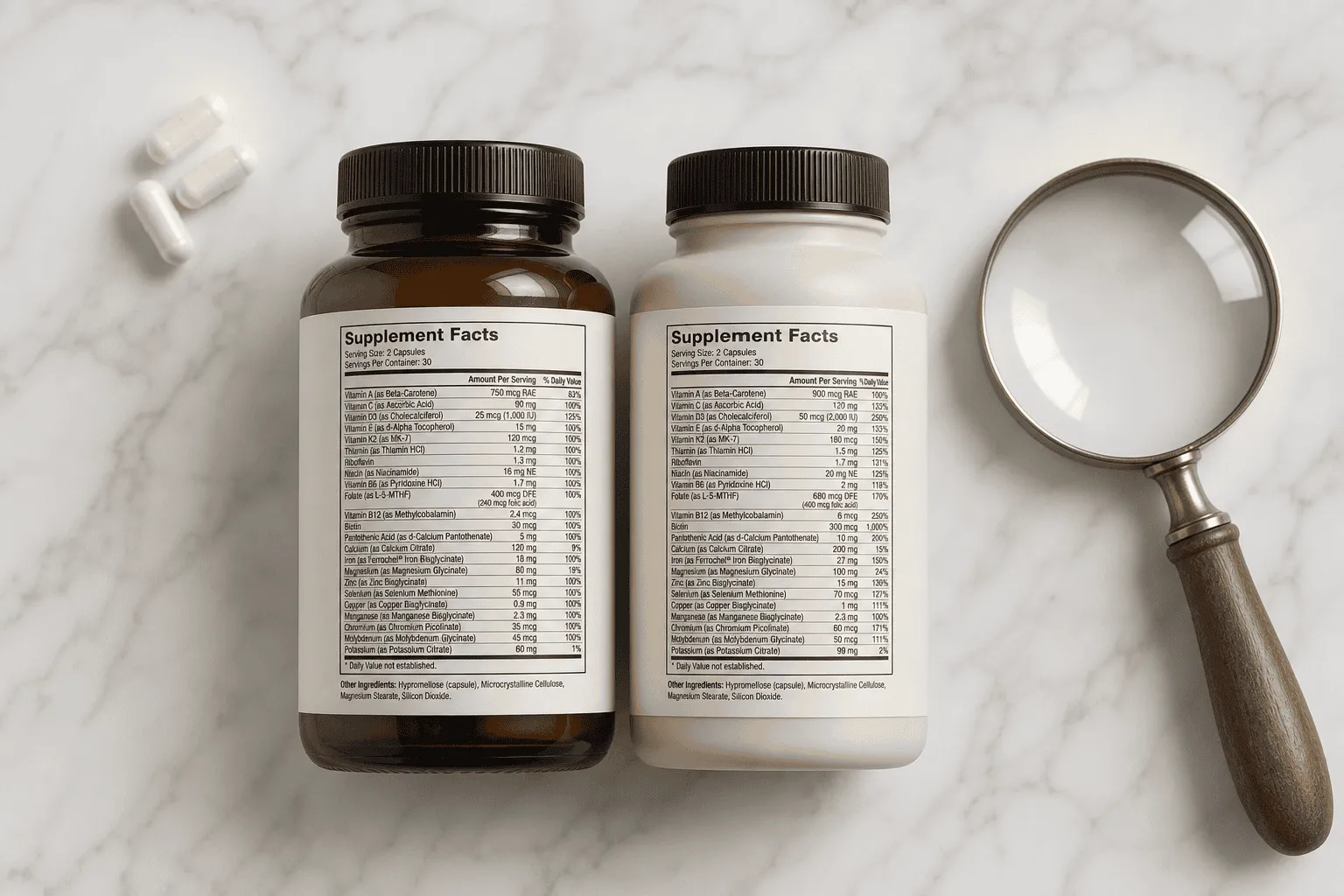
The fastest way to internalize the checklist is to see it applied. The mock labels below show what a transparent supplement facts panel looks like next to one that fails the test.
Mock labels for illustration only — not real products. Left: a panel that passes the checklist. Right: a panel that fails on form omission, proprietary blend, unnamed certifier, and serving size inflation.
Scannable version:
| Good label | Bad label |
|---|---|
| Individual doses per ingredient | ”Proprietary blend — 1500 mg” |
| Active dose matches trial dose | Underdosed vs trial evidence |
| Named certifier (NSF, USP, ConsumerLab, Informed Choice) | “Third-party tested” with no seal |
| Standardized extract stated (“6% allicin”) | Generic “garlic extract 500 mg” |
| Form specified (magnesium glycinate) | “Magnesium 400 mg” with no form |
| Serving size = 1 capsule | Serving size = 4 capsules |
| Expiration date present | ”Manufactured date” only |
Common tricks: red-flag patterns
Red flag
Proprietary blend — the single biggest label warning.
If a company hides ingredient doses behind a "proprietary blend" name, assume you cannot evaluate the product. There are rare exceptions in categories where blends have their own trial data. Most consumer supplements do not need proprietary blends — reputable brands disclose individual doses. A blend exists to make it impossible to tell whether the active ingredient is dosed at 1500 mg or 50 mg.
Blend floor check
Sum cited trial floors vs total blend weight. Browser-only math.
Trial floor sum
—
vs blend total
—
Pick ingredients
Formula
Σ trial floors vs blend total
Ingredients inside the blend
From Supplement Facts
Select ingredients listed inside the blend, then enter the total blend weight from Supplement Facts.
Educational only — not medical advice. Disclaimer.
NIH DSLD bulk dump 16 January 2026: 51,642 products use proprietary-style blend rows. Floors come from the clinical-dose registry, not brand claims.
Other patterns that show up regularly:
- Serving size manipulation. “60 servings” sounds generous until you read the serving size: four capsules. That is 15 actual days of effective dose. The bottle is smaller than the front implies.
- “Natural” and “extract” traps. “Watermelon extract” is not L-citrulline — the concentration is too low to reach trial doses realistically. “Standardized to X%” is the phrase that makes an extract meaningful. Without it, the extract could be anything.
- Form omission. “Magnesium 400 mg” with no form listed is almost always magnesium oxide. Brands that use better forms list them. Brands that use oxide tend to hope you do not ask.
- Front-of-bottle clinical claim. “Clinically studied” without citing the specific study on the specific product is technically legal and practically empty. A study on a different form, a different dose, or a different extract does not apply to the bottle in your hand.
A supplement label is a transparency test. Products that fail it are not necessarily unsafe. They are unfalsifiable — you cannot tell whether they are underdosed, overdosed, or correctly dosed, and the brand has chosen to keep it that way.
The 90-second workflow
One pass through the checklist. Do it a few times and it becomes automatic.
- Flip the bottle to the Supplement Facts panel. The front is marketing.
- Identify the form of the active ingredient. No form listed = assume the cheapest, worst-absorbed version.
- Check the active dose per serving against the trial dose for your target outcome. Cross-check our condition-specific article if we have one.
- Verify a named third-party certifier seal — NSF, USP, ConsumerLab, or Informed Choice. No named seal = no verification.
- Scan the other ingredients. Flag artificial colors, stimulants you did not expect, titanium dioxide, or a proprietary blend.
- Do the cost-per-evidence-aligned-day math. Bottle price ÷ days the bottle lasts at the daily serving count needed to reach trial dose.
- If any of these fail, put it back. The bottle is not transparent enough to evaluate. Move on.
Once you have done this a few times, the whole check takes under 90 seconds. The point is not to become a supplement chemist. It is to refuse products that fail a basic transparency test.
What this guide does NOT answer
Honest scope limits.
- Which specific brands to buy. No affiliate placements in this guide. The checklist tells you how to evaluate any brand yourself.
- Whether a supplement will work for your specific condition. That is what our condition-specific articles cover. This guide tells you how to read the label; the condition article tells you whether the active ingredient has evidence for your goal.
- Whether supplements can replace prescription medication. In most cases they cannot. If you are on prescription treatment, the conversation about adding or substituting a supplement belongs with your clinician, not with a checklist.
- How to verify a third-party seal beyond checking the certifier’s website. Deep verification (calling the certifier, checking lot numbers) is beyond a 90-second check. The seal check described here catches the vast majority of cases.
- Whether a brand’s clinical claim is real. “Clinically studied” requires reading the cited study, comparing the form and dose to the product, and checking who funded it. That is a separate Foundations guide.
Bottom line
90 seconds. Five checks. One decision: does this product tell you enough to evaluate it?
- If all five pass: the product is transparent enough to compare against trial evidence. Buy or don't buy based on whether the evidence supports your goal.
- If any fail: put it back. A product that hides form, dose, certifier, or additives is not worth evaluating further — you cannot tell if it's underdosed, overdosed, or correctly dosed.
- Use this before every purchase. The check is portable — it works on any supplement, not just the ones we've written about.
- Pair with condition-specific articles: this guide tells you how to read the label. Our condition articles tell you whether the active ingredient has evidence for your goal.
FAQ
What does NSF Certified for Sport mean?
NSF Certified for Sport is the strictest common third-party certification for supplements. It tests for ingredient identity, potency, contaminants (heavy metals, microbes), and banned substances on the World Anti-Doping Agency prohibited list. It is the standard for athletes and for anyone who wants the toughest screen before buying. Regular NSF certification exists too — it verifies identity and contaminants but does not include the banned-substance screen.
Is magnesium stearate safe?
At the amounts used in supplements, yes. Magnesium stearate is a flow agent that keeps powders moving through manufacturing equipment. The dose per capsule is milligrams. The "magnesium stearate is dangerous" claims circulating online trace back to a single animal study at doses orders of magnitude higher than what anyone consumes in supplements. If you react to it personally, avoid it. Otherwise it is a standard manufacturing tool, not a health risk.
What is a proprietary blend and why is it a problem?
A proprietary blend is a group of ingredients listed under a single brand name with one total dose and no individual amounts. "Energy Focus Blend — 1500 mg (caffeine, L-theanine, rhodiola, ginseng)" tells you the blend weighs 1500 mg. It does not tell you whether that is 1490 mg caffeine and 10 mg of the rest, or the reverse. The problem is unfalsifiability: you cannot evaluate the dose of any ingredient, so you cannot compare the product to trial data. Reputable brands list individual doses.
How do I know if a supplement is third-party tested?
Look for a named certifier seal on the bottle or product page — NSF, USP, ConsumerLab, or Informed Choice. The phrase "third-party tested" without a named certifier is not verification; it can describe an in-house assay or a one-off test. To verify the seal is real, search the product on the certifier's website. NSF, USP, and ConsumerLab all maintain public directories of certified products.
Are gummies as effective as capsules?
Often not. Gummies typically contain lower active doses per serving than capsules, because the gummy matrix limits how much active ingredient can be loaded before texture and taste break down. They often contain added sugars or sugar alcohols. They are useful for people who cannot swallow capsules, but for a serious dose-matches-trial comparison, capsules or powders are usually the more reliable format. Check the Supplement Facts panel the same way, the dose per serving is what matters, not the format.
Free weekly brief
Want the supplement evidence brief once a week?
One hype-free email on evidence changes, safety notes, label-reading criteria, and tools or dose-registry updates before you buy. No daily sequences, no paid rankings.
Get the free checklistFree. One email a week. Unsubscribe anytime.
How this article was researched
Evidence base: FDA Dietary Supplement Health and Education Act (DSHEA)[1] framework and FDA supplement labeling guidance. Certifier program documentation from NSF, USP (United States Pharmacopeia), ConsumerLab, and Informed Choice. Form-specific bioavailability literature for the worked examples, citrulline pharmacokinetic data (Cormio 2011 trial[7] context), magnesium oxide vs glycinate absorption studies, zinc gluconate vs picolinate comparisons.
The “5 criteria” framework is derived from the buying-criteria sections of our published condition-specific articles (L-citrulline for ED, Korean red ginseng for ED, omega-3 for inflammation, magnesium forms compared, and others). Those sections repeated the same checks article after article; this guide consolidates them into one canonical reference so the condition articles can link here instead of re-explaining.
Mock labels are illustrations only. Real brand labels were considered and rejected, annotating real brands creates trademark and misrepresentation exposure even for positive annotations, and brands change formulas. The mock labels use fictional brand names (“Northbridge Labs” and “Vitality Naturals”) to keep the visual power without legal exposure.
Research date: July 2026. Updates planned when DSHEA reform proposals advance, when new certifier programs enter the US market, or when FDA supplement enforcement guidance changes.
Sources
-
U.S. Food and Drug Administration. Dietary Supplement Health and Education Act of 1994 (DSHEA). FDA labeling guide for dietary supplements.
-
NSF. NSF Certified for Sport program. nsf.org. Accessed August 2026.
-
United States Pharmacopeia (USP). USP Verified Dietary Supplements program. usp.org. Accessed August 2026.
-
ConsumerLab. Product testing methodology and results archive. consumerlab.com.
-
Informed Choice. Banned-substance certification program for sports supplements. informed-choice.org.
-
European Commission. Commission Regulation (EU) 2022/63 of 14 January 2022 amending Annexes II and III to Regulation (EC) No 1333/2008 as regards the food additive titanium dioxide (E 171). EUR-Lex. In force since February 7, 2022.
-
Cormio L, De Siati M, Lorusso F, Selvaggio O, Mirabella L, Sanguedolce F, Carrieri G. Oral L-citrulline supplementation improves erection hardness in men with mild erectile dysfunction: a single-arm pilot trial. Urology. 2011;77(1):119-122. doi:10.1016/j.urology.2010.08.028. PMID 21195829. Referenced for trial dose context (1.5 g/day).
-
de Andrade E, de Mesquita AA, Claro JA, et al. Study of the efficacy of Korean Red Ginseng in the treatment of erectile dysfunction. Asian Journal of Andrology. 2007;9(2):241-244. PMID 16855773. Referenced for trial dose context (3 g/day).