


The short answer
The question “will my weight-loss injection break my birth control” has a real mechanism behind it, a mostly reassuring answer for semaglutide specifically, and one sharp exception next door in the same drug class.
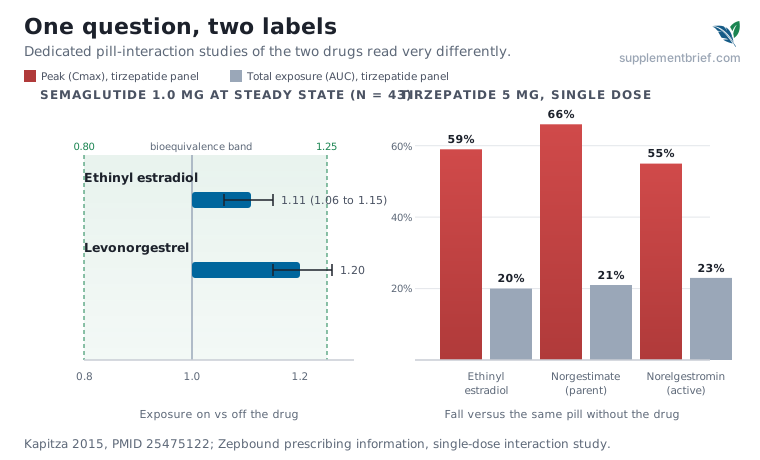
For injectable semaglutide (Ozempic, Wegovy), the evidence is thinner than it should be and still points the same way. The one dedicated trial, run during semaglutide’s development for type 2 diabetes, put 43 women on a combined pill and measured hormone exposure before and during semaglutide treatment: bioequivalence criteria were met for ethinyl estradiol, and levonorgestrel exposure came out about 20 percent higher, in the wrong direction for a failed-contraception story.[1] The current US label states that in clinical pharmacology trials at semaglutide 1 mg injection, the drug did not affect the absorption of orally administered medications, and it carries no pill-specific warning.[5]
For tirzepatide (Mounjaro, Zepbound), the same question has a labeled answer, and the label is cautious by design. A single 5 mg dose of tirzepatide cut the peak concentration of the pill hormones by 55 to 66 percent, and the label instructs women on oral contraceptives to add a barrier method or switch to a non-oral one for 4 weeks after starting and for 4 weeks after every dose escalation.[4] Why two drugs in the same family land so differently, and what the peak-concentration numbers actually mean for pregnancy risk, is the substance of this article.
One more thing belongs in the first hundred words. If a pregnancy happens while you are on any of these drugs, that is a same-week conversation with your prescriber, because the labels direct stopping the drug in pregnancy and the planning rules have a long lead time: semaglutide’s label says to discontinue at least 2 months before a planned pregnancy because of its long half-life.[5]
Our physician-reviewed interaction base tracks this pairing on the GLP-1 agonists and oral contraceptives page, which publishes together with this article and carries the full grading.
Reader checkpoint
Do not stop or change either your injection or your pill over this question on your own.
Every ruling in this article routes through the prescriber who knows your doses and your formulation. And if a pregnancy test comes back positive while you are on any GLP-1-class drug, that is a same-week call, whichever of the numbers below you have been reading.
Why the pill and GLP-1 drugs are a question at all
Incretin drugs do their work through a physiology that oral medications have to pass through. GLP-1 receptor agonists slow gastric emptying as part of how they reduce appetite and post-meal glucose, and slowed emptying can change how quickly co-administered oral medications are absorbed.[2]
A comprehensive pharmacokinetic review of the approved class, covering exenatide, liraglutide, dulaglutide, semaglutide and tirzepatide, puts the interaction picture in one paragraph: these drugs are not metabolized by liver cytochrome enzymes, so classic enzyme competition is off the table, and the documented interaction mechanism is the stomach, not the liver. Most studied drug combinations came out clinically insignificant. The two exceptions the review singles out are oral contraceptives after tirzepatide and levothyroxine after oral semaglutide.[2]
That framing matters for the birth control question. The interaction channel is absorption speed: a slower stomach delivers a lower and later peak of hormone in the blood. Whether a lower peak matters depends on how much total exposure falls, on whether the effect fades as the gut adapts, and on whether anyone has measured the specific combination at the specific dose. For semaglutide, someone has. For tirzepatide, someone has, once, and the label drew a conservative line. For most everything else in the syringe-and-pill world, the honest answer is that nobody has.
What the dedicated semaglutide trial found
The semaglutide-and-pill study predates Ozempic’s fame by a decade. Researchers at Profil, a German contract research organization, recruited 43 postmenopausal women with type 2 diabetes, a population with no pregnancy risk for ethical reasons, and had them take a combined oral contraceptive (ethinyl estradiol 0.03 mg with levonorgestrel 0.15 mg) for 8 days without semaglutide, then again at steady state after dose escalation to semaglutide 1.0 mg once weekly.[1]
The results sit quietly in the bioequivalence table. For ethinyl estradiol, the ratio of total exposure on versus off semaglutide was 1.11 with a 90 percent confidence interval of 1.06 to 1.15, inside the standard equivalence band of 0.80 to 1.25. For levonorgestrel, exposure was 1.20 (1.15 to 1.26), about a fifth higher, which is a drift toward more hormone rather than less. Peak concentrations stayed inside the equivalence window for both hormones.[1]
The study’s limits deserve their own sentence each. It tested 1.0 mg, the diabetes maintenance dose, not the 2.4 mg weight-management dose of Wegovy, so the higher obesity dose has no dedicated pill study. It enrolled 43 women, small by interaction-trial standards. And it studied a combined pill with levonorgestrel; other formulations were assumed similar rather than tested. What it did establish is the direction and rough size of the effect at a therapeutic dose: none that would threaten suppression of ovulation, with levonorgestrel trending up.
The label reflects exactly this. The current Wegovy prescribing information states that in clinical pharmacology trials with semaglutide 1 mg once weekly injection, semaglutide did not affect the absorption of orally administered medications, and adds a general line about monitoring oral medications, with no advice specific to contraceptives.[5] One gap worth naming: the semaglutide tablet is a different absorption story, its label records a 33 percent increase in levothyroxine exposure as its notable drug-interaction finding, and we could not locate a dedicated tablet-and-pill study.[5]
Tirzepatide: the labeled warning
The tirzepatide numbers come from one study summarized in the prescribing information. A combined oral contraceptive (ethinyl estradiol 0.035 mg with norgestimate 0.25 mg) was given alongside a single 5 mg dose of tirzepatide. Peak concentrations fell steeply: ethinyl estradiol by 59 percent, norgestimate by 66 percent, and norelgestromin, the active metabolite, by 55 percent. Total exposure fell far less, by 20, 21 and 23 percent respectively, and the time to peak shifted later by 2.5 to 4.5 hours.[4]
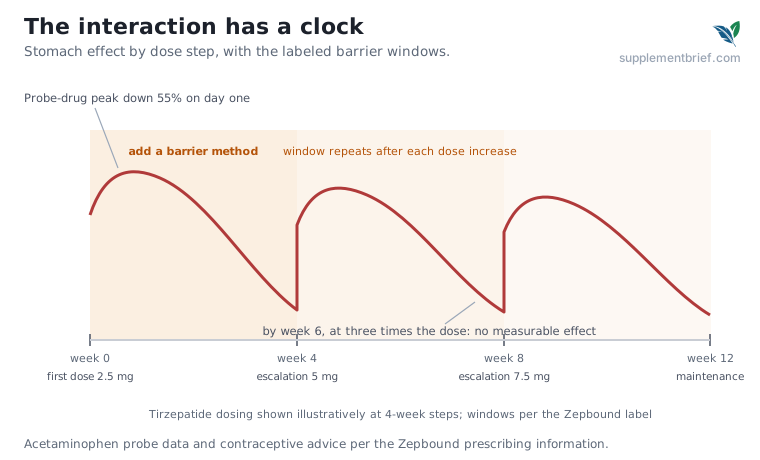
The label turns those numbers into instructions. Women using oral hormonal contraceptives are advised to switch to a non-oral method or add a barrier method for 4 weeks after initiation of tirzepatide and for 4 weeks after each dose escalation. Non-oral hormonal contraceptives, the label notes, should not be affected.[4] The same pharmacokinetic concern extends beyond contraception: a September 2026 review in Maturitas flags that women using oral progestogens for gynecologic conditions or endometrial protection during menopausal hormone therapy face the same delayed-absorption question on tirzepatide, with no dedicated trial to answer it.[11]
A 2026 review in Maturitas walked through what those numbers do and do not mean, and its reading is worth having verbatim in spirit: the much smaller fall in exposure to the active metabolite illustrates that a fall in peak concentration cannot be equated with reduced efficacy. The review calls the interaction biologically plausible but clinically untested, notes that the effect on gastric emptying is greatest after the first dose and diminishes with continued treatment, and concludes that dedicated pharmacokinetic and prospective clinical studies are required.[3]
The diminishing part is measurable, and it is in the same label. A probe drug, acetaminophen, saw its peak concentration cut by 55 percent after a first tirzepatide dose, but at week 6, on a three-times-higher maintenance dose, acetaminophen’s peak and timing were essentially unaffected and total exposure never moved.[4] The stomach adapts. That is why the label’s barrier advice is anchored to initiation and escalation windows rather than to forever.
Put together, the two labels describe one mechanism at two intensities. Semaglutide’s stomach effect at steady state was small enough that its dedicated trial read as bioequivalence and the label stayed generic. Tirzepatide’s first-dose effect was large enough on paper that the label chose a four-week barrier window as the conservative translation of a pharmacokinetic signal into practice, while the clinical question of whether real pregnancies track that signal remains untested.[3]
Nausea, vomiting, and the missed-pill logic
For most pill users on these drugs, the symptom profile is the more concrete absorption risk. In the pooled weight-management trials behind the semaglutide label, 44 percent of treated women reported nausea against 16 percent on placebo, 25 percent reported vomiting against 6 percent, and 30 percent reported diarrhea against 16 percent.[5]
A pill that comes back up, or races through with diarrhea, follows the missed-pill rules of your own brand. Those rules live in the patient leaflet in the box, they vary by formulation, and a pharmacist will read them with you over the phone in two minutes. The practical habit worth building on a GLP-1 with a rough first month is simple: know what your leaflet says about vomiting within a few hours of a pill, and treat a stretch of repeated vomiting as the moment to add backup protection and call the prescriber, both for the dehydration and for the contraception question.
This is also the window where the labeled advice and the common-sense advice converge. The tirzepatide label’s four-week rule covers dose escalations precisely because each escalation re-creates the first-dose physiology for a while.[4] A user of either drug who is vomiting through an escalation has two reasons, the label’s and the toilet’s, to use backup protection that month.
The pregnancy backdrop
The reason this whole question carries voltage is that these drugs are prescribed overwhelmingly to women of reproductive age, often while pregnancy is possible, and the planning rules are strict.
The labels set the frame. Wegovy’s label tells women to discontinue at least 2 months before a planned pregnancy, explicitly because of semaglutide’s long half-life, and Zepbound’s label directs stopping when a pregnancy is recognized, citing embryo-fetal findings in animals and insufficient human data.[5][4]
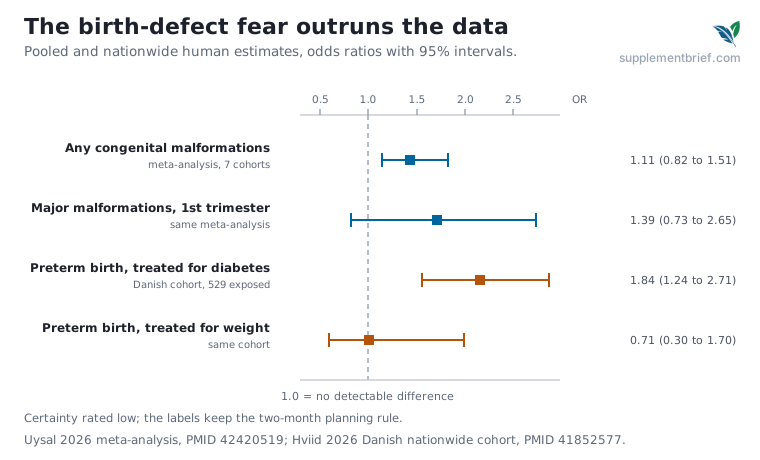
The human data that exist, mostly from women with diabetes who did not stop in time, have been coming in cautiously reassuring. A Danish nationwide registry study identified 529 pregnancies with periconceptional GLP-1 receptor agonist exposure among 756,636 singleton pregnancies. After propensity matching, the one outcome that stayed elevated was preterm birth, and only among women using the drugs for diabetes: semaglutide aOR 1.84 (95 percent CI 1.24 to 2.71). Among women using them for weight management without diabetes, no such association appeared (aOR 0.71, 95 percent CI 0.30 to 1.70), which the authors read as compatible with the underlying diabetes driving the preterm signal rather than the drug. The authors disclose funding from the Novo Nordisk Foundation, a research foundation linked to semaglutide’s manufacturer.[6]
A 2026 systematic review and meta-analysis pooled seven cohorts with over 40,000 exposed pregnancies and found no statistically significant increase in any congenital malformations (OR 1.11, 95 percent CI 0.82 to 1.51) or in first-trimester-exposure major malformations (OR 1.39, 95 percent CI 0.73 to 2.65), and no significant signal for stillbirth, miscarriage, small-for-gestational-age or preterm birth. A urinary-tract malformation signal appeared only in unadjusted data, which the authors attribute to residual confounding. Their summary, cautiously reassuring evidence with low certainty, is the accurate state of play: the birth-defect fear common in online discussion outruns what the human data show so far, and the label rule to plan and stop early still stands because certainty is low.[7]
One more pregnancy-adjacent fact runs in the opposite direction from what most readers expect. In polycystic ovary syndrome, GLP-1-class therapy can restore fertility: meta-analytic work behind the international PCOS guideline documents higher spontaneous pregnancy rates with anti-obesity pharmacotherapy, and weight loss of this size routinely brings ovulation back.[8][9] A woman with PCOS who started a GLP-1 for weight may be more fertile on treatment than off it. Contraception decisions on these drugs belong with the prescriber for exactly this reason, and a 2026 clinical review in the European Journal of Contraception and Reproductive Health Care recommends exactly that conversation, suggesting non-oral hormonal methods and long-acting reversible contraception as the more reliable options during treatment.[9]
Where supplements enter this question
Two supplement pairings with oral contraceptives are graded on our interaction hub, and both publish alongside this article.
St John’s wort is the serious one. Enzyme induction by hyperforin cuts hormone exposure measurably, a controlled trial found a 13 to 15 percent drop with breakthrough bleeding and probable ovulation in some cycles, and our base grades the pair as a moderate concern. The full grading lives on the St John’s wort and oral contraceptives page.
Berberine, the “nature’s Ozempic” of supplement marketing, is a softer and purely mechanism-based caution. A 2026 review of berberine-drug interactions documents inhibition of CYP3A4, the enzyme that clears ethinyl estradiol, with a measured clinical anchor in transplant medicine (cyclosporine exposure up 34.5 percent) and no contraceptive-specific human data at all. We grade it as a caution: no measured effect on the pill, a plausible direction of changed exposure, and a pharmacist conversation before stacking it with a GLP-1 for weight loss.[10] The berberine and oral contraceptives page carries the details, and our berberine vs Ozempic guide covers why the stack’s own evidence is modest.
If your appetite for complementary approaches runs toward nutrition rather than botanicals, the GLP-1 companion supplements guide maps what actually has trial support alongside these drugs, protein and micronutrient monitoring first among them.
Who needs the prescriber conversation
Bring the question to your prescriber or pharmacist before adjusting anything yourself, without exception, if any of these describe you:
- You take tirzepatide and rely on an oral contraceptive. The label’s four-week barrier windows after initiation and each escalation are the default to discuss, and a non-oral method is the labeled alternative.[4]
- You take injectable semaglutide and want explicit reassurance rather than inference. The dedicated trial is one study of 43 women at 1.0 mg, and your prescriber can weigh that against your pill formulation.[1]
- You might try to conceive within the next few months. The planning rule for semaglutide starts two months out, and it is a planning conversation, not a panic one.[5]
- You have PCOS. Returning ovulation on treatment is a documented pattern, and contraception adequacy is a live question on the way up in dose.[8]
- You are vomiting repeatedly or running diarrhea on any of these drugs. That is a dehydration question and a missed-pill question at the same time.[5]
- You are adding supplements on top: St John’s wort for mood or berberine for weight. Both change the contraceptive conversation.[10]
And the time-critical one: a positive pregnancy test while on any GLP-1-class drug is a same-week call, because the labels direct discontinuation in pregnancy and early input matters either way.[4]
What you should take away
- What is actually known: injectable semaglutide has one dedicated pill study showing no loss of hormone exposure, and its label carries no contraceptive warning; tirzepatide's label reports large peak-concentration drops after a first dose and prescribes four-week barrier windows.
- What is still unknown: whether tirzepatide's peak drops translate into real pregnancies, what happens at semaglutide's 2.4 mg weight-loss dose, and how the semaglutide tablet interacts with the pill. Nobody has measured any of these.
- Where the evidence ends: pregnancy-safety data are cautiously reassuring but rated low-certainty, and the labels keep the two-month planning rule.
- When action is reasonable on your own: reading your pill's missed-dose instructions and keeping a barrier method at hand for vomiting stretches or tirzepatide escalation months.
- When this is definitely a prescriber matter: starting, stopping, or timing either medication around conception plans, and any positive pregnancy test on treatment.
- Questions for your clinician: does my pill formulation change your read of the semaglutide trial, do my tirzepatide escalation dates need barrier coverage, and how far ahead should we plan the two-month washout if I want to conceive?
FAQ
Does Ozempic make birth control less effective?
The one dedicated trial says no signal in that direction. In 43 women measured before and during semaglutide 1.0 mg weekly, ethinyl estradiol exposure stayed inside the bioequivalence band and levonorgestrel ran about 20 percent higher, and peak concentrations were unaffected for both.[1] The US label carries no contraceptive-specific warning for the injection.[5] The trial is small and predates the 2.4 mg weight-loss dose, which keeps it a trial to know the limits of rather than a blanket guarantee.
Do I need backup contraception while on semaglutide?
The label does not ask for it. The situations where backup earns its place are practical: episodes of vomiting or diarrhea that could carry your pill away from you, for which your own brand's missed-pill rules apply, and any period where you and your prescriber are actively weighing pregnancy timing.[5] For tirzepatide the answer is different and explicit, four weeks of barrier protection after starting and after each dose increase.[4]
Why does the Zepbound label say four weeks of backup contraception?
Because of one pharmacokinetic study. A single 5 mg tirzepatide dose cut pill-hormone peaks by 55 to 66 percent, though total exposure fell only about a fifth and the active metabolite's fell least.[4] The effect on the stomach is largest at first dose and at each escalation, then fades with continued treatment, so the label anchors the barrier advice to those windows.[3] Whether real-world contraceptive failure tracks these numbers is untested; the label chose the conservative translation.
What if I vomit shortly after taking my pill on a GLP-1 drug?
Your pill's own missed-dose instructions take over, and they vary by brand and formulation. The patient leaflet states the vomiting window for your specific pill, and a pharmacist will interpret it with you. Nausea and vomiting are the most common side effects of these drugs, 44 and 25 percent in the pooled semaglutide weight-management trials, so the scenario is common enough to plan for rather than panic about.[5]
How long before trying to get pregnant should I stop semaglutide?
The label says at least 2 months before a planned pregnancy, because the drug's long half-life means it clears slowly.[5] The same planning window applies to tirzepatide in clinical guidance, 8 weeks being the figure specialists cite for both long-acting agents.[9] Conception planning on these drugs is a prescriber conversation from the start, especially with PCOS in the picture.
Do GLP-1 drugs cause birth defects?
The honest summary is a lower signal than the internet suggests and less certainty than anyone would like. In a meta-analysis of seven cohorts with over 40,000 exposed pregnancies, malformation odds did not differ significantly from unexposed comparisons, and a Danish nationwide study found no elevated preterm risk among women using the drugs for weight management.[7][6] Animal studies show embryo-fetal effects, human certainty is rated low, and the labels keep the precautionary rule: plan, stop two months ahead, and involve your prescriber.[4]
Free weekly brief
Want the supplement evidence brief once a week?
Get one hype-free email on evidence changes, safety notes, and interaction-base updates before you buy. No daily sequences, no paid rankings.
Get the free checklistFree. One email a week. Unsubscribe anytime.
How this article was researched
Evidence scan: PubMed, September 2026, with search terms including “semaglutide oral contraceptive”, “tirzepatide oral contraceptive pharmacokinetics”, “GLP-1 receptor agonist pregnancy congenital malformations cohort” and “berberine drug interactions CYP3A4”. Label claims were verified against the current US prescribing information for Zepbound (revised September 2, 2026) and Wegovy (revised June 30, 2026) through DailyMed, and every PMID was checked against live PubMed records on the research day.
Two common coverage errors were corrected against primary sources rather than repeated. Popular summaries put tirzepatide’s ethinyl estradiol exposure drop at 21 percent, which is the norgestimate figure; ethinyl estradiol’s is 20 percent, and the active metabolite’s is 23.[4] And the claim that these drugs are directly teratogenic states animal findings as settled human fact; the pooled human cohorts do not show a significant malformation signal, with the certainty caveats stated above.[7] Claims that could not be anchored to a verifiable primary source were left out.
Research date: September 12, 2026. Updates planned when a dedicated tablet-and-contraceptive study, a tirzepatide clinical-effectiveness study, or new pregnancy-cohort data publish.
Sources
-
Kapitza C, Nosek L, Jensen L, et al. Semaglutide, a once-weekly human GLP-1 analog, does not reduce the bioavailability of the combined oral contraceptive, ethinylestradiol/levonorgestrel. The Journal of Clinical Pharmacology. 2015;55(5):497-504. doi:10.1002/jcph.443. PMID 25475122.
-
Min JS, Jo SJ, Lee S, et al. A Comprehensive Review on the Pharmacokinetics and Drug-Drug Interactions of Approved GLP-1 Receptor Agonists and a Dual GLP-1/GIP Receptor Agonist. Drug Design, Development and Therapy. 2025;19:3509-3537. doi:10.2147/DDDT.S506957. PMID 40330819.
-
Viana DPDC, Invitti AL, Jacobsen L, Schor E. Tirzepatide and oral progestogens: A hypothesis-generating review of a biologically plausible pharmacokinetic interaction in gynaecologic disease control and menopausal hormone therapy. Maturitas. 2026;214:109116. doi:10.1016/j.maturitas.2026.109116. PMID 42721915.
-
Eli Lilly and Company. Zepbound (tirzepatide) injection, for subcutaneous use: prescribing information. US Food and Drug Administration. dailymed.nlm.nih.gov. Revised September 2, 2026. Accessed September 12, 2026.
-
Novo Nordisk. Wegovy (semaglutide) injection/tablet: prescribing information. US Food and Drug Administration. dailymed.nlm.nih.gov. Revised June 30, 2026. Accessed September 12, 2026.
-
Hviid KVR, Banasik K, Mortensen LH, et al. Periconceptional GLP-1 receptor agonist exposure and obstetric outcomes: a Danish nationwide cohort study. Human Reproduction Open. 2026;2026(2):hoag015. doi:10.1093/hropen/hoag015. PMID 41852577.
-
Uysal N, Horoz E, Gungor M, et al. Pregnancy outcomes following maternal GLP-1 receptor agonist exposure: a systematic review and meta-analysis. Scientific Reports. 2026. doi:10.1038/s41598-026-61582-8. PMID 42420519.
-
Goldberg A, Graca S, Liu J, et al. Anti-obesity pharmacological agents for polycystic ovary syndrome: A systematic review and meta-analysis to inform the 2023 international evidence-based guideline. Obesity Reviews. 2024;25(5):e13704. doi:10.1111/obr.13704. PMID 38355887.
-
Dilbaz B, Ateş Ç. The effects of glucagon-like peptide-1 receptor agonists on fertility, contraception, and pregnancy: clinical perspectives. The European Journal of Contraception and Reproductive Health Care. 2026;31(4):237-244. doi:10.1080/13625187.2026.2644895. PMID 41860479.
-
Dumitru CN, Marcu T, Dumitru AO, et al. Berberine-Drug Interactions: Mechanisms, Clinical Relevance and Risk Stratification: A Narrative Review. Pharmaceuticals. 2026;19(8):1313. doi:10.3390/ph19081313. PMID 42653808.
- Viana DPDC, et al. Tirzepatide and oral progestogens: a hypothesis-generating review of a biologically plausible pharmacokinetic interaction. Maturitas. 2026. PMID 42721915.