


The short answer
Nobody has tested berberine on top of semaglutide in a controlled trial. That single fact should shape the whole decision.
There is no evidence that adding berberine to semaglutide (Ozempic, Wegovy) or tirzepatide (Mounjaro, Zepbound) produces extra weight loss. The strongest berberine trial to date, a 6-month randomized trial in 337 adults with obesity, found no reduction in visceral fat or liver fat at 1 g per day.[1] Meanwhile, both substances lower blood glucose through separate pathways, so the combination adds glucose-lowering pressure that neither alone creates in the same way. On a GLP-1 medication alone, that pressure stays manageable for most people. Stacked with insulin or a sulfonylurea, it becomes a mechanism-based hypoglycemia concern that deserves a prescriber conversation before the first capsule.[2]
If you came here from a TikTok video about the “Nature’s Ozempic stack”, the honest summary is this: the stack is a hypothesis nobody has tested, built on a nickname we have already taken apart in the berberine vs Ozempic guide. If you came here because your prescriber mentioned berberine for cholesterol while you are on a GLP-1, the answer is more nuanced and starts with disclosure, not with a bottle.
Why people stack berberine with GLP-1 medications
The stack makes intuitive sense before you look at the data. GLP-1 medications are expensive, supply has been uneven, and the people prescribed them often carry the exact metabolic concerns berberine is marketed for: glucose, cholesterol, weight. Berberine is cheap, available without a prescription, and carries a nickname that positions it as a natural partner to the injection.
Three threads usually lead people to this page:
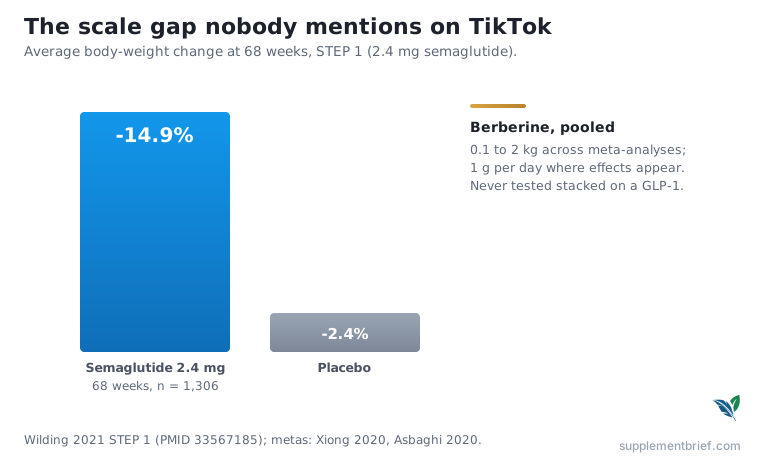
- Cost and access anxiety. Semaglutide and tirzepatide work, and the STEP 1 trial put numbers on it: 14.9% average body-weight reduction over 68 weeks at the 2.4 mg dose, against 2.4% for placebo.[2] When insurance stops covering the medication, “extend it with berberine” sounds like thrift.
- The plateau search. Weight loss on a GLP-1 decelerates. Somewhere around month six, the rate drops and people start looking for something to add. Berberine appears in that search because marketing positions it as metabolic support.
- The nickname. “Nature’s Ozempic” did the pairing years before anyone asked whether the pairing works. Our berberine vs Ozempic guide covers why the nickname misleads: unlike GLP-1 agonists, appetite suppression is not a well-established mechanism for berberine, and its weight-loss evidence is modest and unstable across meta-analyses, with pooled estimates ranging from roughly 0.1 to 2 kg.[3][4]
None of these threads is foolish. All three deserve a better answer than a capsule.
What each substance actually does to your glucose
The safety question behind this stack is mechanical, so the mechanism is worth one careful paragraph each.
GLP-1 receptor agonists (semaglutide, tirzepatide, liraglutide) copy the incretin signal. They increase insulin release when glucose rises, slow the stomach, and quiet appetite. Their glucose-lowering is glucose-dependent, which is why hypoglycemia on a GLP-1 alone is uncommon. When the medication is prescribed for diabetes alongside insulin or a sulfonylurea, that protection thins out, because the other drugs lower glucose on their own schedule.
Berberine affects glucose metabolism through several mechanisms, including AMPK activation and improved insulin sensitivity, and nudges glucose uptake and lipid handling in a direction that resembles metformin more than anything injectable. Meta-analyses of berberine for metabolic markers show real but modest movement in fasting glucose and lipids at gram-per-day doses.[3][4] The trials that moved these numbers used 1 g per day or more, and the dose registry page for berberine shows how few shelf labels reach that level.
There is also a third, quieter connection. Laboratory studies show berberine metabolites stimulate secretion of GLP-1 itself, the very hormone the injection mimics.[6] That work is preclinical, and it cuts both ways: it makes the stack mechanistically plausible, and it makes the absence of a human combination trial more conspicuous. Plausible mechanisms are how promising combinations get tested, not how they get recommended.
Two separate levers, both pointing the same direction. A GLP-1 holds glucose down through the incretin signal; berberine pushes insulin sensitivity in the same downward direction. Neither is dangerous alone for most people. The question is what happens when both pull at once, especially in a regimen that already includes other glucose-lowering drugs.
What the evidence says about the combination
Here is the part the TikTok version skips: there is no controlled trial of berberine stacked on a GLP-1 medication. Not for weight loss, not for glucose, not for anything. Anyone claiming the stack is “proven” or “safe” is extrapolating from two separate literatures that never meet.
What each literature says on its own:
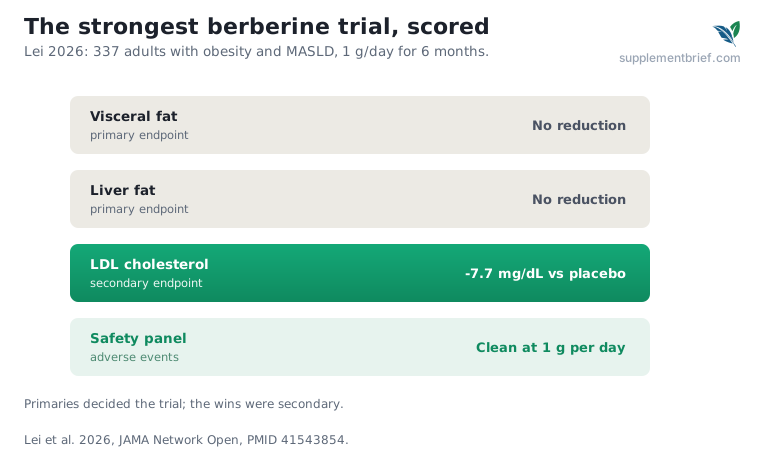
Berberine alone missed its primary endpoints in the strongest trial. The 2026 JAMA Network Open randomized trial gave 337 adults with obesity and fatty liver disease 1 g of berberine daily for 6 months. Visceral fat did not fall. Liver fat did not fall. The wins were secondary: LDL cholesterol dropped 7.7 mg/dL more than placebo, apolipoprotein B and high-sensitivity CRP moved favorably, and safety was clean.[1] That trial is the best argument against expecting stacking benefits: if berberine alone did not move adiposity at the full trial dose, the case for it adding weight loss on top of semaglutide rests on hope.
Weight meta-analyses are small and unstable. Pooled estimates for berberine and body weight across meta-analyses land between about 0.1 and 2 kg, with dose-response analyses suggesting effects, where present, need at least 1 g per day.[3][4] Even taking the friendlier end at face value, a fraction of a kilogram is not a meaningful addition to a medication class delivering double-digit percentage weight loss.[2]
The interaction itself is pharmacodynamic. Additive glucose lowering follows from the two separate mechanisms, while clinical trial data on the combination itself do not exist. Our physician-reviewed interaction base grades the GLP-1 plus berberine pair as a moderate concern on exactly that basis, with the practical risk concentrated when insulin or a sulfonylurea is also in the regimen.[2] The grading is deliberately sober, and the full mechanism, evidence tier, and reviewer sign-off sit on the GLP-1 and berberine interaction page.
One more pharmacological footnote belongs here because it changes the prescriber conversation: berberine inhibits CYP3A4 and CYP2D6 in laboratory studies.[5] These enzymes process a long list of common medications. In vitro inhibition does not automatically translate to clinical problems, and GLP-1 agonists are not primarily CYP3A4 substrates, but a drug-metabolism interaction is exactly the kind of detail a prescriber cannot check if they do not know you are taking berberine.
Who must talk to a prescriber before the first capsule
The stack question has different answers for different regimens. The dividing line is what else lowers your glucose.
Ask first, without exception, if any of these describe you:
- You take a sulfonylurea (glimepiride, gliclazide, glibenclamide). Sulfonylureas force insulin release regardless of glucose level, and berberine adds an independent glucose-lowering effect. This is the pairing where additive hypoglycemia stops being theoretical; we grade it as a major concern in the interaction base.
- You take insulin, for any reason. The same arithmetic applies with less forgiveness, because injected insulin has no glucose-sensing brake at all.1
- You take a GLP-1 for diabetes, not for weight loss alone. Diabetes regimens often run closer to the glucose floor, and the goal is control, not additional downward pressure from an unmonitored source.
- You take multiple prescriptions. CYP3A4 involvement means the question is not only about glucose.[5]
- You are pregnant, breastfeeding, under 18, or carry a history of significant GI disease or gallbladder problems. The berberine guide covers the full exclusion list.
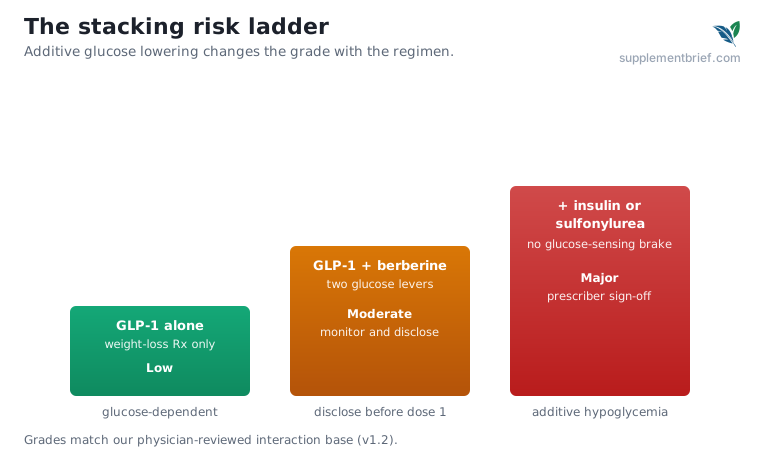
If your GLP-1 is prescribed for weight loss alone, you have no other glucose-lowering medications, and you have no diabetes: the hypoglycemia math is gentler, because GLP-1s lower glucose in a glucose-dependent way. The honest answer in that narrow case is still “tell your prescriber and expect them to ask why”, because there is no demonstrated benefit to justify even a small risk, and monitoring burden is a real cost.
The symptoms worth memorizing before any stacking experiment: shakiness, sweating, sudden hunger, confusion, irritability, blurred vision. Glucose below 70 mg/dL with these signs is not a supplement-tolerance question, it is a same-day medical conversation.
If the goal is more weight loss, this is the wrong shelf
The productive version of “what can I add to my GLP-1” has a well-researched answer, and berberine is not on it. People on GLP-1 medications run into concrete, mechanical problems: protein intake collapses when appetite disappears, constipation and dehydration follow from slowed digestion, and lean mass bleeds during rapid weight loss unless something anchors it.
The GLP-1 companion framework walks the full list. The short version:
- Protein. The single highest-leverage addition for most people. The protein for GLP-1 guide covers targets and food-first tactics.
- Electrolytes and fluids. Cheap, boring, and the difference between tolerating the medication and not.
- Creatine and resistance training. Lean-mass preservation during fast loss.
- Soluble fiber. For the constipation that nobody posts about.
Each of these addresses a failure mode the medication creates. Berberine addresses a hope the medication did not.
If your prescriber does approve berberine
Some prescribers will say yes, usually for the cholesterol angle: a 7.7 mg/dL LDL movement[1] is in statin-adjacent territory for people who cannot take statins, and the safety record at 1 g per day is clean.[1] If yours approves, four conditions make the experiment defensible:
- Dose like the trials. 1 g per day is the dose the largest cited randomized trial used; it is not an established minimum effective dose, and it marks the level where most of these effects were measured. The berberine dose registry page shows how shelf labels compare, and 500 mg products often sit outside the tested range.
- Tell the prescriber everything else you take. The CYP3A4 question is a list question, not a berberine question.[5]
- Expect more frequent glucose checks for the first weeks if any other glucose-lowering drug is in play. This is the monitoring step our interaction base pairs with the moderate grading.[2]
- Define what success means before starting. A recheck of LDL or hs-CRP in 3 months is a testable endpoint. “Feels more metabolic” is not.
And the framing worth keeping: berberine on a GLP-1 is a cholesterol question for a subset of patients, not a weight-loss multiplier. The trial that would license the multiplier interpretation does not exist.
FAQ
Is berberine safe with Ozempic?
No controlled trial has tested the combination. On a GLP-1 alone for weight loss, the glucose risk is relatively low because GLP-1s lower glucose in a glucose-dependent way. With insulin or a sulfonylurea in the regimen, additive hypoglycemia becomes a mechanism-based concern that needs prescriber sign-off before starting. Our GLP-1 + berberine interaction page carries the full mechanism and evidence grading.
Does berberine add weight loss on top of semaglutide?
There is no evidence that it does. Berberine alone missed its primary fat-loss endpoints in the strongest randomized trial at 1 g per day for 6 months,[1] and pooled weight estimates across meta-analyses are small and unstable.[3][4] Semaglutide delivers a different order of magnitude on its own.[2]
Can I take berberine instead of Ozempic to save money?
Swapping a prescribed GLP-1 for berberine is a treatment decision, and the evidence does not support the trade: the medications have double-digit percentage weight-loss trials behind them, and berberine does not.[2] If cost is the barrier, that conversation belongs with the prescriber, who has real options (dose spacing, alternative coverage, transition planning). Our berberine vs Ozempic guide covers the comparison in full.
What are the symptoms of additive hypoglycemia to watch for?
Shakiness, sweating, sudden hunger, confusion, irritability, and blurred vision. Glucose below 70 mg/dL with any of these signs is a same-day medical conversation, not a tolerance question. The risk concentrates when berberine is stacked on a regimen that already includes insulin or a sulfonylurea.
My prescriber approved berberine for cholesterol while I am on Wegovy. What now?
Take it at a trial-relevant dose (1 g per day), disclose every other medication because berberine inhibits CYP3A4 and CYP2D6 in laboratory studies,[5] expect more frequent glucose checks for the first weeks if any other glucose-lowering drug is involved, and define the endpoint: a recheck of LDL or hs-CRP in about 3 months is testable. The LDL movement seen in trials was 7.7 mg/dL beyond placebo.[1]
Where does berberine fit in the GLP-1 companion supplement framework?
It does not, by design. The companion framework addresses problems the medication creates: protein gaps, constipation, dehydration, lean-mass loss. Berberine addresses a hoped-for multiplier effect with no trial behind it. The companion guide covers what actually belongs on that shelf.
Free weekly brief
Want the supplement evidence brief once a week?
Get one hype-free email on evidence changes, safety notes, interaction-base updates, comparison criteria, and tools or dose-registry updates before you buy. No daily sequences, no paid rankings.
Get the free checklistFree. One email a week. Unsubscribe anytime.
How this article was researched
Evidence scan: PubMed and ClinicalTrials.gov, September 2026. Search terms included “berberine GLP-1 combination”, “berberine semaglutide”, “berberine hypoglycemia”, “berberine obesity meta-analysis”, and “berberine CYP3A4”.
Priority given to: the strongest direct test of berberine for adiposity (Lei et al. 2026, JAMA Network Open, read in full with its registration, NCT05647915),[1] the pivotal semaglutide weight trial (Wilding et al. 2021, STEP 1),[2] and the dose-response and pooled obesity meta-analyses used by our dose registry.[3][4]
A key framing rule: the absence of any stacking trial is reported as the finding it is, rather than padded with proxy claims. Interaction severity language matches the physician-reviewed interaction base (GLP-1 + berberine, moderate) so the article and the checker cannot drift apart.
Research date: September 6, 2026. Updates planned when a combination trial registers, when new berberine RCTs at gram doses publish, or when the interaction base re-verification lands.
Sources
-
Lei L, Wang B, Zhao L, et al. Berberine and Adiposity in Diabetes-Free Individuals With Obesity and MASLD: A Randomized Clinical Trial. JAMA Network Open. 2026;9(1):e2554152. doi:10.1001/jamanetworkopen.2025.54152. PMID 41543854.
-
Wilding JPH, Batterham RL, Calanna S, et al. Once-Weekly Semaglutide in Adults with Overweight or Obesity. New England Journal of Medicine. 2021;384:989-1002. doi:10.1056/NEJMoa2032183. PMID 33567185.
-
Xiong P, Niu L, Talaei S, et al. The effect of berberine supplementation on obesity indices: A dose-response meta-analysis of randomized controlled trials. Complementary Therapies in Clinical Practice. 2020;39:101113. doi:10.1016/j.ctcp.2020.101113. PMID 32379652.
-
Asbaghi O, Ghanbari N, Shekari M, et al. The effect of berberine supplementation on obesity parameters, inflammation, and liver enzymes: a systematic review and meta-analysis. Clinical Nutrition ESPEN. 2020;38:43-49. doi:10.1016/j.clnesp.2020.04.010. PMID 32690176.
-
Zhao Y, Hellum BH, Liang A, et al. The in vitro inhibition of human CYP1A2, CYP2D6 and CYP3A4 by tetrahydropalmatine, neferine and berberine. Phytotherapy Research. 2012;26(2):277-83. doi:10.1002/ptr.3554. PMID 21678521.
-
Yang WL, Zhang CY, Ji WY, et al. Berberine Metabolites Stimulate GLP-1 Secretion by Alleviating Oxidative Stress and Mitochondrial Dysfunction. American Journal of Chinese Medicine. 2024;52:253-274. doi:10.1142/S0192415X24500113. PMID 38351702.
Footnotes
-
Our interaction base grades insulin plus berberine and sulfonylurea plus berberine as major concerns on the same additive-glucose-lowering mechanism; see the insulin + berberine and sulfonylureas + berberine pages. ↩
Evidence watch
Automated PubMed / registry digest for this guide — triaged PMIDs only, not a promise to rewrite on every abstract.
Recent PMIDs in the log
Search queries
- berberine semaglutide combination
- berberine GLP-1 receptor agonist
- berberine obesity randomized trial