


The short answer
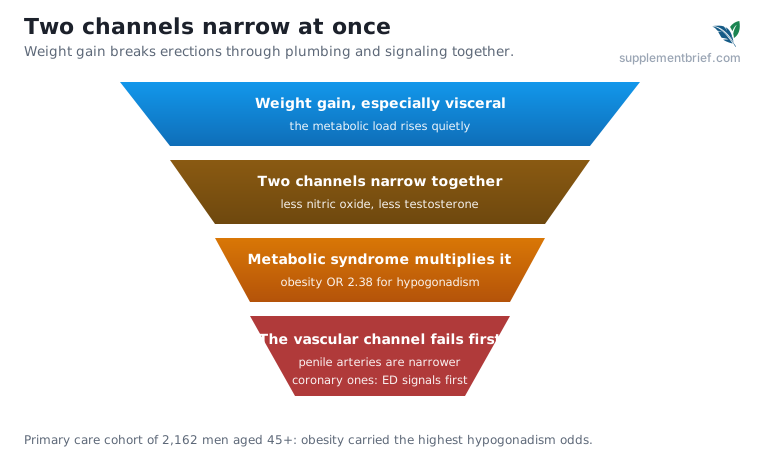
Gaining weight breaks erections through two parallel channels, and losing weight repairs both. The first channel is vascular: visceral fat pumps out inflammatory cytokines that damage the endothelium, the single layer of cells lining every artery, and the small arteries of the penis are among the first to feel it.[1] The second channel is hormonal: obesity suppresses the brain-to-testis signaling axis, and in severely obese men, functional hypogonadism is present in about 64 percent.[2]
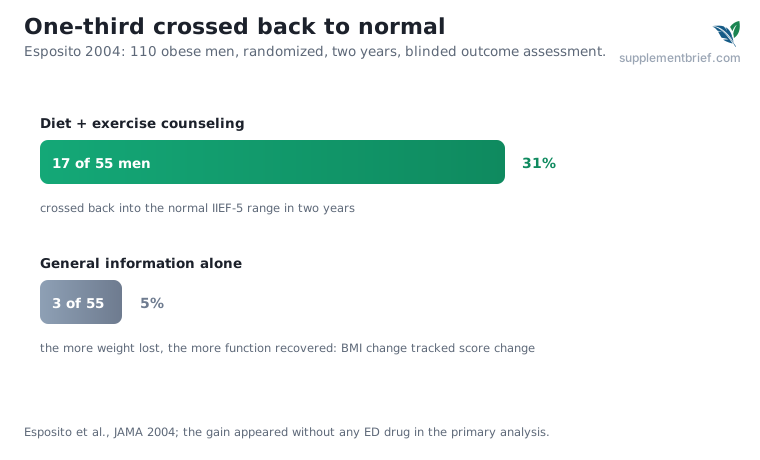
The reversibility is the strongest evidence in this field. In a randomized trial of 110 obese men, two years of diet and exercise counseling improved erectile scores in about a third, with 17 of 55 men in the intervention group crossing back into the normal range versus 3 of 55 on general information alone.[3] Bariatric surgery, the most aggressive weight-loss intervention, improves erectile scores by 5 to 6 points on the 25-point IIEF-5 scale and raises testosterone by roughly 156 pg/mL on average.[4][5]
Supplements play a narrow supporting role here. L-citrulline has one small trial in mild erectile dysfunction, Korean red ginseng has a Cochrane review calling its effect trivial, and ashwagandha raises testosterone without reliably improving sexual symptoms. None of them substitutes for the vascular repair that weight loss itself delivers. If you are on this journey and taking a GLP-1 medication, the sexual function picture is genuinely mixed and still being worked out.
The verdict
- Best evidence-backed intervention: structured weight loss. The Esposito trial (randomized, n=110, two years, double-blind outcome assessment) showed that one-third of obese men regained normal erectile function through diet and increased physical activity alone.[3] The more weight lost, the more function recovered: BMI change was independently associated with erectile score change.
- Most overrated shortcut: testosterone booster blends. A systematic review of 27 proposed boosters found that most fail to raise testosterone at all, and an independent analysis of the studies behind Amazon’s best-selling products found that filtering out unreliable reviews erased 60 percent of erection-improvement claims.[6][7]
- Honest gap: no supplement trial has been conducted specifically in men whose erectile dysfunction developed alongside weight gain. The citrulline, ginseng, and amino acid evidence base was built in mixed or unstated populations.
- Medical conversation worth having: if erectile dysfunction arrived with weight gain, it can be an early vascular warning sign. On average, erectile dysfunction precedes a coronary event by two to five years.[8] That window is an opportunity for cardiovascular risk reduction, not a reason to buy a bottle.
Why weight gain breaks erections
The vascular channel
The penis runs on nitric oxide. When the endothelium is healthy, it converts L-arginine into nitric oxide, which relaxes the smooth muscle in penile arteries and allows blood to flow in. Visceral fat disrupts this system from multiple directions at once. Enlarged fat cells release interleukin-6, interleukin-8, and C-reactive protein into the portal circulation. In a study of 80 obese men aged 35 to 55, those with erectile dysfunction had significantly higher levels of all three inflammatory markers, and their blood vessels responded less to L-arginine infusion.[1]
The same inflammatory state consumes nitric oxide through reactive oxygen species that scavenge NO and reduce its availability for vasodilation.[9] A 2025 review traced the full chain from insulin resistance to impaired penile blood flow reserve.[10]
The hormonal channel
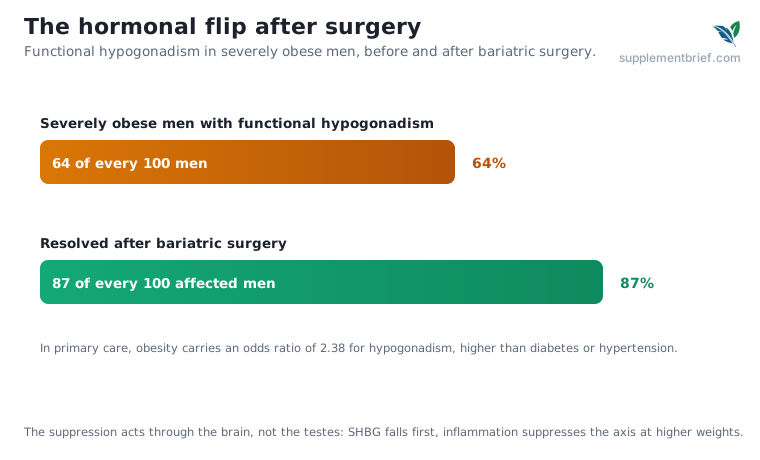
Obesity suppresses testosterone through the brain, not the testes. In moderately obese men, reduced SHBG lowers total testosterone. In markedly obese men, inflammatory cytokines genuinely suppress the hypothalamic-pituitary-gonadal axis.[11] In a primary care study of 2,162 men aged 45 and older, obesity carried an odds ratio of 2.38 for hypogonadism, higher than diabetes or hypertension.[12] Among severely obese men, functional hypogonadism is present in 64 percent and resolves in 87 percent after bariatric surgery.[2]
The metabolic syndrome multiplier
Metabolic syndrome more than doubles the odds of erectile dysfunction: a meta-analysis of 12,067 men calculated an odds ratio of 2.67.[13] Individual components drive the risk more than the syndrome label, with fasting glucose the strongest single predictor (OR 2.07).[14]
What weight loss repairs
The landmark trial
In the anchor trial, 110 obese men (BMI 30 or higher, no diabetes or hypertension) were randomized to two years of lifestyle counseling or general information. The counseling group lost 5.7 BMI points, increased activity from 48 to 195 minutes per week, and their erectile scores rose from 13.9 to 17.0 while the control group stayed flat. Seventeen of 55 counseled men crossed into the normal range versus 3 of 55 controls.[3] Changes in BMI, activity, and C-reactive protein were each independently associated with improvement: the relationship is graded.
Bariatric surgery: the ceiling of reversibility
Surgery produces the largest weight losses and the largest erectile recoveries. Four meta-analyses published between 2017 and 2026 pool the evidence:
| Meta-analysis | Studies | Participants | IIEF improvement | Testosterone change |
|---|---|---|---|---|
| Glina 2017[4] | 2-3 | ~300 | IIEF-5 +5.66 | not pooled |
| Xu 2019[5] | 12 | 420 | IIEF-5 +5.45, IIEF-total +8.2 | not pooled |
| Małczak 2023[15] | 14 | 508 | IIEF SMD 1.19 | +156 pg/mL |
| Qin 2026[16] | 21 | 695 | IIEF-5 +6.45, IIEF-total +9.03 | +8.21 (unit NS) |
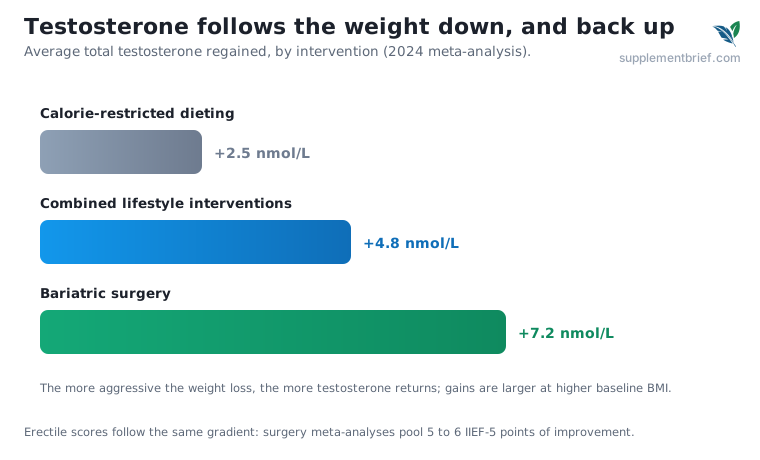
A 2024 meta-analysis specifically of testosterone recovery found that obese men gain an average of 2.5 nmol/L of total testosterone with calorie-restricted dieting, 4.8 nmol/L with combined interventions, and 7.2 nmol/L with bariatric surgery, with greater gains at higher baseline BMIs.[17]
Exercise: the vascular route, not the testosterone route
A common belief holds that lifting weights raises testosterone, which then improves erections. The evidence splits this chain: resistance training has zero effect on resting testosterone in eugonadal men (meta-analysis SMD 0.00 across 421 participants).[18] What exercise does improve is erectile function through vascular mechanisms: aerobic training improves IIEF scores by 2.8 points on average, up to 4.9 in severe baseline ED.[19] The prescription: 160 minutes of moderate-to-vigorous aerobic activity per week for six months.[20]
The Mediterranean diet evidence
The MÉDITA trial (n=215 with type 2 diabetes, 8.1 years) found a Mediterranean diet attenuated sexual function decline by 1.22 IIEF points compared to a low-fat diet.[21] A smaller two-year study in metabolic syndrome found 13 of 35 men normalized erectile scores on a Mediterranean diet versus 2 of 30 controls.[22]
GLP-1 medications and sexual function
Readers on GLP-1 companion nutrition ask this constantly, and the data point in both directions.
A controlled pilot (n=83, two months, tirzepatide vs lifestyle vs testosterone gel) found the tirzepatide group improved IIEF-5 more than both comparators, including the testosterone arm.[23] A meta-analysis of 7 studies found GLP-1 agonists improved erectile scores by 2.73 points and raised testosterone by 73 ng/dL.[24] Meta-regression shows testosterone recovery tracks weight lost, with no direct testicular action.[25]
On the concern side, a database analysis of 3,094 non-diabetic obese men found semaglutide initiators were 4.5 times more likely to receive a new ED diagnosis, but the absolute risk was 1.47 percent versus 0.32 percent.[26] A target trial emulation found the signal attenuated to non-significance after causal calibration.[27] FAERS pharmacovigilance shows no disproportionality.[28] No randomized trial with a sexual function primary endpoint exists.
What supplements do in this context
Supplements address symptoms, not the metabolic driver. No trial has tested whether any supplement works better in obese versus lean men.
L-citrulline has the most direct trial: 24 men with mild ED, 1.5 g per day, 50 percent improved erection hardness versus 8.3 percent on placebo (single-blind pilot, not obesity-specific).[29] Korean red ginseng was called trivial by the Cochrane review: the pooled IIEF improvement of 3.52 points falls below the 4-point clinical significance threshold.[30] Ashwagandha raises testosterone 14.7 percent in overweight men, but sexual well-being scores did not separate from placebo.[31] Tribulus has a split evidence base complicated by manufacturer funding in the largest positive trial.[32] Our nitric oxide guide covers what to avoid.
ED as an early cardiovascular warning
Erectile dysfunction frequently precedes a coronary event by two to five years, with an average of about three years.[8] In the landmark study of 300 men with acute chest pain and angiographically confirmed coronary disease, ED was present in 49 percent and preceded cardiac symptoms in 67 percent of cases by an average of 38.8 months.[33] The mechanism: penile arteries are smaller than coronary arteries, so the same plaque burden obstructs penile flow earlier.[34] A meta-analysis of 92,757 participants found ED increased cardiovascular event risk by 44 percent and all-cause mortality by 25 percent.[35]
What we still do not know
No supplement trial has been conducted specifically in men whose erectile dysfunction developed alongside weight gain. The GLP-1 sexual function literature is contradictory and will remain unsettled until a randomized trial with a sexual function primary endpoint is completed. Whether the testosterone recovery seen with weight loss fully explains the erectile improvement, or whether vascular repair plays the dominant role, is not cleanly separated in existing trials. The precise timeline of erectile recovery after bariatric surgery (weeks versus months) has not been mapped at the individual level.
What to take away
Read this first
Weight gain breaks erections through damaged blood vessels and suppressed testosterone. Weight loss repairs both. Supplements play a supporting role at best, and erectile dysfunction that arrives with weight gain is a cardiovascular conversation, not just a sexual one.
One-third of men regained normal function with lifestyle change alone
In the Esposito trial, 17 of 55 men crossed back into the normal erectile range through two years of diet and exercise counseling, versus 3 of 55 controls.[3] The more weight lost, the more function recovered.
Surgery restores the most, and testosterone follows
Bariatric surgery improves IIEF-5 scores by 5 to 6 points and resolves functional hypogonadism in 87 percent of severely obese men.[2][16] Testosterone gains track the magnitude of weight lost.[17]
Exercise works through blood vessels, not testosterone
Aerobic exercise improves erectile function by an average of 2.8 IIEF points, but does not raise resting testosterone in eugonadal men.[18][19] The prescription: 160 minutes of moderate-to-vigorous aerobic activity per week.[20]
GLP-1 medications: the picture is genuinely mixed
Controlled data show benefit tracking weight loss, database studies send contradictory signals, and no randomized trial with a sexual function endpoint exists.[23][26] If sexual function changes on a GLP-1, that is a conversation with the prescriber.
Supplements are adjuncts, not solutions
L-citrulline has the best single trial (50 percent improved hardness in 24 men). Korean red ginseng was called trivial by Cochrane. Ashwagandha raises testosterone without reliably improving sexual symptoms. None tested specifically in obese men with ED.[29][30][31]
The two-to-five-year window
Erectile dysfunction precedes a coronary event by two to five years on average.[8] If erections declined with weight gain, the same process may be running in the coronary arteries. That is the most important sentence in this article.
How we researched this
Every number was traced to the cited primary source or meta-analysis on PubMed, verified live on the publication day. Trial design details (n, blinding, duration, funding) are stated where the record names them. Our methodology explains the general process.
FAQ
Can losing weight fix erectile dysfunction?
In about one-third of obese men, yes, at least back to the normal range. In a randomized trial of 110 men, two years of diet and exercise counseling restored normal erectile function in 17 of 55 men, versus 3 of 55 controls. Bariatric surgery, which produces the largest weight losses, improves scores by 5 to 6 points on the 25-point IIEF-5 scale.[3][16]
Why does belly fat cause erectile dysfunction?
Visceral fat releases inflammatory cytokines (IL-6, IL-8, CRP) that damage the endothelium and reduce nitric oxide availability, which is the chemical that triggers erections. Independently, obesity suppresses the brain-to-testis signaling axis, lowering testosterone. Both channels are reversible with weight loss.[1][11]
Does Ozempic or Wegovy cause erectile dysfunction?
The data are contradictory. One database study found a higher rate of ED diagnoses in non-diabetic men starting semaglutide, but the absolute risk was 1.47 percent versus 0.32 percent, and the finding did not survive causal calibration. A controlled pilot found tirzepatide improved erectile scores more than testosterone gel. No randomized trial with a sexual function primary endpoint exists.[26][27][23]
Does lifting weights raise testosterone and help erections?
Resistance training does not raise resting testosterone in men with normal levels (meta-analysis SMD 0.00). Aerobic exercise improves erectile function by an average of 2.8 IIEF points through vascular mechanisms. The prescription is 160 minutes of moderate-to-vigorous aerobic activity per week, not a testosterone boost from lifting.[18][19]
Is ED after weight gain a warning sign of heart disease?
It can be. Erectile dysfunction precedes a coronary event by two to five years on average, because penile arteries are smaller and show the same plaque burden earlier. A meta-analysis of 92,757 men found ED increased cardiovascular event risk by 44 percent. The window is an opportunity for risk reduction.[8][35]
What supplements work for ED caused by obesity?
No supplement has been tested specifically in men whose ED developed alongside weight gain. L-citrulline (1.5 g/day) improved erection hardness in 50 percent of 24 men with mild ED. Korean red ginseng was called trivial by a Cochrane review. Ashwagandha raises testosterone about 15 percent without reliably improving sexual symptoms. These are adjuncts to weight loss, not replacements for it.[29][30][31]
Sources
-
Giugliano F, Esposito K, Di Palo C, et al. Erectile dysfunction associates with endothelial dysfunction and raised proinflammatory cytokine levels in obese men. Journal of Endocrinological Investigation. 2004;27(7):665-669.. PMID 15505991.
-
Escobar-Morreale HF, Santacruz E, Luque-Ramírez M, Botella Carretero JI. Prevalence of 'obesity-associated gonadal dysfunction' in severely obese men and women and its resolution after bariatric surgery: a systematic review and meta-analysis. Human Reproduction Update. 2017;23(4):390-408.. PMID 28486593.
-
Esposito K, Giugliano F, Di Palo C, et al. Effect of lifestyle changes on erectile dysfunction in obese men: a randomized controlled trial. JAMA. 2004;291(24):2978-2984.. PMID 15213209.
-
Glina FPA, de Freitas Barboza JW, Nunes VM, Glina S, Bernardo WM. What Is the Impact of Bariatric Surgery on Erectile Function? A Systematic Review and Meta-Analysis. . 2017;5(3):393-402.. PMID 28526630.
-
Xu J, Wu Q, Zhang Y, Pei C. Effect of Bariatric Surgery on Male Sexual Function: A Meta-Analysis and Systematic Review. Sexual Medicine. 2019;7(3):270-281.. PMID 31302076.
-
Morgado A, Tsampoukas G, Sokolakis I, et al. Testosterone boosters: A systematic review of their ingredients and effects. International Journal of Impotence Research. 2024;36(4):348-364.. PMID 37697053.
-
Balasubramanian A, Yu J, Srivatsav A, et al. A review of the ingredients, efficacy, and safety of the most commercially popular testosterone boosters. Journal of Sexual Medicine. 2019;16(2):203-212.. PMID 30770069.
-
Jackson G. Erectile dysfunction and asymptomatic coronary artery disease: frequently detected by computed tomography coronary angiography but not by exercise electrocardiography. International Journal of Clinical Practice. 2013;67(11):1159-1162.. PMID 23981083.
-
Kaltsas A, Zikopoulos A, Dimitriadis F, et al. Oxidative Stress and Erectile Dysfunction: Pathophysiology, Impacts, and Potential Treatments. Current Issues in Molecular Biology. 2024;46(8):8807-8834.. PMID 39194738.
-
Wang H, Guo J, Chung E. Metabolic Syndrome-Associated Erectile Dysfunction: Multiple Vascular Endothelial Dysfunction Mechanisms and Potential Therapeutic Targets. International Journal of Biological Sciences. 2025;21(13):5842-5858.. PMID 41079939.
-
Grossmann M. Hypogonadism and male obesity: Focus on unresolved questions. Clinical Endocrinology. 2018;89(1):11-21.. PMID 29683196.
-
Mulligan T, Frick MF, Zuraw QC, Stemhagen A, McWhirter C. Prevalence of hypogonadism in males aged at least 45 years: the HIM study. International Journal of Clinical Practice. 2006;60(7):762-769.. PMID 16846397.
-
Besiroglu H, Otunctemur A, Ozbek E. The relationship between metabolic syndrome, its components, and erectile dysfunction: a systematic review and a meta-analysis of observational studies. Journal of Sexual Medicine. 2015;12(6):1309-1318.. PMID 25872648.
-
Corona DG, Vena W, Pizzocaro A, et al. Metabolic syndrome and erectile dysfunction: a systematic review and meta-analysis study. Journal of Endocrinological Investigation. 2023;46(11):2195-2211.. PMID 37515706.
-
Małczak P, Wysocki M, Pisarska-Adamczyk M, et al. Influence of Bariatric Surgery on Erectile Dysfunction: a Systematic Review and Meta-Analysis. Obesity Surgery. 2023;33(6):1652-1658.. PMID 37086370.
-
Qin Z, Wu W, Wei Y, Xu H, Liu B, Bao B. The impact of bariatric surgery on male sexual function: a systematic review and meta-analysis. Frontiers in Endocrinology. 2026;17:1798050.. PMID 41958883.
-
Ken-Dror G, Fluck D, Fry CH, Han TS. Meta-analysis and construction of simple-to-use nomograms for approximating testosterone levels gained from weight loss in obese men. Andrology. 2024;12(2):297-315.. PMID 37345263.
-
Potter NJ, Tomkinson GR, Dufner TJ, et al. The Effect of Exercise Modalities on Resting Total Testosterone: A Systematic Review and Meta-Analysis. Journal of Strength and Conditioning Research. 2021;35(12):3521-3528.. PMID 35134000.
-
Khera M, Bhattacharyya S, Miller LE. The effect of aerobic exercise on erectile dysfunction: a systematic review and meta-analysis of randomized controlled trials. Journal of Sexual Medicine. 2023;20(12):1369-1375.. PMID 37814532.
-
Gerbild H, Larsen CM, Graugaard C. Physical activity to improve erectile function: a systematic review of intervention studies. Sexual Medicine. 2018;6(2):75-89.. PMID 29661646.
-
Maiorino MI, Bellastella G, Caputo M, et al. Effects of Mediterranean diet on sexual function in people with newly diagnosed type 2 diabetes: The MÉDITA trial. Journal of Diabetes and Its Complications. 2016;30(8):1519-1524.. PMID 27614727.
-
Esposito K, Ciotola M, Giugliano F, et al. Mediterranean diet improves erectile function in subjects with the metabolic syndrome. International Journal of Impotence Research. 2006;18(4):405-410.. PMID 16395320.
-
La Vignera S, Cannarella R, Garofalo V, et al. Endocrine and sexual effects of tirzepatide versus transdermal testosterone in obese men with metabolic hypogonadism: a controlled pilot study. Reproductive Biology and Endocrinology. 2025;23(1):92.. PMID 40604795.
-
Mirghani HO, AlQurashi AM. Effects of GLP-1 agonists on erectile dysfunction and sex hormones: A systematic review and meta-analysis. World Journal of Methodology. 2026;16(3):119385.. PMID 42626264.
-
Salvio G, Ciarloni A, Ambo N, et al. Effects of GLP-1 receptor agonists on circulating testosterone levels in men: a systematic review and meta-analysis with meta-regression. Andrology. 2025;13(8):2022-2034.. PMID 40105090.
-
Able C, Liao B, Saffati G, et al. Erectile dysfunction and testosterone deficiency in non-diabetic men prescribed semaglutide for weight loss. International Journal of Impotence Research. 2025;37(4):315-319.. PMID 38778151.
-
Tang H, Lu Y, Zhang B, et al. GLP-1 receptor agonist and risk of erectile dysfunction in men with type 2 diabetes: a target trial emulation. eClinicalMedicine. 2026;94:103857.. PMID 42005929.
-
Pourabhari Langroudi A, Pourabhari M, Chen AL, et al. Male sexual dysfunction and GLP-1 receptor agonists: analysis of the FDA adverse event reporting system. International Journal of Impotence Research. 2025;37(8):661-667.. PMID 40240532.
-
Cormio L, De Siati M, Lorusso F, et al. Oral L-citrulline supplementation improves erection hardness in men with mild erectile dysfunction. Urology. 2011;77(1):119-122.. PMID 21195829.
-
Lee HW, Lee MS, Kim TH, et al. Ginseng for erectile dysfunction. Cochrane Database of Systematic Reviews. 2021;4:CD012654.. PMID 33871063.
-
Lopresti AL, Drummond PD, Smith SJ. Effects of a standardised extract of Withania somnifera (Ashwagandha) on testosterone, dehydroepiandrosterone sulfate and erectile function in overweight men aged 40-70 years. American Journal of Men's Health. 2019;13(2):1557988319835985.. PMID 30854916.
-
Suharyani S, Amanda B, Angellee J, et al. The effectiveness of Tribulus terrestris extract on erectile dysfunction: A systematic review and meta-analysis of randomized controlled trials. International Journal of Impotence Research. 2026;38(1):11-18.. PMID 40360723.
-
Montorsi F, Briganti A, Salonia A, et al. Erectile dysfunction prevalence, time of onset and association with risk factors in 300 consecutive patients with acute chest pain and angiographically documented coronary artery disease. European Urology. 2003;44(3):360-364..1016/s0302-2838(03)00305-1. PMID 12932937.
-
Montorsi P, Ravagnani PM, Galli S, et al. The artery size hypothesis: a macrovascular link between erectile dysfunction and coronary artery disease. American Journal of Cardiology. 2005;96(12B):19M-23M.. PMID 16387561.
-
Vlachopoulos CV, Terentes-Printzios DG, Ioakeimidis NK, Aznaouridis KA, Stefanadis CI. Prediction of cardiovascular events and all-cause mortality with erectile dysfunction: a systematic review and meta-analysis of cohort studies. Circulation: Cardiovascular Quality and Outcomes. 2013;6(1):99-109.. PMID 23300267.