


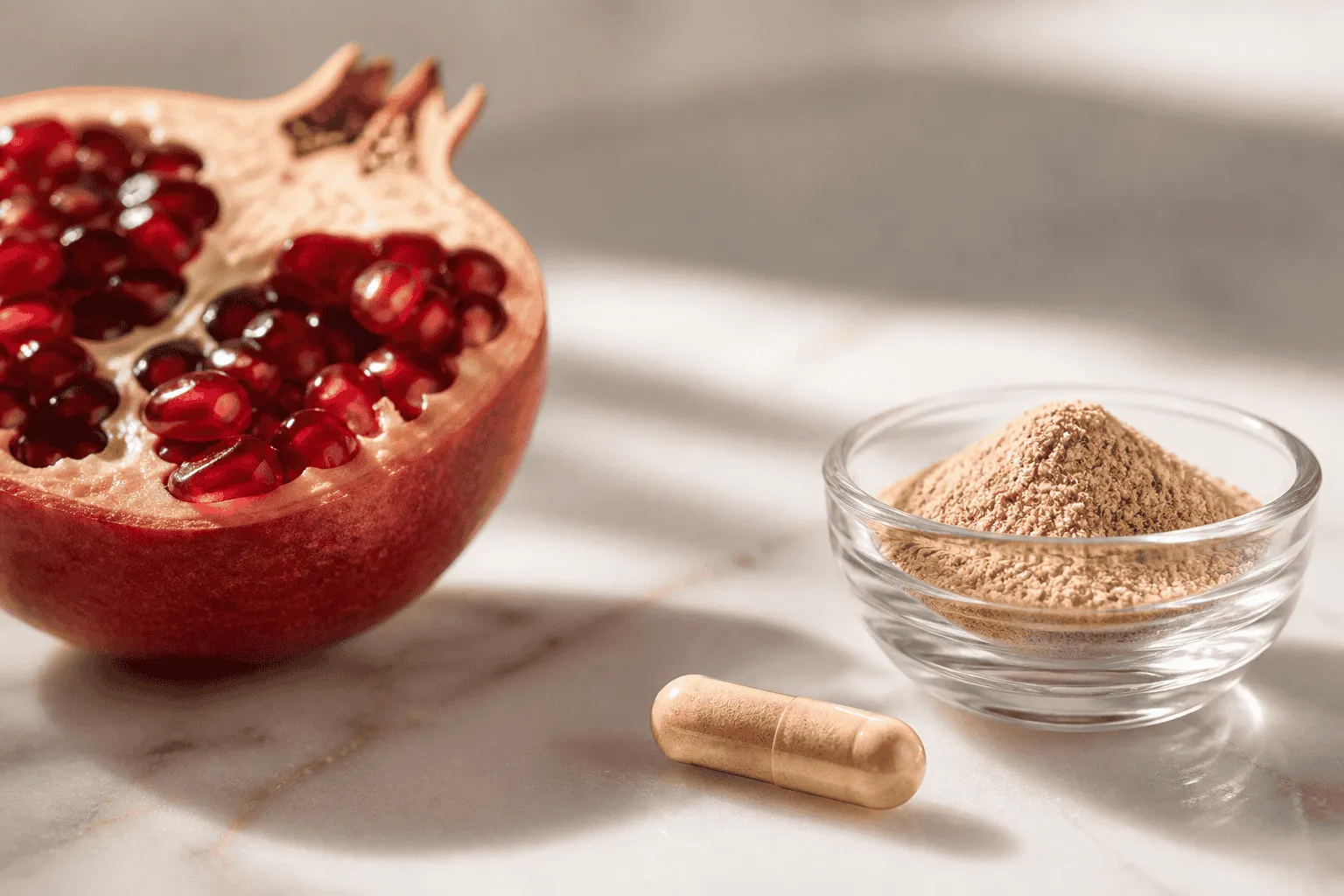
Why pomegranate is the wrong mental model
Urolithin A is having a moment because Timeline (Nestlé’s longevity-adjacent brand) spent real money on trials and because “mitophagy” sounds smarter than “antioxidant.” The pitch usually starts with pomegranate. That is already a category error. Most buyers arriving from a podcast already have Mitopure in the cart before they learn the molecule is not in the peel.
Ellagitannins from pomegranate, berries, and walnuts are precursors. Your colon bacteria have to convert them. Roughly half of people in European cohorts land in metabotype A and produce urolithin A; another chunk are metabotype B and make related urolithins; about one in ten are metabotype 0 and make essentially none (Cortés-Martín et al.[3]). Percentages swing by age and geography — anyone quoting “7%” as gospel is selling false precision.
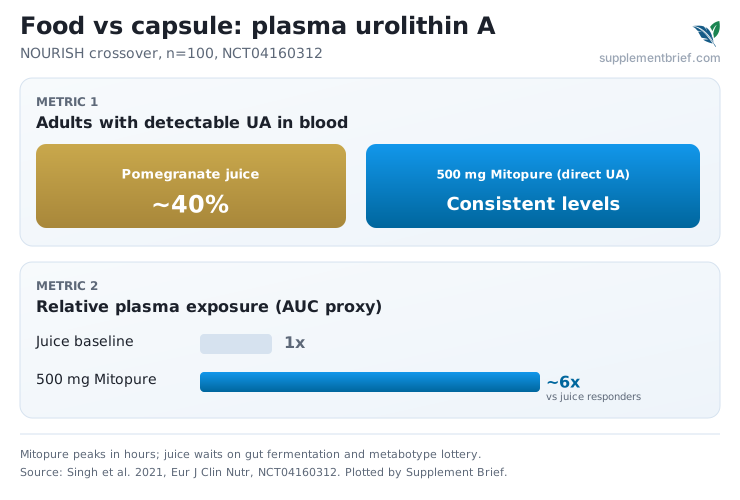
The NOURISH crossover (n=100, NCT04160312) made the food-versus-capsule gap impossible to hand-wave: after pomegranate juice, only about 40% of adults had detectable urolithin A in blood, while 500 mg Mitopure produced roughly six times the plasma exposure, peaking in hours instead of waiting on fermentation kinetics (Singh et al.[4]). Eating the fruit is fine nutrition. It is not a standardized urolithin A intervention.
Almost every human efficacy trial in this space used Amazentis’s Mitopure (synthetic, high-purity urolithin A) not extract from the peel. Generic “500 mg urolithin A” on Amazon is a different product category until someone runs the same RCTs on it. That funding concentration is worth stating plainly: the evidence base is real, but it is also company-owned. Independent replication is thin on the ground.
Mitopure and the microbiome lottery
Mechanistically, urolithin A is discussed as a mitophagy activator — a way to recycle damaged mitochondria rather than let them leak reactive oxygen species (Ryu et al.[1]). Andreux et al. (2019) showed the compound is safe in older sedentary adults at 500–1000 mg for four weeks and shifts mitochondrial gene expression in muscle biopsy tissue (Andreux et al.[2]). Gene expression is not a gym membership. It is a biological hint, not proof you will notice anything on a Tuesday morning.
Metabotype thinking matters for buyers who believe they are “already covered” because they drink pomegranate juice. They might be. They might not. Direct supplementation was designed precisely to bypass that lottery — which is both Mitopure’s scientific argument and its business model. You cannot test metabotype at home with a kit from Target; urine profiling after an ellagitannin challenge exists in research labs, not in the checkout flow next to the probiotic gummies.
If you are comparing labels rather than molecules, our supplement label guide and third-party certification explainer cover the boring parts that matter when no USP monograph exists for urolithin A.
ATLAS and the number on the slide
If you have seen one urolithin A statistic, it is probably “~12% muscle strength.” That number comes from ATLAS (Singh et al., Cell Reports Medicine 2022, n=88, NCT03464500)[5]. It is also the statistic most likely to be stripped of context in a podcast ad.
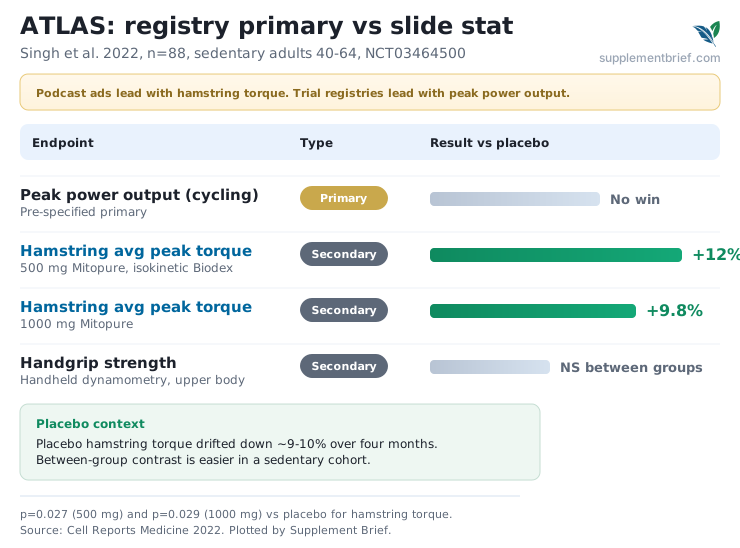
The trial’s pre-specified primary endpoint was peak power output on cycling. Mitopure did not beat placebo there. That matters. A proof-of-concept study can still publish interesting secondary findings, but “we improved muscle strength” is not the same as “we hit the endpoint the trial was powered around.” Timeline’s public materials understandably lead with hamstring torque. Trial registries lead with PPO. Both facts can be true; only one is the primary outcome.
Where the signal actually lived was isokinetic leg testing on a Biodex dynamometer: hamstring average peak torque rose about 12% on 500 mg (p=0.027 vs placebo) and about 9.8% on 1000 mg (p=0.029). Knee flexion max torque moved similarly at both doses. Placebo arms drifted downward over four months (roughly 9–10% losses in hamstring torque) which makes the between-group contrast easier to see in a sedentary cohort.
Handgrip (upper body, handheld dynamometry) did not separate from placebo between groups. The 1000 mg arm had a within-group uptick (+5.1%, p=0.08) that does not rescue the marketing line “stronger grip.” If your use case is carrying groceries, ATLAS did not prove Mitopure helps. If your use case is knee flexion torque in an isokinetic chair, it did.
Both doses beat placebo on hamstring torque. The trial was not designed to crown a winner between 500 and 1000 mg, and the paper does not show a statistically significant inter-dose superiority fight. Timeline’s own narrative leans on 1000 mg for endurance markers (peak VO₂, six-minute walk distance) that looked stronger at the higher dose in within-group analyses. Lower body strength, meanwhile, moved at both doses. That is the honest shape of the data — not “500 mg failed, 1000 mg won,” and not “handgrip proved it works.”
Population context: overweight, untrained adults aged 40–64 with low VO₂max. A supplement effect in that group is plausible. Extrapolating to a trained 32-year-old because a longevity influencer said so is still extrapolation.
Muscle data beyond ATLAS
Andreux 2019 (n=60, elderly sedentary, 500–1000 mg, four weeks) is the safety-and-biology floor: tolerable, reaches muscle, nudges mitochondrial gene expression[2]. No strength testing. Useful for “does oral UA do anything in tissue,” useless for “will I lift more.”
Liu et al. (JAMA Network Open 2022, n=66, ≥65 years, 1000 mg for four months) reported better muscle endurance in flexor digitorum and tibialis anterior, plus lower C16/C18 ceramides and CRP[6]. This paper gets misfiled as “brain health” in secondary summaries. It measured muscle and blood markers. No cognition battery. When a brand page says “JAMA study proves cognitive protection,” check the methods table before you believe it.
ENDURO (n=42 male distance runners, 1000 mg, four weeks at altitude) is the athlete study[8]. Creatine kinase after damaging downhill runs dropped more in the urolithin A group (time × treatment p≈0.049). Three-kilometer race times did not improve. There were no soccer players (only runners) despite how often “endurance athletes” blur into a generic stock photo. Recovery chemistry shifted; race-day performance did not.
Stack these trials and you get a coherent but narrow human story: muscle function and recovery biomarkers in selected adults, small samples, mostly four weeks to four months, all Mitopure, all industry-sponsored. Nothing yet on mortality, dementia, or sleep architecture in published peer-reviewed form. “Twenty-five clinical trials” counts PK studies, biomarker pilots, and registered programs still waiting on papers — not twenty-five proof points that you will live longer.
Immune shifts smaller than the press release
Denk et al. (Nature Aging 2025, MitoImmune, n=50, 1000 mg, 28 days) reported immune-cell remodeling[7]. Naive-like CD8+ T cells increased by 0.50 percentage points (95% CI 0.16–0.83; p=0.044). Fatty-acid oxidation capacity in CD8+ subsets moved more. Exploratory lab work suggested monocytes swallowed more E. coli ex vivo.
That is interesting immunology. It is not “immune rejuvenation” in any sense a normal person should pay for. Twenty-eight days, fifty people, exploratory endpoints — the right adjective is “hypothesis-generating,” not “clinically transformative.”
Cardiac messaging follows the same pattern. Liu 2022’s ceramide drop is a research lipid panel story. A 2025 iScience paper adds preclinical heart-function gains in animals and ceramide shifts in older humans (Liu et al.[17]). Ejection fraction in people? Not demonstrated. Ceramides are talked about in cardiology research circles; they are not something your GP orders instead of a lipid panel. If you want a parallel on biomarkers outpacing outcomes, our omega-3 piece walks through the same trap in a different molecule.
Timeline’s blog posts about “heart health” are translating animal mechanics and plasma lipids into consumer language. That translation is the part to interrogate, not the existence of the rat data.
Sleep, brain, and preclinical distance
The sleep pitch is where urolithin A content often drifts into fiction — including polished PDF “protocols” that read like registered trials but have no NCT number behind them. If a document opens with actigraphy, PSQI, and metabotype stratification and never cites ClinicalTrials.gov, treat it as aspirational writing.
Mouse sleep-deprivation papers exist (Misrani et al.[11]; Zhu et al.[12]). Circadian clock work exists in colitis models and tail-suspension rats (Du et al.[13]; Zhou et al.[14]). A cell-culture paper linked urolithin A to vitamin D receptor signaling and TPH2 mRNA at micromolar concentrations (Livingston et al.[15]), not a human serotonin or sleep study. The mechanistic chain from “SCN clock genes moved in a rat” to “you will sleep deeper on Mitopure” has more gaps than a typical podcast episode admits.
Peak plasma urolithin A after 500 mg Mitopure sits around ~1.2 µM. Many mechanistic papers use doses and routes (intraperitoneal injection, high µM baths) that do not map onto swallowing a softgel. A 2026 Frontiers mini-review on sleep pathways says the quiet part out loud: mechanistic plausibility, no human actigraphy or polysomnography data for urolithin A monotherapy yet[16].
Registered trials are coming, and names get sloppy in the meantime. NCT07060898 (~650 participants) is primarily a self-reported brain-health app study; sleep impairment is a secondary questionnaire, not a polysomnography primary. NCT06990256 (~80 participants, China) includes polysomnography but tests urolithin A with fisetin in combination. Citing “650 people proved sleep benefits” in 2026 is already wrong. NCT07161310 (oncology plus checkpoint inhibitors, n≈45) is immune profiling in cancer treatment, not a wellness sleep SKU. We track the sleep-endpoint call on NCT07060898 as an open prediction before readout.
Timeline is allowed to sell hope on pending brain-health readouts. You are allowed to wait for the paper.
Urolithin A next to NMN
NMN and urolithin A share shelf space in longevity stacks and almost nothing in trial design.
Urolithin A’s human work chases mitophagy and muscle endpoints. NMN/NR research mostly chases NAD+ elevation, with functional outcomes all over the map, some papers show improved walking distance or insulin sensitivity in small groups; others show blood NAD+ rise without an outcome anyone cares about on a Tuesday. No head-to-head study compares them. Stacking both is biologically cute on a whiteboard (mitochondrial cleanup plus NAD+ substrate) and unsupported by a published synergy trial in humans.
The NR side also carries a label-math trap worth knowing before you compare prices. The chronic supplementation trial behind most NR citations dosed 500 mg twice a day, 1,000 mg per day in total, and that is the protocol that elevated blood NAD+ in healthy middle-aged and older adults.[18] A bottle listing 500 mg per daily serving sits at half the studied total unless the serving instructions say otherwise. Read the per-serving arithmetic before assuming a once-a-day capsule reproduces the trial.
The influencer script often pairs them anyway because both words appear on Huberman-era diagrams. That is commerce logic, not evidence logic. If you can only budget one experiment, pick based on which human endpoints match your goal (hamstring torque data for UA, NAD+ papers for NMN) and accept that neither has longevity outcome trials.
Mitopure is also priced like a premium ingredient ($3–5+ per 500 mg serving at retail is typical), while generic NMN often wins on cost per gram and loses on standardization. Paying more buys you the molecule that was actually tested, not a proof that it outperforms cheaper NAD+ precursors.
Magnesium is a useful sanity check on a different axis: form changes absorption chemistry without guaranteeing the outcome you wanted. Same lesson, different shelf, see magnesium forms compared.
Dose, labels, and who should wait
Research programs clustered on 500–1000 mg daily for one to four months. Heilman et al. tox work in rats supports a wide safety margin (Heilman et al.[9]). Published Mitopure trials report no serious adverse events at those doses. FDA GRAS notice GRN 791 covers urolithin A up to 1000 mg per serving in specific food formats[10], a food-safety clearance, not a longevity indication. GRAS also does not mean every softgel on the market matches the impurity profile Amazentis filed.
Who might try it anyway? Older adults already lifting or walking with intent, curious about muscle data, aware they may be metabotype 0 and cannot juice their way to blood levels. Who should wait? Anyone buying for sleep, cognition, or immune reset; anyone treating fatigue or insomnia before a clinician rules out thyroid, anemia, apnea, or depression; anyone expecting Mitopure to substitute for exercise.
On labels: look for explicit urolithin A milligrams, not “ellagitannin blend” or “pomegranate extract equivalent.” Demand a COA if you buy generic. Ignore stack bundles until someone replicates Timeline’s trials outside Timeline’s ecosystem. We are not linking products here yet, when we do, it will be because search demand justified it, not because the molecule went viral.
Before spending: ask whether your goal matches what was measured (hamstring torque, not REM sleep); whether resistance training and protein are already in place; whether you are treating a symptom that needs diagnosis first. If the honest answer to the first question is no, the rest of the bottle is optimism tax.
Dose check
Label dose vs trial floor — browser-only math.
—
Enter label dose
Trial reference
From your label
Enter your label dose — the gauge updates instantly.
Two doses of branded Mitopure in middle-aged adults for four months. The primary endpoint — peak power output — was not met. Muscle strength rose about 12%, with improvements in peak VO2, six-minute walk, plasma acylcarnitines and CRP as secondary outcomes. Manufacturer-run trial on a specific synthesised preparation.
Educational only — not medical advice. Disclaimer.
Sources
-
Ryu D, Mouchiroud L, Andreux PA, et al. Urolithin A induces mitophagy and prolongs lifespan in C. elegans and increases muscle function in rodents. Nature Medicine. 2016;22(8):879-888. doi:10.1038/nm.4132.
-
Andreux PA, Blanco-Bose W, Ryu D, et al. The mitophagy activator urolithin A is safe and induces a molecular signature of improved mitochondrial and cellular health in humans. Nature Metabolism. 2019;1(6):595-603. doi:10.1038/s42255-019-0073-4. PMID:32694802.
-
Cortés-Martín A, García-Villalba R, González-Sarrías A, et al. The gut microbiota urolithin metabotypes revisited: the human metabolism of ellagic acid is mainly determined by aging. Food & Function. 2018;9(9):4100-4109. doi:10.1039/C8FO00956B.
-
Singh A, D'Amico D, Andreux PA, et al. Direct supplementation with urolithin A overcomes limitations of dietary exposure and gut microbiome variability in healthy adults to achieve consistent levels across the population. European Journal of Clinical Nutrition. 2021;75(9):1321-1331. doi:10.1038/s41430-021-00950-1. Trial: NCT04160312.
-
Singh A, D'Amico D, Andreux PA, et al. Urolithin A improves muscle strength, exercise performance, and biomarkers of mitochondrial health in a randomized trial in middle-aged adults. Cell Reports Medicine. 2022;3(5):100633. doi:10.1016/j.xcrm.2022.100633. Trial: NCT03464500.
-
Liu S, D'Amico D, Shankland E, et al. Effect of urolithin A supplementation on muscle endurance and mitochondrial health in older adults: a randomized clinical trial. JAMA Network Open. 2022;5(1):e2144279. doi:10.1001/jamanetworkopen.2021.44279.
-
Denk D, Singh A, Kasler HG, et al. Effect of the mitophagy inducer urolithin A on age-related immune decline: a randomized, placebo-controlled trial. Nature Aging. 2025;5(11):2309-2322. doi:10.1038/s43587-025-00996-x. Trial: NCT05735886.
-
Robinson N, Garnham A, Snow B, et al. Evaluating the impact of urolithin A supplementation on running performance, recovery, and mitochondrial biomarkers in highly trained male distance runners. Sports Medicine. 2025. doi:10.1007/s40279-025-02292-5. Trial: NCT04783207.
-
Heilman JM, Andreux PA, Tran NL, et al. Safety assessment of urolithin A, a metabolite produced by the human gut microbiota upon dietary intake of plant derived ellagitannins and ellagic acid. Food and Chemical Toxicology. 2017;108(Pt A):289-297. doi:10.1016/j.fct.2017.07.050.
-
U.S. FDA. GRAS Notice GRN 791 — urolithin A (Amazentis SA). FDA response PDF; no questions letter December 2018.
-
Misrani A, Tabassum S, Zhang ZY, et al. Urolithin A prevents sleep-deprivation-induced neuroinflammation and mitochondrial dysfunction in young and aged mice. Molecular Neurobiology. 2024;61(3):1448-1466. doi:10.1007/s12035-023-03651-x. PMID:37725214.
-
Zhu H, Zhao H, Qian H, et al. Urolithin A ameliorates athletic ability and intestinal microbiota in sleep deprivation from the perspective of the gut-muscle axis. Molecular Nutrition & Food Research. 2024;68(7):e2300599. PMID:38468112.
-
Du Y, Haraguchi A, Okamura H, et al. Effect of urolithin A on the improvement of circadian rhythm dysregulation in intestinal barrier induced by inflammation. Nutrients. 2024;16(14):2263. doi:10.3390/nu16142263.
-
Zhou S, Li X, Liang F, et al. Mitophagy regulates the circadian rhythms by degrading NR1D1 in simulated microgravity and isolation environments. International Journal of Molecular Sciences. 2024;25(9):4853. doi:10.3390/ijms25094853.
-
Livingston S, Mallick S, Lucas DA, et al. Pomegranate derivative urolithin A enhances vitamin D receptor signaling to amplify serotonin-related gene induction by 1,25-dihydroxyvitamin D. Biochemistry and Biophysics Reports. 2020;24:100825. doi:10.1016/j.bbrep.2020.100825. PMID:33088927.
-
Frontiers in Nutrition review authors. Potential impact of urolithin A on pathways relevant to sleep health: a mini review. Frontiers in Nutrition. 2026. doi:10.3389/fnut.2026.1779855.
-
Liu S, Faitg J, Tissot C, et al. Urolithin A provides cardioprotection and mitochondrial quality enhancement preclinically and improves human cardiovascular health biomarkers. iScience. 2025. doi:10.1016/j.isci.2025.111814. PMID:40034121.
-
Martens CR, Denman BA, Mazzo MR, et al. Chronic nicotinamide riboside supplementation is well-tolerated and elevates NAD(+) in healthy middle-aged and older adults. Nature Communications. 2018;9(1):1286. Dose per full text: 500 mg twice per day (NIAGEN, 1,000 mg/day). doi:10.1038/s41467-018-03421-7. PMID:29599478.
Evidence watch
Automated PubMed / registry digest for this guide — triaged PMIDs only, not a promise to rewrite on every abstract.
Recent PMIDs in the log
Search queries
- urolithin A mitochondrial randomized trial
- NMN nicotinamide mononucleotide human trial
- urolithin A muscle endurance